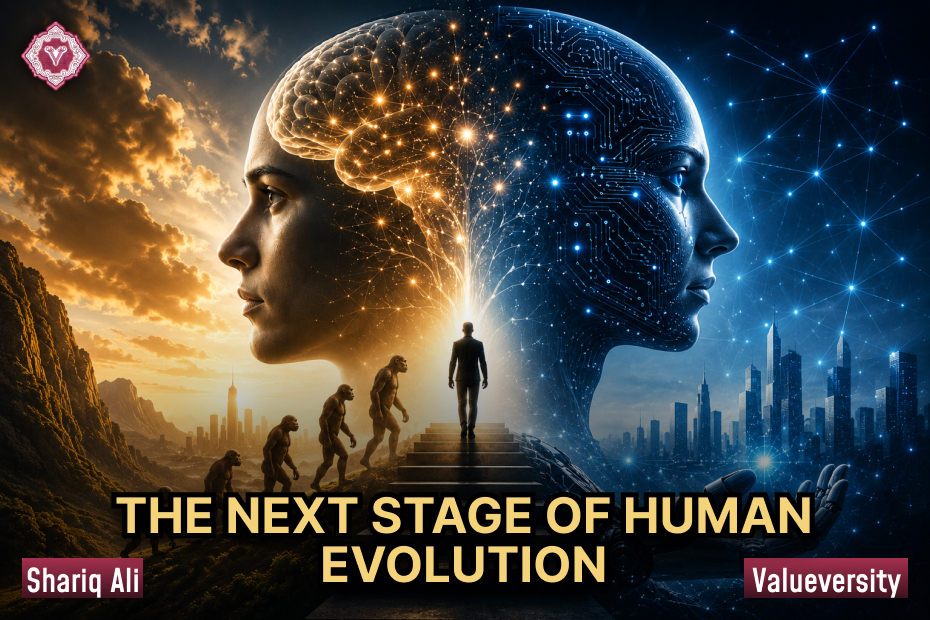
The Next Stage of Human Evolution
Dr. Shariq Ali
Valueversity
Throughout human history, every major technological breakthrough has transformed not only our tools but also the way we think. Artificial Intelligence (AI) is perhaps the most significant development in this continuing journey.
In my view, AI is not a replacement for human beings; rather, it is an evolutionary extension of human intelligence.
Neuroscience tells us that the brain is constantly trying to conserve energy. For this reason, tasks that are repeated frequently gradually become part of automatic processing.
Driving a car, typing on a keyboard, performing routine calculations, searching for information, or making everyday decisions are all examples of such activities.
During these tasks, the brain expends relatively little mental effort.
In contrast, when we are required to solve a novel problem, generate an original idea, connect seemingly unrelated concepts, or analyse a complex situation, the brain’s executive functions and working memory become much more active.
These are the very capacities that underpin creativity, scientific inquiry, innovation, and discovery.
Although these processes demand considerably more mental energy, virtually every major achievement of human civilisation has emerged from them.
Imagine a researcher who needs to review one hundred scientific papers on a particular topic. In the past, most of the researcher’s time would have been spent gathering, organising, and synthesising information. Today, AI can summarise those papers, compare their findings, and identify their key insights within minutes. Yet determining what new theory may emerge from that knowledge, which questions remain unanswered, and where future research should be directed still depends on human judgment.
Similarly, for a writer, AI can be an outstanding assistant in finding references, compiling data, preparing an initial draft, or refining language.
However, infusing an idea with human experience, emotion, insight, and meaning remains a uniquely human ability. This is where humans and artificial intelligence become not rivals, but ideal partners.
Perhaps the most profound transformation of the future will be that AI significantly reduces our cognitive load, allowing human beings to devote more of their mental energy to imagination, moral reasoning, scientific discovery, art, philosophy, and the exploration of new possibilities.
One of the brain’s most remarkable characteristics is neuroplasticity—its ability to continuously adapt in response to new demands.
If AI assumes responsibility for routine cognitive tasks, humans will be free to develop their higher intellectual abilities more fully than ever before.
First, we invented machines to amplify the power of our hands. Then we launched the Industrial Revolution to multiply our physical strength. Today, we are creating artificial intelligence to expand the reach of our minds.
Perhaps this marks the beginning of the next stage in human evolution۔ A stage in which machines do not replace people, but instead enable them to become more creative, more insightful, and more capable than ever before.
In my opinion, the true purpose of artificial intelligence is not to replace humanity, but to empower human beings to realise the very best of their intellectual and creative potential.