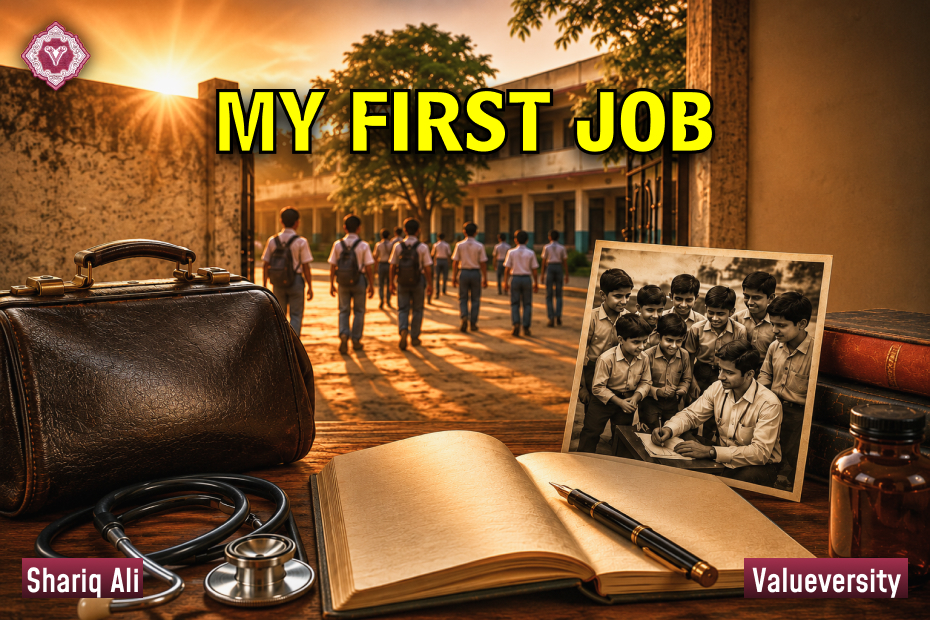
My First Job
Dr Shariq Ali
Valueversity
After graduating with an MBBS from Dow Medical College, this was my first job—a position as a School Medical Officer in the Federal Capital Area of Karachi. It was a time filled with uncertainty about the future, youthful enthusiasm, boundless hope, and countless dreams.
This appointment was made possible through the famous Five-Point Programme introduced by Pakistan’s Prime Minister, Muhammad Khan Junejo. One of the programme’s objectives was to provide government employment opportunities for educated young people, particularly newly graduated doctors.
Even before joining this programme, I had successfully passed the Sindh Public Service Commission examination and secured second position across the entire province of Sindh. What made this achievement especially gratifying was that it had been earned solely through hard work and merit, without political influence or personal recommendations. Although domicile-based discrimination did exist at the time, merit was still genuinely respected in many areas of public service.
My first government appointment was at a government school in Karachi’s FC Area (Federal Capital Area), where both the primary and secondary schools shared the same campus. Although housed in separate buildings, they stood side by side behind a common boundary wall.
It was in this school that I assumed my first official responsibility as a Medical Officer.
The FC Area was essentially a residential colony built for government employees. Most of its apartments housed clerks, head clerks, and other lower-grade civil servants. Their children attended the school. It was a modest, hardworking, relatively underprivileged community where material resources were limited, yet the people possessed the warmth, kindness, and generosity that define ordinary human beings everywhere.
The first few days were spent understanding my new surroundings.
Each morning I would sit in the staff room with the teachers. They welcomed me politely, though, understandably, they regarded the newly arrived government doctor with a mixture of curiosity and cautious reserve.
Gradually, my naturally sociable disposition and friendly manner began to bridge those initial distances. Everyday conversations, shared laughter, and mutual respect slowly transformed unfamiliarity into trust.
The headmaster himself was an unforgettable personality. He wore a thick white beard, possessed a commanding presence, and spoke with a remarkably powerful voice that could easily carry from one end of the playground to the other. Deeply religious by temperament, he maintained strict discipline, yet beneath that firmness lay an exceptionally kind and compassionate heart. He was approaching retirement, and decades of experience had bestowed upon him a quiet dignity that everyone respected.
His deputy, who in practice managed much of the school’s day-to-day administration and served as his trusted right-hand man, was an equally remarkable individual. His face bore deep scars from childhood smallpox, but it was almost always lit by a cheerful smile. Possessing an endless sense of humour, he delighted in teasing people. As our friendship grew, he would often joke with me because I was an unmarried young doctor while several young female teachers at the primary school were also at that stage of life.
“Doctor Sahib,” he would say with a mischievous smile, “that female teacher seems to pay you a great deal of attention during the morning assembly. But you’re far too respectable to notice.”
He would then shake his head knowingly and smile. In those days, being called “respectable” almost felt like an insult to me.
Behind his humour, however, lay exceptional wisdom, sound judgement, and practical intelligence. He spoke little, but whenever he offered an opinion, it carried the weight of long experience. In many ways, he was the school’s true administrator.
Among the teaching staff, my closest friend became Mr Zaheer, the Physical Training (PT) instructor. Although he was somewhat older than I was, our personalities seemed perfectly matched.
The secret foundation of our friendship was an old table tennis table stored away in one of the school’s neglected storerooms. Whenever we found free time, we would play together. Having captained my college table tennis team, I usually won, but Mr Zaheer was always eager to improve. Without either of us realising it, those friendly matches steadily strengthened our friendship.
To commute to my first government job, I had purchased a brand-new Beco bicycle for eleven hundred rupees. Every day I cycled approximately one mile between my home and the school.
As our friendship deepened, Mr Zaheer said to me one day,
“Doctor Sahib, it doesn’t feel right seeing you come to work on a bicycle. From tomorrow onwards, you won’t be cycling anymore. I’ll pick you up from home every morning and drop you back in the evening.”
True to his word, from the following day he arrived each morning on his little 50cc Honda motorcycle to collect me and took me home again after school.
During our table tennis games, his young son, who studied at the same school, often came to watch. Whenever he saw his father losing, he would say with innocent disappointment,
“Abba… you’ve lost again!”
Whenever he was watching, I often allowed Mr Zaheer to win.
Within only a few weeks, the school no longer felt unfamiliar. The teachers had accepted me as one of their own, and during this time I began developing an idea that I believed could genuinely benefit the children.
One day, finding the right opportunity, I shared my proposal with the headmaster and his deputy. I wanted to establish a proper School Health Clinic and carry out systematic medical examinations of every child in every class. My aim was to identify treatable illnesses and physical problems at an early stage. Children requiring further investigation or specialist care would then be referred to Services Hospital, where several of my senior colleagues were serving as Medical Officers.
As they listened, broad smiles appeared on both their faces.
Perhaps they had already realised that I had not come merely to mark attendance, but to make a meaningful contribution.
A day or two later they invited me into the headmaster’s office. Both were present. Looking at me warmly, the headmaster said,
“Doctor Sahib, I shall retire within a year or two. At present, the school’s Boys’ Fund contains approximately fifty-five thousand rupees. My wish is to use this money to establish a proper school clinic for you, so that this good work will continue even after I retire.”
When Mr Zaheer heard the news, he was overjoyed. I shared the idea with several friends from my neighbourhood, and they enthusiastically joined us in helping establish the clinic.
An old room filled with discarded furniture and junk was emptied, thoroughly cleaned, and freshly painted white.
Mr Zaheer and I rode around Liaquatabad on his little motorcycle searching the second-hand furniture market.
We purchased a desk, chairs, a patient stool, a height-measuring scale, weighing scales, a medicine cabinet, and filing cabinets for medical records.
Health record forms were cyclostyled and printed in Karimabad. My friends built a beautiful wooden signboard from discarded timber lying in a garage. It proudly displayed the words:
School Health Service – FC Area
The school peons and other members of staff enthusiastically helped prepare the room and install everything.
Once all the arrangements had been completed, the headmaster officially inaugurated the clinic during a simple internal ceremony by cutting the ribbon.
What I remember just as vividly is the delicious qorma that the headmaster personally cooked in a large pot for the occasion. The entire school staff—including teachers, the gatekeeper, and even the man responsible for ringing the school bell—sat together on a traditional floor spread and shared the meal. Decades later, I can still remember its unforgettable taste.
In truth, it was a celebration of experienced, kind-hearted teachers placing their trust in the dream of a young doctor.
Using the printed health assessment forms, we began systematically examining every child in every class.
Very soon the value of the clinic became evident.
Many children were diagnosed for the first time with refractive errors affecting their vision. Others were found to have chronic ear infections and hearing impairment, particularly secretory otitis media. Numerous additional conditions were identified that could be completely treated with relatively simple interventions but had remained unnoticed for years because of limited resources and lack of awareness.
Children requiring further treatment were referred to Services Hospital, where several of my senior colleagues kindly provided ongoing care. Gradually, an effective referral system developed between the school, the clinic, and the hospital.
On one occasion, after hearing favourable reports about the clinic, the District Education Officer, Mr Anwar Ahmad Zai, came to visit us personally.
This work continued regularly for nearly a year and a quarter.
During that period, hundreds of children underwent medical examinations, and numerous treatable illnesses were identified at an early stage.
Sitting with the children, talking to them, and entering their world left a lasting impression upon me. I discovered that many possessed extraordinary intelligence, curiosity, and an eagerness to learn.
Yet the greatest obstacle they faced was not a lack of ability but a lack of opportunity. Nutritious food was often unavailable, healthcare remained limited, and access to quality education was scarce.
I often found myself wondering how many of these children might have become scientists, engineers, teachers, or doctors had they been born into different circumstances.
Human potential is too often imprisoned by circumstance long before it is tested by effort, and that realisation filled me with sadness.
Yet despite everything, I experienced a deep sense of fulfilment within that small school clinic. Perhaps because it had not been handed to us as a finished government project. Every part of it had been built with affection. It was a dream transformed into reality through the headmaster’s trust, the deputy headmaster’s practical support, Mr Zaheer’s friendship, the dedication of the school staff, and my own youthful enthusiasm.
Running the clinic, examining the children, and making even a small positive difference in their lives became one of the greatest privileges of my early medical career.
During this period, I also continued my postgraduate studies. Alongside my school responsibilities, I prepared for the FCPS Part I examination and eventually passed it successfully. That achievement opened the door to specialist training in a teaching hospital.
Eventually, the day arrived when I had to leave my first job behind. It was not an easy decision. By then I had formed deep emotional bonds with the school, the children, and my colleagues. But in pursuit of further professional training, I moved to Civil Hospital Karachi after being appointed, on merit, as a Resident Medical Officer in the Department of Plastic Surgery under Professor Khalid Mahmood Durrani.
Reluctantly, I had to bid farewell to the little health clinic we had built together.
Even today, after several decades, when I think back to my first job, I do not remember the salary, the official status, or the government benefits.
Instead, I remember the white-bearded headmaster; his wise and quietly efficient deputy; Mr Zaheer’s little 50cc Honda motorcycle; those evening table tennis games; and the innocent children whose eyes were full of dreams, even though their opportunities were painfully limited.
Life later blessed me with major hospitals, modern operating theatres, higher qualifications, and countless professional experiences. Yet the first lessons I learned about trusting people, building institutions, working as a team, and serving quietly without seeking recognition were learned in that humble little school.
Perhaps that is why, even today, my first job no longer feels like the beginning of my career.
It feels like the first true school of my life.