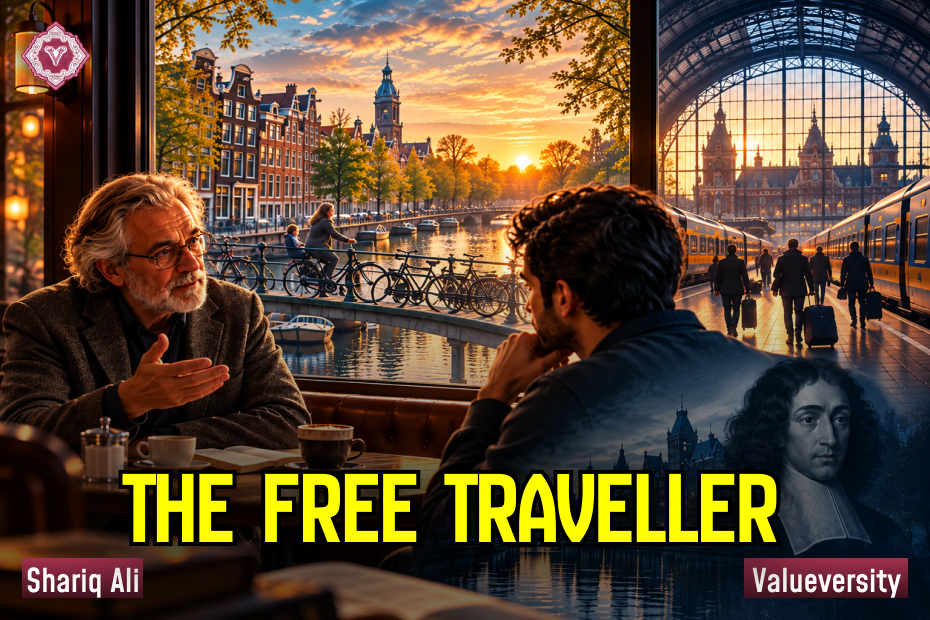
The Free Traveller
Shariq Ali
Valueversity
There is a peculiar rhythm to an Amsterdam morning.
When the city awakens, it does not feel as though the night has ended. Rather, it is as if someone has gently breathed movement into a beautiful painting hanging on a wall.
Reflections of centuries-old buildings begin to shimmer on the still waters of the canals. Somewhere, a bicycle bell rings on a bridge; elsewhere, a tram glides softly along its tracks. Long rows of bicycles by the roadside, small boats floating on the water, and old buildings leaning over both sides of the canals all come together to create the portrait of a city that carries its past with it while continually moving towards the future.
That morning, I too was a traveller.
My train was due to depart from Amsterdam Centraal. There was still plenty of time.
Amsterdam Centraal feels like a small city in itself. A constant flow of travellers through its vast hall, the sound of suitcase wheels rolling across the floor, conversations in different languages, names of cities changing on the illuminated departure board, and announcements echoing at intervals.
Everyone had come from somewhere or was going somewhere. Just like our lives.
I sat down in a coffee house, ordered a hot chocolate, and began watching people come and go outside the window.
At the next table sat an elderly man. Greying hair, a dark grey coat, an open book in front of him, and a small cup of coffee.
Our eyes met, and we both smiled. I moved over and joined him.
“I’m Spin,” he said, extending his hand. “Professor Spin.”
Our conversation moved from the weather to travel, and then to philosophy.
“I used to teach philosophy,” he told me. “Now, mostly, I read it myself.”
“What is the difference?”
He smiled.
“When you teach, you answer other people’s questions. When you read, you begin questioning your own answers.”
I asked:
“How do we know that what we believe to be true is actually true?”
He looked out of the window. A young woman rode past on a bicycle, with a child sitting in a small seat behind her.
“That is one of the great questions of human history.
There is what is true, and then there is what we believe to be true.”
“So, the difference between fact and opinion?”
“A fact is something that can be tested through evidence, independently of whether we like it or dislike it. An opinion is what we think about that fact.”
“But what if millions of people believe the same thing?”
He pointed towards the packet of sugar lying on the table.
“If everyone sitting here said that this contained salt, would the sugar become salt?”
I laughed.
“No.”
“Then how can the majority be the measure of reality?”
He took a sip of his coffee.
“Human beings have not always understood the world through facts. Where knowledge was absent, there were stories: where the sun went, why the sky thundered, why droughts came.”
“Myths?”
“Yes. But do not mistake myth for a lie. Myth and fiction can give meaning to human experience.
The problem begins when we mistake symbolic truth for testable reality. It is equally mistaken to read poetry as a laboratory report, or a laboratory report as poetry.”
I smiled.
“But today we have science and the internet.”
“We do. But we still have our myths. Only their clothes have changed. We create stories about our nation, our ideology, our leaders, and even ourselves. Then we search for evidence to prove those stories.”
“Confirmation bias?”
He nodded.
“We imagine ourselves to be judges, when quite often we are merely lawyers defending our own ideas.”
“Then how is free thought possible?”
“By asking why I believe what I believe. And whether there is any evidence that could make me change my mind.”
I asked:
“What if an idea has become part of my identity?”
The smile disappeared from his face.
“That is where the difficulty begins. Once an idea becomes an identity, disagreement no longer feels like an argument; it feels like an attack. The other person no longer appears merely wrong. They begin to look like an enemy.”
At that moment, an announcement echoed through the station.
Professor Spin looked at his watch.
“We should go.”
We left the coffee house. Ahead of us, travellers were making their way towards their respective platforms.
As we walked, I asked:
“So, does free thought mean believing in nothing at all?”
He stopped and looked at me, but instead of answering, he smiled, shook my hand, and said goodbye.
We went our separate ways.
As the train pulled away from Amsterdam Centraal, the canals, bridges, and old buildings slowly began to recede into the distance.
For some reason, I took out my phone and typed:
Spin. Amsterdam. Philosopher.
A name appeared on the screen:
Baruch Spinoza.
Born in Amsterdam in 1632, he was a philosopher who championed reason, freedom of thought, and the understanding of human prejudice, and who paid a price for questioning, independently and openly, the powerful religious and intellectual traditions of his time.
I put away my phone and looked out of the window.
And then, somehow, Professor Spin’s unfinished answer seemed to complete itself:
“A person who believes in nothing is not free; he is empty. A free person has beliefs, but he does not allow his beliefs to rule over reality.”