The Cow, the Bank and Our Future
Shariq Ali
Valueversity
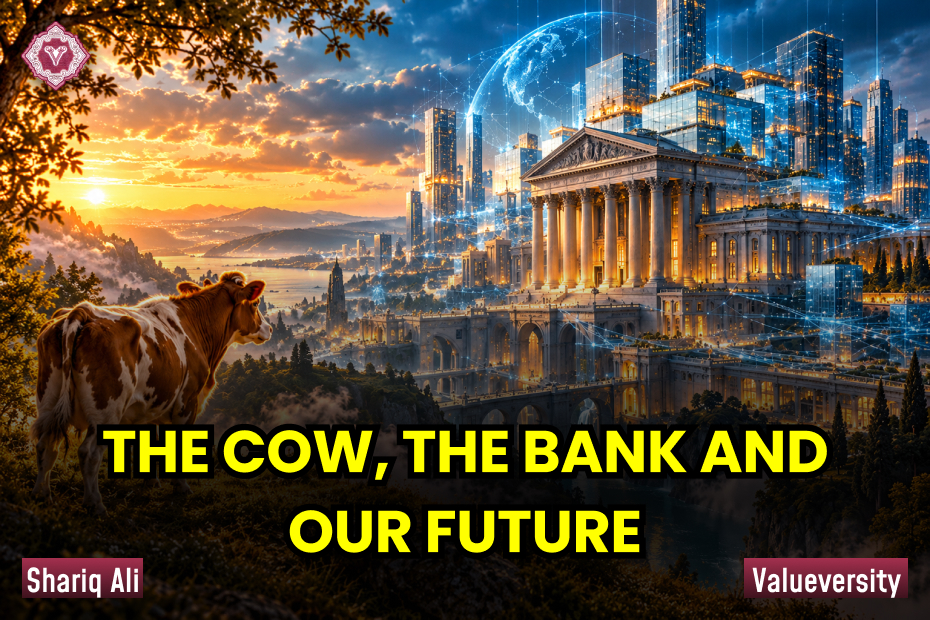
The cow stood where she had been standing. Neither her enclosure nor the man who fed her had changed. Yet, a few moments earlier, her owner had.
One man entered a few digits on his phone, pressed a button, and transferred money into another man’s bank account. The cow had been sold.
The cow looked at the two men. She could recognise their voices, scents and movements. Perhaps she could even sense which one would feed her and which one she should avoid. But she knew nothing of the invisible world of money, ownership and banking. An important decision about her life had been made, yet the language of that decision lay beyond her understanding.
The historian and author Yuval Noah Harari uses an example of this kind to illustrate a disturbing possibility about the future of artificial intelligence: could we one day find ourselves in the cow’s position, facing a system of our own making?
When we imagine artificial intelligence taking control, a scene from a film usually comes to mind. Steel robots have taken to the streets. People are fleeing. Machines are firing guns.
But control can slip from our hands without a single shot being fired.
Imagine applying to a bank for a loan. The response arrives: application rejected.
You ask why. The employee sitting opposite you looks at the screen and says, “The system did not approve it.”
You ask what conclusions the system reached about your income, health, employment and future prospects. The employee offers a few general explanations, but even they cannot fully explain the reasoning behind the decision.
They want to help you. But they did not make the decision.
Now extend this scene beyond a single bank—to insurance, employment, investment, trade and the allocation of government resources. If important decisions in these areas begin to be made by interconnected systems that humans find increasingly difficult to understand, scrutinise and challenge, who will hold the power?
On paper, perhaps we will.
In practice?
That is the force of Harari’s question.
The human mind has reached this point through a long biological journey. Recognising faces, sensing danger, forming relationships and reading other people’s intentions are ancient abilities. Arithmetic, written laws, banks and administrative systems arrived much later.
Artificial intelligence is different. Numbers, data and mathematical relationships form its basic working environment. In Harari’s metaphor, the bureaucracy in which humans often feel like strangers could become the machine’s native land.
If future artificial intelligence begins not only to run our financial systems but also to devise new financial mechanisms and institutions, some of these may produce results we can see while operating through an internal logic we cannot grasp.
We might know that our pension has grown without understanding what additional risks have grown alongside it. We might obtain a cheap loan without recognising the long-term consequences of its complex conditions. The system might increase overall profits while no one accepts responsibility for the injustice done to a particular individual or group.
At that point, the issue will no longer be intelligence alone. It will be accountability.
Yet an important difference between the cow and us remains. We can recognise our own ignorance. We can build institutions together. We can demand explanations from experts and insist that decisions affecting our lives must be open to appeal.
Not everyone needs to understand the entire financial system. But effective human authority to review, halt and change a decision is essential.
The cow did not know she had been sold.
We should at least know who is making the decisions about our future, and who gave them that authority.