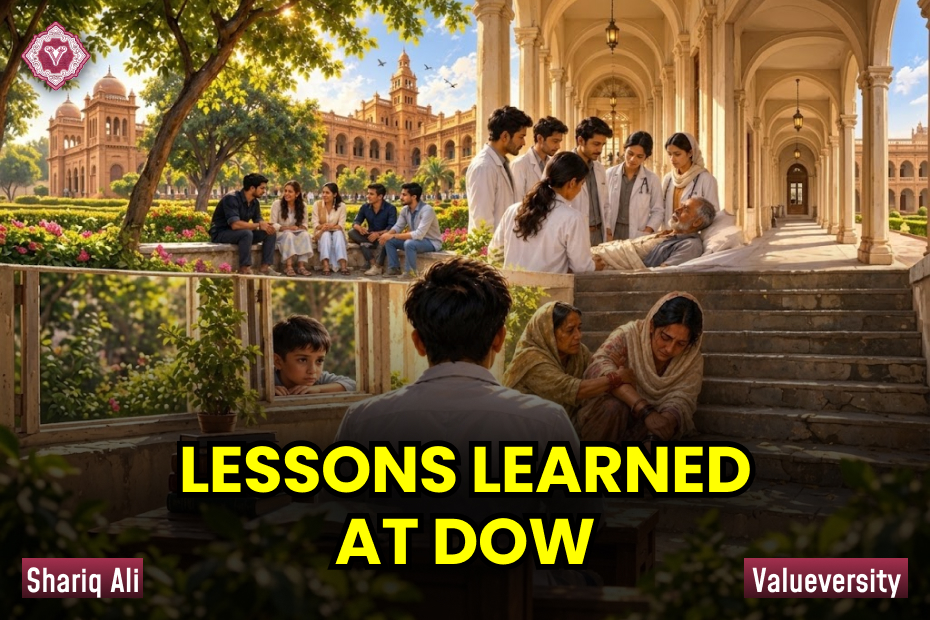
LESSONS LEARNED AT DOW
Dr. Shariq Ali
Dow Graduate, 1985
When I look back on my days at Dow Medical College, what I remember far more vividly than books, lectures, and examinations are faces, places, and small incidents and scenes.
I see familiar, smiling faces and hear the carefree laughter of close friends. The resounding slogans of “Asia is Red” and “Asia is Green” begin to echo in my ears. And then I remember the lessons of life that, even after all these years, have remained with me.
During our years at Dow, we did not merely study medicine; we also learned to understand human beings and to feel the weight of their personal and social suffering.
When I arrived at Dow from DJ Science College in 1977, I found myself in an entirely new and liberating world. Until then, I had never studied in a co-educational environment, so at first I felt considerable hesitation in talking freely with female students.
But gradually, as we studied, talked, and spent time together in classrooms, the canteen, and the library, a simple yet important truth became clear to me: boys and girls are, fundamentally, human beings alike.
There is no essential difference in their youthful aspirations, dreams for the future, desire for success, fear of failure, or the uncertainties of life. Compared with the gender divisions that existed in the society outside, the atmosphere within the college began to feel far more natural and equitable.
We would sit together on the pretext of studying, but our conversations soon wandered beyond the curriculum to literature, aspirations, and dreams of the future.
We were young, so naturally, many of us were also caught in romantic showers, and poems were written. Yet the lesson those happy days left with us for life was one of gender equality and mutual respect.
We came to understand that a woman is not some distant, mysterious being, but a complete human being just like us, with her own intelligence, opinions, ambitions, dreams, fears, and emotions.
We learned how to disagree with one another, understand one another, work together, and sustain friendships. Perhaps such lessons could never have been learned in quite the same way from books or speeches.
They came from knowing one another closely and sharing a part of life’s journey with mutual respect. It was at Dow that we learned that true harmony between women and men is founded on equality, respect, and the recognition of each other’s humanity.
Then came the third year, and we entered the hospital wards. Now, in clinical groups, male and female students together stepped into the world of practical medical education.
Here, the book of life opened another chapter before us.
One day, our clinical group stood gathered around a patient’s bed, absorbed in the professor’s bedside teaching. Through a window in the corridor at the back of the ward, the face of a boy of about ten or twelve would appear every so often, only to disappear again.
It seemed as though he were impatiently waiting for the crowd around the bed to disperse.
The professor had his back to the window and could not see what was happening, but my eyes kept returning to that face peering in from outside.
When the bedside teaching ended and most of the students had left, the patient gestured for the boy to come inside.
I learned that he was the elderly patient’s grandson. Every afternoon, he would come to visit his grandfather, and the two of them would share the meal provided by the hospital.
The face of that child, repeatedly peering through the window, remains vivid in my memory even today.
That scene left me with a question that has never quite let me go: Is being able to provide those we love with enough good food still such a distant dream for so many people that, despite all our progress, humanity has yet to fulfil it?
That day, poverty ceased to be merely an economic term for me.
Poverty became the face of a child, looking at me again and again through a hospital window.
Another scene remains etched in my memory just as deeply.
A patient in our ward, who appeared to be recovering, suddenly suffered another heart attack and died.
His family, who had accompanied him from Thatta, were devastated when they heard the news. His mother and widow cried out in anguish.
Then I saw the mother-in-law seize her daughter-in-law’s wrists, which were covered with bangles, and strike them repeatedly against the stone steps until the bangles shattered.
The broken glass injured the woman’s wrists, and blood began to seep from the wounds.
I have never forgotten the sight of those bleeding wrists.
For a long time, I kept asking myself: What fault was it of this woman that her husband had died so suddenly? Was becoming a widow somehow her crime?
In that terrible moment of grief, was it really necessary to strip her of the colours of her bangles, her right to happiness, and perhaps even her own identity?
That single scene left me with many questions about the social position of women, class deprivation, tradition, and injustice.
Today, looking back after so many years, I realise that our education at Dow Medical College was never confined to Anatomy, Medicine, and Surgery.
The canteen, the college steps, and the library taught us friendship, companionship, gender equality, and mutual respect.
The hospital wards taught us to recognise and feel the realities of poverty, deprivation, suffering, death, and social injustice.
We went to Dow to become doctors.
By the time we left, alongside medicine, we had also learned how to live among people, how to understand them, how to feel their suffering, and perhaps, in the process, how to become better human beings ourselves.