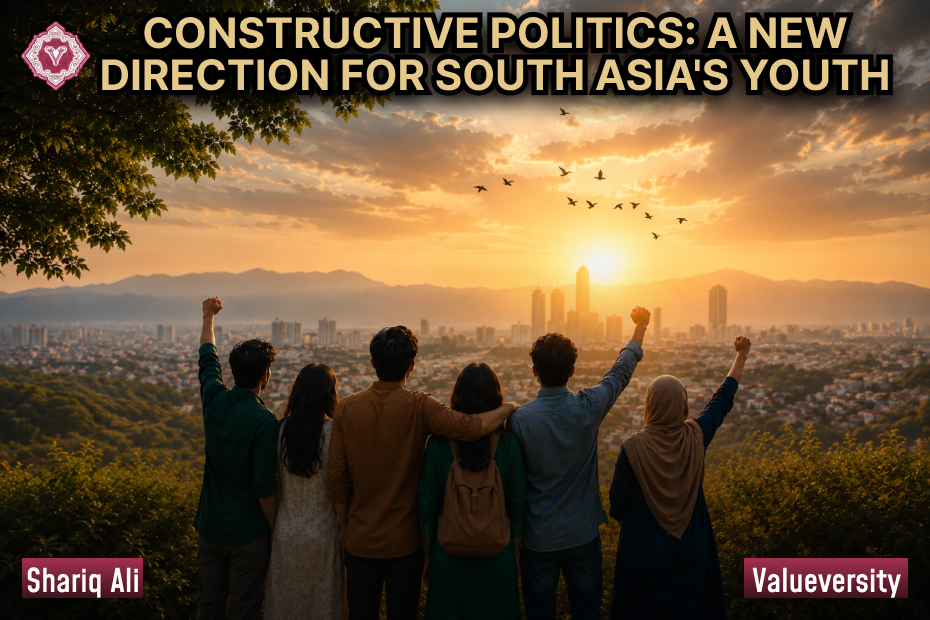
Constructive Politics: A New Direction for South Asia’s Youth
Dr Shariq Ali
Valueversity
South Asia stands at a pivotal political moment. Across the region, a new generation is demonstrating that it is no longer content to remain a passive observer of public affairs. Increasingly, young people recognise that sustainable national progress cannot be achieved through personality cults, emotional slogans, or short-term political rivalries. Rather, it depends on addressing the real challenges that shape the daily lives of ordinary citizens. Quality education, accessible healthcare, dignified employment, economic justice, environmental sustainability, and social equality are the foundations upon which resilient, prosperous, and inclusive societies are built.
Recent student demonstrations at Jantar Mantar offer an important example of this emerging shift. The significance of the movement lies not in support for or opposition to any particular political party or public figure, but in its effort to redirect the national conversation towards issues that genuinely matter to citizens. It reflects a growing desire among young people to redefine politics—not as a contest for power, but as a means of public service, democratic accountability, and meaningful social reform.
Equally noteworthy was the peaceful and disciplined character of the protest. History consistently reminds us that enduring social transformation is rarely achieved through coercion or violence. Instead, it is built upon patience, dialogue, tolerance, and moral conviction.
The ability to express disagreement through reasoned debate and mutual respect, rather than hostility, is one of the defining characteristics of a mature democracy. Encouraging young people to embrace these values is, in effect, an investment in the democratic culture of the future.
Perhaps the movement’s greatest contribution lies in its potential to cultivate ethical leadership. The true strength of any nation is measured not only by its institutions or economic resources, but by the integrity, responsibility, resilience, and public spirit of the people who sustain them. When politics helps nurture these qualities in young citizens, it produces far more than capable political leaders—it develops informed, responsible, and engaged members of society.
Today, South Asia urgently needs a politics that builds bridges rather than deepening divisions, encourages dialogue instead of hatred, and places long-term national wellbeing above short-term political advantage.
If the region’s young people continue to channel their energy towards solving real public problems, promoting ethical leadership, and advancing democratic change through peaceful means, they will not only shape a brighter future for their own nations but also contribute to greater peace, stability, and sustainable development across South Asia. Such a vision offers the strongest foundation for a region that is more just, more enlightened, and filled with greater hope for generations to come.