The White Saint of Jacobabad
Shariq Ali
Valueversity
It was a scorching afternoon in June. The earth seemed to be breathing fire. The air was hot, the trees stood silent, and an eerie stillness hung over the landscape.
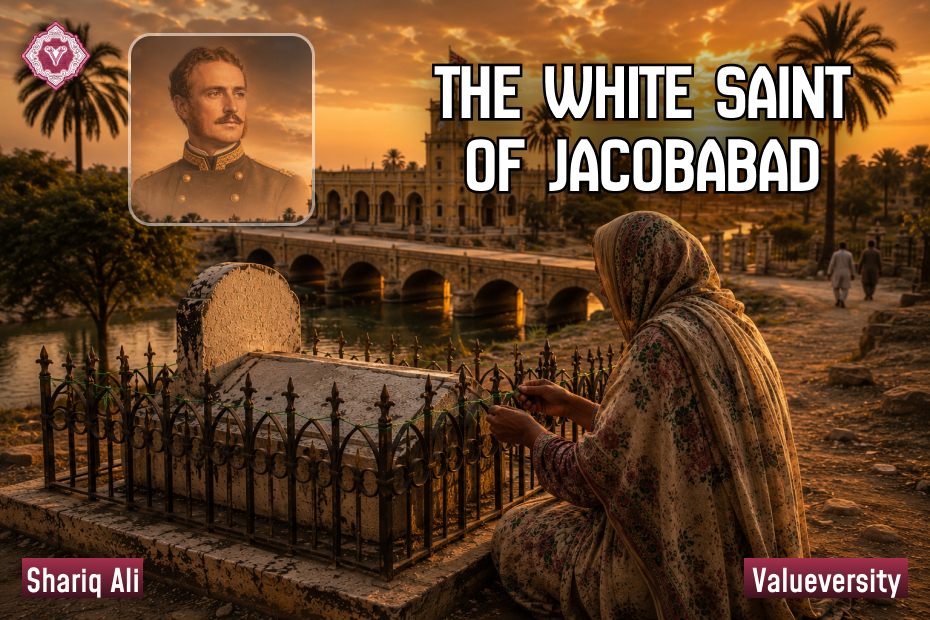
An elderly woman slowly entered the cemetery. In her hand was a green thread. She stopped beside an old grave, bowed her head, and tied the thread to the metal grille surrounding it.
She closed her eyes. Her lips moved gently, as if whispering a prayer. Then she turned and slowly walked away.
There was nothing unusual about this scene. At countless shrines across the Indian subcontinent, people do the same. They tie their hopes, fears, and wishes to colored threads and leave them behind.
But this was not the grave of a Sufi saint, a religious scholar, a mystic, or a holy man.
An Englishman was buried here.
A man born thousands of miles away on a cold continent, whose language, religion, culture, and skin color were all different.
Yet, more than one hundred and fifty years after his death, people still travel not only from Jacobabad but also from distant regions to visit his grave, make vows, and express their devotion.
Why?
By what fundamental identity is a human being remembered?
By religion?
By race?
By nationality?
By language?
Or by character and deeds?
This story begins nearly two hundred years ago.
Even then, this region was harsh, barren, and difficult. Water was scarce, settlements were scattered, and life was far from easy.
Then a young officer arrived.
His name was John Jacob (1812–1858).
A British military officer and administrator, he still occupies a unique place in the history of Sindh. In this challenging and relatively desolate part of northern Sindh, he established a new settlement that would later become known as Jacobabad.
John Jacob not only built roads, canals, and public buildings, but also worked to establish law and order, reduce tribal conflicts, and promote agricultural development. Despite the extreme heat, he was known for living among the local people, even though Jacobabad remains one of the hottest cities in the world.
His honesty, administrative ability, and public service earned him extraordinary respect among the local population. That is why, more than a century and a half after his death, his name survives not merely as a historical figure but as a lasting symbol of service and character.
Jacob was not a native of this land. No doubt he carried memories of the green fields of his homeland in his heart, yet fate brought him to this sun-scorched corner of Sindh.
Here, he built canals, constructed roads, worked to maintain peace, eased people’s hardships, and founded a new settlement.
As time passed, that settlement grew into a city.
Then one day, he departed from this world.
He was buried in the very soil he had come to improve.
Perhaps he never imagined that one day his name would become part of the city’s name.
Perhaps he never knew that future generations would light candles at his grave, make vows there, and remember him with respect.
A person’s true identity lies in character and actions. John Jacob’s sense of justice, integrity, sincerity, and service to the people became part of the collective memory of the region.
The woman who tied the green thread to his grave may not know what religion he followed or in which country he was born.
But she probably knows that her elders spoke of him with respect.
Perhaps that is why she still comes to his grave today.
In life, we often chase identities based on religion, language, name, status, wealth, and fame. Yet true human identity runs much deeper than all of these.
It is reflected in how we treat other human beings.
Did we make life easier for others?
Did we act justly?
Did we share someone’s sorrow?
Did we give hope to a discouraged heart?
Perhaps, after enough time has passed, it is these questions that ultimately determine how people will remember us.