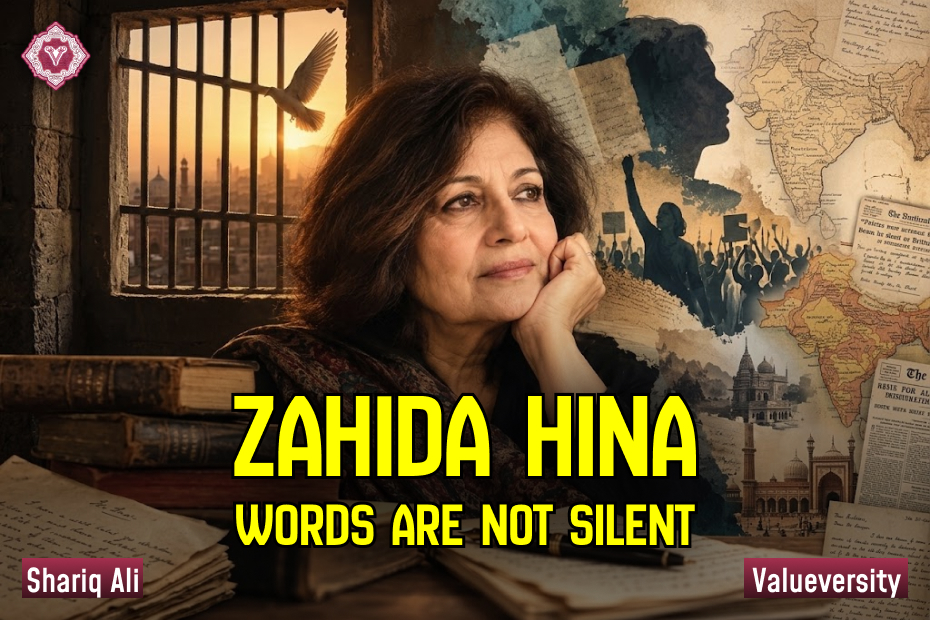
Zahida Hina
Words Are Not Silent
Shariq Ali
Valueversity
It was during my medical college days, and I was part of the organising committee for our annual mushaira, or poetry symposium.
We were in the process of inviting poets such as Dilawar Figar, Rais Amrohvi, Saleem Kausar, and others. As part of those efforts, three of us friends went, if I remember correctly, to Jaun Elia’s home in Gulshan-e-Iqbal to invite him to participate in the event.
It was there that I also briefly met Zahida Hina.
At the time, our attention was focused on Jaun Elia, so I remember nothing particularly significant about that brief encounter with Zahida Hina. What remained in my memory was simply that she, too, was a respected writer and the editor of Alami Digest.
In age, experience, and literary stature, she was far senior to us, and so that brief meeting was marked above all by a sense of respect.
I met Jaun Elia again later, and at somewhat greater length, when our literary group, Takhleeq Circle, organised an evening in his honour. But I never had another opportunity to meet Zahida Hina.
With some people, however, the real encounter does not take place face to face. It takes place through the words they have written.
My real acquaintance with Zahida Hina also came through her stories, her columns, and the questions her writing has continued to ask of society.
Her life began in Sasaram, a city in Bihar.
She grew up in a home deeply connected with books and reading. From childhood, Urdu literature, poetry, traditional tales, and history became part of her intellectual world. Her formal education began relatively late, but her journey as a reader had already begun at home.
She wrote her first story at the age of nine.
In time, that early passion developed into a long journey through short fiction, novels, drama, translation, and journalism.
Her newspaper columns brought her to a vast readership that did not necessarily consist of regular readers of fiction and novels.
Alongside her journalism, short-story collections such as Qaidi Saans Leta Hai, Titliyan Dhoondne Wali, Rah Mein Ajal Hai, and Raqs-e-Bismil Hai, as well as the novel Dard Ka Shajar, became important landmarks in her creative journey.
An English collection of her selected stories, The House of Loneliness, was also published. Its translators included Faiz Ahmed Faiz, Muhammad Umar Memon, Samina Rahman, Shah Bano Alvi, and several other distinguished writers and translators.
To describe Zahida Hina’s writing simply as storytelling would perhaps not be enough.
In her work, history repeatedly comes knocking at the door of the present.
War, dictatorship, women’s freedom, human rights, nuclear weapons, peace, and freedom of expression do not appear in her writing merely as political slogans. Behind them lies an extensive engagement with history and a profound commitment to human freedom.
Her pen has never been an entirely comfortable presence in the corridors of power.
In 2006, during military rule, it was announced that she would receive the Presidential Pride of Performance Award. She declined to accept it. Later, in 2011, during a democratic government, she accepted the same national honour.
For her, dissent was not something to be confined to words alone. A willingness to bear the consequences of one’s convictions has remained an important part of her intellectual outlook.
Her first collection of short stories, Qaidi Saans Leta Hai, was published in 1983. Its cover was designed by Sadequain.
The title itself contains an entire metaphor:
The Prisoner Breathes.
Perhaps a large part of Zahida Hina’s creative work can be seen as an expansion of that brief sentence.
The prison exists.
The chains exist.
Oppression exists.
But the human being is still breathing.
And as long as there is breath, there will also be questions.
Alongside Urdu fiction, Zahida Hina has spent several decades in journalism.
From editing Alami Digest to writing newspaper columns, writing has never been merely a professional activity for her. Her commitment to human and democratic rights, the place of women in society, and freedom of expression is evident in both her journalistic and literary work.
Her writings have been translated into numerous languages, including English, German, Russian, Hindi, Sindhi, Gurmukhi, Marathi, Bengali, and Pashto.
In 2001, she received the SAARC Literary Award.
Time passed, and the circle of recognition continued to widen.
In April 2025, at the Arts Council in Karachi, she was presented with the Ahfaz-ur-Rahman Lifetime Achievement Award in recognition of her commitment to freedom of expression and her contributions to journalism and literature. Because of ill health, she was unable to attend the ceremony herself, and her elder daughter, Fainana, accepted the award on her behalf.
In her message, Zahida Hina recalled the difficult times during which she and Ahfaz-ur-Rahman continued to write amid repression and censorship.
But perhaps a writer’s true honour does not lie in a shield, a medal, or a certificate.
The real honour is that, even after decades have passed, the questions that writer raised have not become irrelevant.
The freedom of thought Zahida Hina championed, the intolerance she challenged, the human dignity she defended against war and violence, and her insistence on seeing women as complete human beings within history and society, these questions remain before us today.
At the 2017 launch of the English collection of her stories, she said something simple about her creative process. An event or a moment takes hold of her, and she immerses herself in that state and continues to write.
From the Tilism-e-Hoshruba and Dastan-e-Amir Hamza of her childhood to the wars, migrations, and human tragedies of modern history, perhaps these different worlds have always met one another within her imagination.
I no longer remember clearly that brief and formal meeting in the house in Gulshan-e-Iqbal.
But today, that encounter carries a different meaning.
It was a meeting of a few fleeting moments with a writer whose words I would truly encounter only much later.
The best time to pay tribute to a writer is while that writer is still among us.
Respected Zahida Hina, perhaps your greatest honour is simply this: what you wrote was read.
The questions you raised were heard.
The chains you pointed towards became visible to us.
And in the long corridors of Urdu literature, the voice of your words can still be heard.
Zahida Hina Sahiba, this piece is written in honour of your living voice.