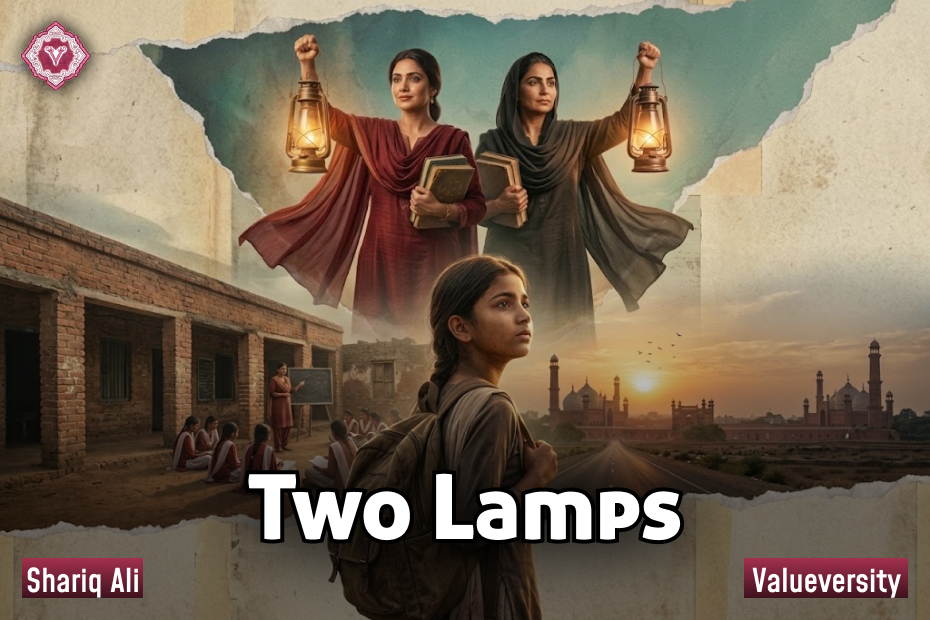
Two Lamps
Shariq Ali
Valueversity
Hajran was the daughter of the woman who worked in our home. She was about the same age as my younger sister and helped her mother with small household chores. I have rarely seen anyone with such a passion for learning. With my younger sister’s old schoolbag slung over her shoulder, containing two or three worn-out books, she would go about her little chores as if she were just about to leave for school.
At my mother’s instruction, I even took the money for her admission fee to the headmaster of a school in the poor neighbourhood across from our home.
Later, I discovered that instead of sending Hajran to school, her mother had sent her utterly uninterested brother, Farooq, who had no inclination towards studying at all.
Even today, across the Indian subcontinent, who knows how many Hajrains continue to suffer from the same educational prejudice.
The social misconception that a boy has the first right to education, and a girl only after him.
Nearly two centuries ago, two women in India had the courage to challenge this very misconception.
Their names were Savitribai Phule and Fatima Sheikh.
Morning had not yet fully awakened in a street in Pune. Two women, books in their hands, were walking towards their school. Along their path waited ridicule, humiliation, and hostility. But their steps did not falter.
What these women carried in their hands were not merely books. They carried a quiet rebellion against an old social order.
This was Pune in 1848. At the time, the very idea of formal education for girls—particularly those from lower castes and poor families—was a challenge to prevailing social traditions. That same year, Jyotirao Phule and Savitribai established a school for girls at Bhide Wada in Pune. Savitribai, who herself had been deprived of education when she married, was first taught by her husband. She later received formal teacher training and became an educator.
But opening the school was only the beginning of the real struggle.
Even the short journey from home to school became an ordeal for Savitribai. Accounts of her life repeatedly describe opponents throwing mud, cow dung, and stones at her and hurling insults as she walked. It is said that she carried an extra sari with her so that, upon reaching school, she could change her clothes and stand before her pupils with the dignity expected of a teacher.
As the opposition intensified, Jyotirao and Savitribai were forced to leave their family home. At this difficult moment, their friend Usman Sheikh gave them shelter in his house. It was here that his sister, Fatima Sheikh, became part of their educational struggle. Fatima taught girls alongside Savitribai and helped bring education to families whose daughters and children from disadvantaged communities had virtually no access to schooling.
Their partnership was extraordinary for its time. A Hindu woman and a Muslim woman were working together to educate children who had been denied knowledge because of their gender, caste, or poverty. Education here was no longer merely about learning letters and numbers; it had become a declaration of social equality.
Within a few years, their efforts were no longer confined to a small classroom. By 1851, the Phules were running three schools for girls in Pune. Their pupils were taught not only reading, writing, and arithmetic, but also subjects that helped them understand the world around them.
Savitribai’s struggle extended far beyond education. She worked for widows, marginalised women, and those oppressed by the caste system. When plague struck Pune in 1897, she devoted herself to caring for the sick. In the course of that service, she contracted the disease herself and died.
Far fewer details of Fatima Sheikh’s life have survived in the historical record than those of Savitribai. Perhaps that very fact makes this story even more meaningful. Some figures in history leave behind no substantial biographies—only the lamps they once lit.
I never discovered when that old schoolbag finally came off Hajran’s shoulder.
But whenever I read the story of Savitribai and Fatima Sheikh, I find myself thinking that perhaps, in every neighbourhood, there is still a Hajran standing somewhere with a schoolbag on her shoulder.
All that is needed is for us not to allow her brother, her poverty, or her gender to decide who has the first right to a book.