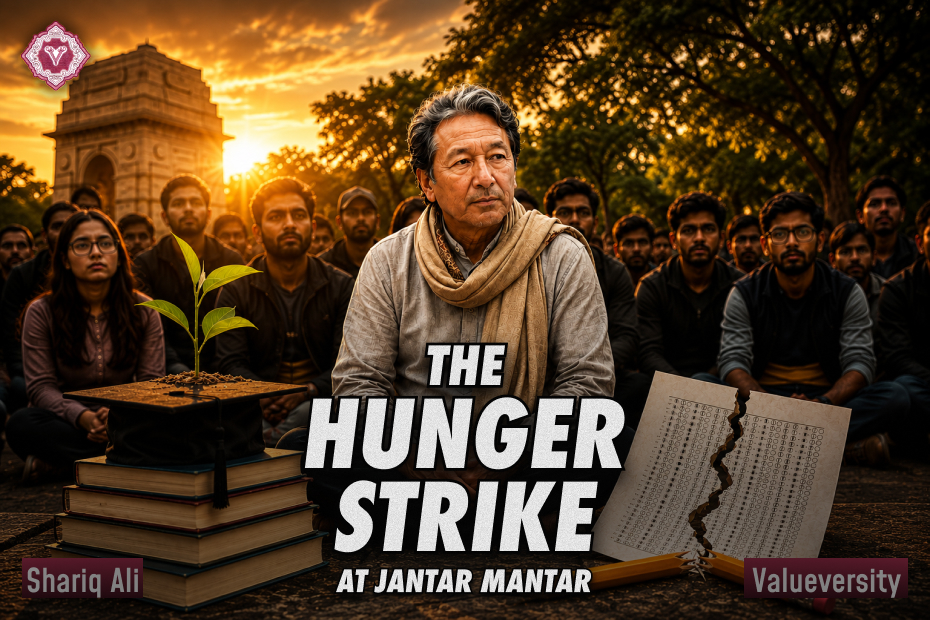
The Hunger Strike at Jantar Mantar
Dr. Shariq Ali
Valueversity
When the crisis of leaked examination papers emerged in India, most of the debate focused on who was responsible and how the papers had been leaked. But the educationist Sonam Wangchuk from Ladakh changed the direction of the discussion. He began a hunger strike at Jantar Mantar in New Delhi, yet his protest was not against a single examination or an isolated incident. Instead, he questioned an entire education system that ties the future of millions of children to the outcome of a few hours of testing.
As his health grew weaker, the strength of his message grew stronger.
Teachers, students, civil society groups, artists, and ordinary citizens rallied behind him because this was not merely Wangchuk’s struggle. It was the voice of every student who lives with the fear of failure rather than the joy of learning.
The real question is not why examination papers are leaked. The real question is why we have created a system in which a single examination paper can determine the fate of millions of dreams.
Is the purpose of education to nurture curiosity, character, and ability or simply to produce marks and grades?
When children study only to pass examinations instead of acquiring knowledge, the loss extends far beyond the individual. Society as a whole is deprived of its creativity and innovation. Stress, disappointment, and the fear of failure are all consequences of this mindset.
Sonam Wangchuk’s hunger strike reminds us that educational reform cannot be achieved merely by changing the curriculum. We must also decide whether we are preparing our children only for examinations—or for life.