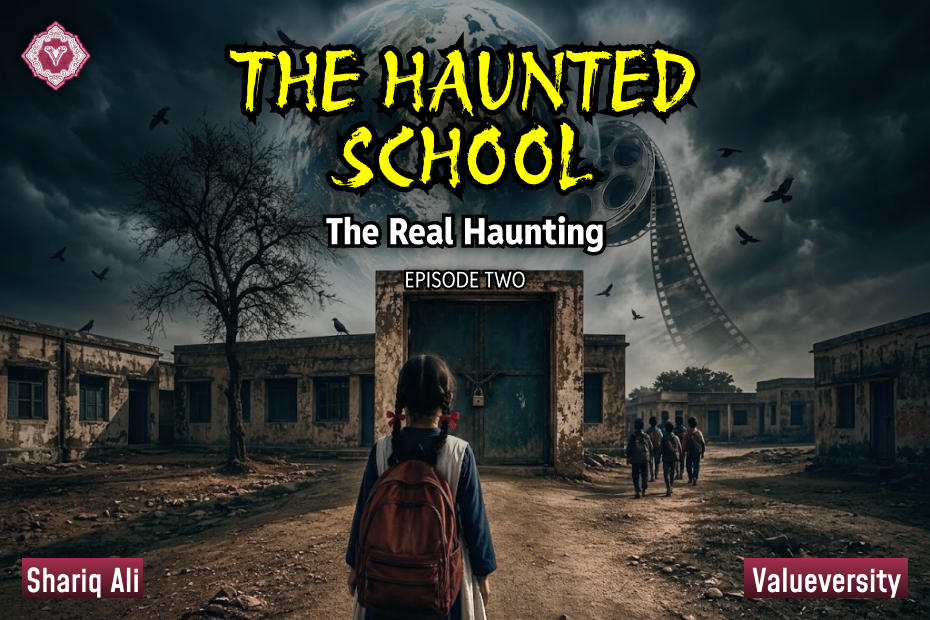
The Haunted School
The Real Haunting
Episode Two
Shariq Ali
Valueversity
In the first episode, we left Rabia standing outside the locked gates of a school.
A nine-year-old girl, a schoolbag on her shoulder, a few friends beside her, and a rusty gate locked in front of them.
She had been told:
“This school is haunted. There are ghosts here.”
Now imagine that instead of being frightened, Rabia asks a question:
“Where are the ghosts?”
In the empty classroom?
Under the dust-covered desks?
Or in the government file where this school perhaps still exists?
With that question, the story of ghosts ends, and the story of people begins.
Pakistan’s education crisis is not the failure of a single government, one province, or a few years. Its roots are far deeper and much older.
Corruption, the erosion of merit and the resulting failure of governance, greed, unhealthy social attitudes, declining moral values, poverty, shortage of teachers, remote communities, inadequate school buildings, natural disasters, and administrative neglect. The causes may differ, but the result is the same.
A child remains out of school.
And the most important aspect of that loss is never recorded in any government report.
The loss of possibility.
We may never know which of those children deprived of education might have become an exceptional teacher, doctor, scientist, skilled professional—or simply an informed and empowered citizen.
Because those possibilities are shut down before they ever have a chance to unfold.
Just like the door of a haunted school.
The greatest power of education is that it teaches a person to ask questions.
Why am I being deprived?
What are my rights?
Just because something has always been this way, must it always remain so?
Rabia’s question appears very simple:
“Why is my school closed?”
Yet that small question holds an entire system accountable.
It was this same question that caught the attention of filmmaker Seemab Gul.
British-Pakistani filmmaker Seemab Gul, during her travels in Pakistan, came across schools that physically existed, yet provided no education. In those silent buildings, she saw not merely administrative failure, but a powerful story waiting to be told.
Instead of producing a government report, she gave the issue the language of cinema.
She transformed statistics into characters.
And gave the questions of millions of children the voice of one little girl.
That girl’s name was:
Rabia.
In the film, the school in Rabia’s village closes down.
People say it is haunted. There are ghosts inside.
But instead of searching for ghosts, Rabia searches for the reason.
And from that search emerged Seemab Gul’s film:
Ghost School.
Now the question is no longer whether there is a ghost in the school.
The question is: what is the real haunting?
Corruption?
Poverty?
Administrative neglect?
Dishonesty?
Or is it the collective indifference that accepts, as something ordinary, the denial of a child’s fundamental right?
Rabia has pushed against the locked door.
And the story hidden behind it has reached the world.
But one strange twist in that story was still to come.
The film that tried to open the door of a locked school found another door closed in its own path.
That door was not in Toronto or London.
It was in Sindh.
To be continued…