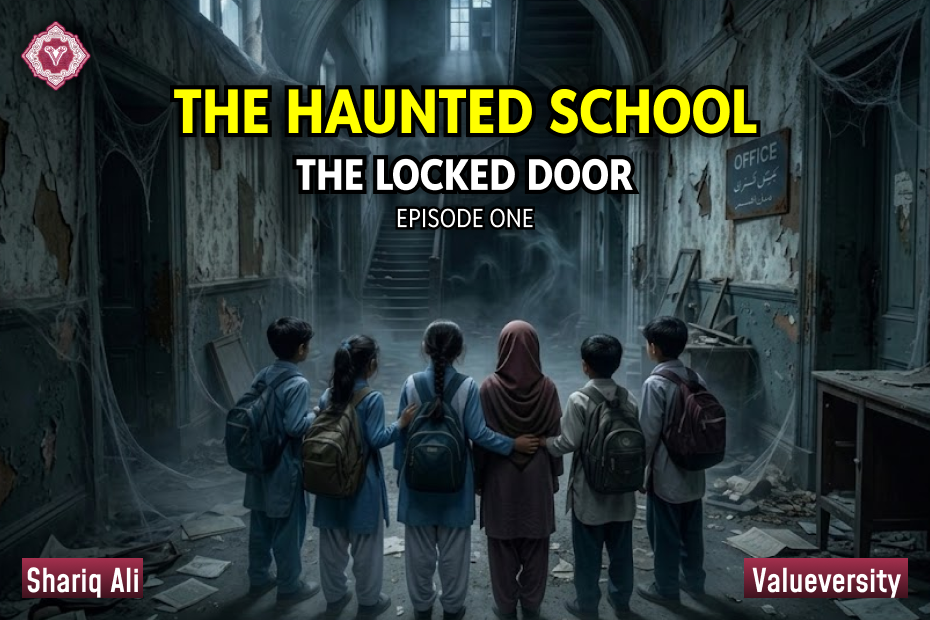
THE HAUNTED SCHOOL
THE LOCKED DOOR
EPISODE ONE
Shariq Ali
Valueversity
Morning sunlight falls across an unpaved road. Rabia and a few of her friends are walking along with schoolbags on their shoulders. Nine-year-old Rabia is a few steps ahead of the others.
The school building comes into view.
A solid brick boundary wall. A rusted iron gate. Paint peeling from the walls.
The children reach the entrance.
But the gate is locked.
This is not their first visit. Nor is their disappointment new. Still, they wait for a while. Perhaps the teacher will come. Perhaps he has the key. Perhaps today the lock will finally open.
But no one comes.
Through the broken windowpanes, an empty classroom can be seen: desks covered in dust, a dirt-stained chart hanging from the wall, and a blackboard still bearing the faint traces of a lesson written long ago.
When the wind blows, dry leaves rustle across the courtyard.
One child asks another:
“Why does our school never open?”
The answer comes:
“This school is haunted. There are ghosts here. An evil spirit hangs over it.”
The children silently stare at the building.
This could have been a scene from a horror film.
If only it were.
Behind many such silent buildings in Pakistan lies a mysterious story. Not a story of demons or ghosts, but a frightening story created by human beings.
Such schools have been given a strange name:
Ghost schools.
Schools that, in one form or another, exist within the official system and on government records, but in reality are not providing children with the education for which they were established.
There is no single form of a ghost school.
In some places, the building exists but the teacher does not. It is quite possible that the teacher—or someone else—is still regularly drawing the salary.
Elsewhere, a teacher is officially posted on paper but is nowhere to be seen in the classroom.
Some schools once functioned but have remained closed for years.
Elsewhere, a shortage of teachers, remote location, flooding, population displacement, unsafe buildings, or administrative failure has interrupted education.
So every closed school is certainly a tragedy, but it is not necessarily the result of corruption.
For a child, however, these explanations may mean very little.
There is only one overwhelming reality before them:
The door is closed.
And on the other side of that door are their books, their teacher, and their future.
Those of us who live in cities may take school for granted as an ordinary part of life.
The alarm rings in the morning.
Children get ready. They put on their uniforms. Breakfast is hurriedly finished. Some catch a bus; others get into a car with their parents.
Sometimes there are complaints about homework, sometimes anxiety about exams, and sometimes simply the reluctance to get out of bed.
We forget that in the same country there are children for whom going to school is not an ordinary routine, but an unfulfilled dream and an unsatisfied longing.
And fulfilling that dream is not within their own control.
In Pakistan, a very large number of children between the ages of five and sixteen—running into tens of millions—remain out of school.
The problem is particularly severe in rural and disadvantaged areas. For girls especially, poverty, distance, lack of safety, restrictive social attitudes, and the absence of accessible schools create further barriers.
This raises a fundamental question.
If a village school remains closed for years, surely the loss is not merely that children fail to learn the alphabet or multiplication tables.
The real loss is far greater.
Imagine that the girl standing before that locked gate had access to a functioning school.
She would learn to read.
Then to write.
Then to ask questions.
Perhaps, for the first time, she would discover through books a world beyond her village. She would learn that the earth does not end at its boundaries. There are oceans and mountains, other countries and other languages. There is science. There is history. There is poetry.
Perhaps one day she would become a teacher.
Perhaps a doctor.
Perhaps an engineer.
Perhaps she would return to her own village and teach other children.
And perhaps she would become none of these things. Perhaps she would simply become an educated citizen, an empowered woman, and a mother capable of making better-informed decisions for her children.
That, too, is no small achievement for any society.
But now imagine another possibility.
The school gate remains locked.
The girl waits one day.
Then another.
Perhaps after a few weeks, her schoolbag is placed in a corner of the house.
Life does not leave empty spaces unfilled for long.
Where school does not reach, something else eventually does.
For many children, books are replaced by the tools of labour.
One begins working in the fields.
Another starts helping at a small shop.
For a girl, once the path to education is closed, the likelihood of early marriage and economic dependence may increase.
This does not mean that every such child is destined to fail. Human beings possess an extraordinary ability to find their way even through the most difficult circumstances.
The question is not whether a child can succeed despite every obstacle.
The question is:
Why did we place those obstacles in the child’s path in the first place?
Education is not merely a means of securing a good job.
It gives people the language to understand their world.
It gives them the ability to recognise their rights.
It teaches them to distinguish reliable information from falsehood.
It gives them the confidence to make their own decisions.
And perhaps most importantly:
It teaches them to ask questions.
That is why Article 25-A of the Constitution of Pakistan makes free and compulsory education for every child between the ages of five and sixteen a responsibility of the state.
School, therefore, is not a favour bestowed upon a child.
It is the child’s right.
Now let us return to that same morning.
The children are still standing before the locked gate.
The wind blows.
The rusted iron gate makes a faint creaking sound.
Perhaps one of the children asks once again:
“Why is this school closed?”
And once again comes the answer:
“This is a ghost school. It is haunted.”
There is indeed something haunting this story.
But we have not yet identified the real ghost…
To be continued…