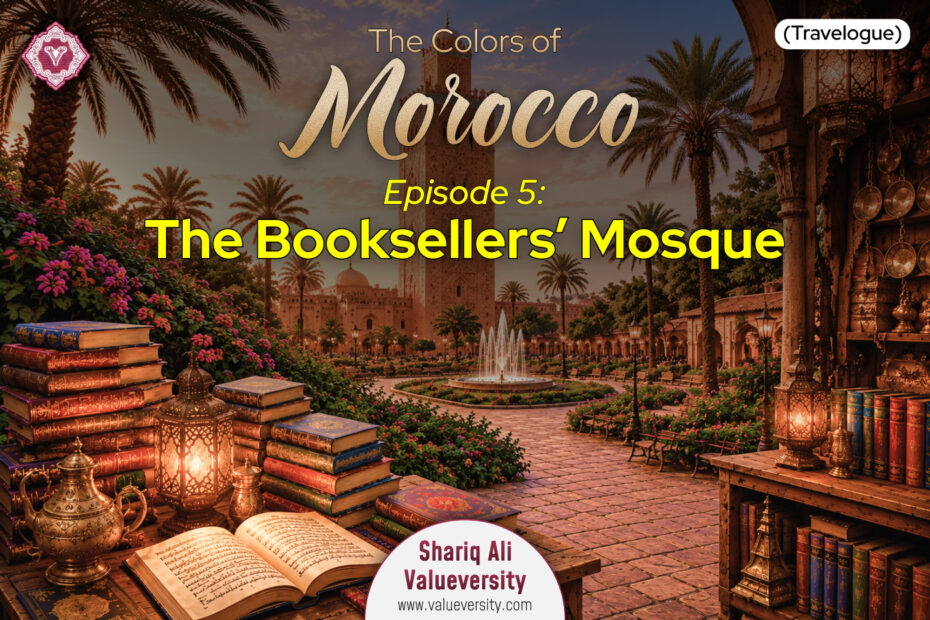
The Booksellers’ Mosque , Episode Five
The Colors of Morocco
Shariq Ali
Valueversity
After resting for a while at the hotel, we planned an evening visit to the Koutoubia Mosque and the gardens adjoining it. Soon we were in a taxi, heading toward our destination in the heart of the city, bathed in the soft, glowing sunlight of a pleasant Moroccan evening.
The mosque becomes visible from afar because of its dignified presence and towering minaret. Vast gardens stretch alongside the structure. The Koutoubia Mosque is not merely a place of worship; it is a living chapter of Morocco’s history.
Built in the twelfth century during the Almohad period, the mosque is a defining symbol of Marrakesh. It is said that the design of its minaret later influenced the Giralda of Seville and the Hassan Tower in Rabat.
Its name, “Koutoubia,” is linked to the booksellers who once set up their stalls around it. It stands as a reminder of a time when knowledge and learning were an integral part of everyday life in the city.
The surrounding book markets had turned it into an intellectual center. Manuscripts on religion, philosophy, and social sciences circulated here, along with the discussions they inspired.
This place symbolizes an era when a city’s identity was shaped not only by buildings, but by the free exchange of ideas.
We spent a long time strolling through the gardens encircling the mosque. The shadows of the trees were growing longer, and there was a gentle coolness in the air.
There were no bookstalls along the garden pathways, but many elderly men and women sat by small makeshift stalls. On them lay simple, everyday items.
As we walked, our gaze settled on an elderly Moroccan man. He had a frail body, sun-darkened skin, a white beard, a khaki jellaba worn thin near the knees, and a slightly misshapen cap on his head. He sat on a blanket spread over the grass. In front of him were a few modest necessities: caps, matchboxes, a few simple combs, perhaps two or three packets of needles and thread.
He did not call out to attract attention, nor did he narrate a tale of hardship. His lips were silent, yet his entire being told a story. We bought a few items we did not really need.
The transaction was completed through gestures and broken English. Dignity and self-respect were preserved. He was a vendor, not a beggar—fully aware of the meaning of self-worth. I liked this very much. When I recalled a similar scene back in Pakistan, I felt a quiet sense of shame within myself.
In Morocco, care for the elderly is largely provided through a strong family system, where parents usually live with their children. At the state level, limited pensions and social assistance exist, but the real support comes from family, local community, and a shared sense of responsibility.
By now, evening had settled in. After exploring the Koutoubia Mosque and its surroundings, we crossed a busy main road and entered a marketplace alive with lights, sounds, and energy.
This area lay close to Jemaa el-Fna.
We were looking for a good restaurant for dinner. A dignified doorman standing at the entrance of a brightly lit, elegantly decorated building—dressed in formal attire with a traditional turban—seemed to sense this immediately. Smiling, he welcomed us in English and invited us inside his restaurant. His manner was confident; we could not refuse.
The interior was equally refined and charming. A manager in a black Western-style suit greeted us warmly and guided us through the main floor to a private corner.
Our seating was quite close to the musicians.
In front of us, a traditional Moroccan orchestra was performing beautifully. Drums, frame drums, castanets, and a stringed instrument—whose name I do not know—combined to create a captivating atmosphere.
Moroccan orchestral music blends Andalusian, Arab, Berber, and African influences into a unique sound identity—difficult to describe, yet easy to recognize.
The rhythm was so enchanting that hands began to move on their own. The heart filled with an unfamiliar joy.
The restaurant décor was also admirable: mosaic tiles, intricately patterned pillars, soft lighting, and people conversing in hushed tones.
It felt as though art and music were part of everyday life here.
Storytellers, musicians, artists, and the public—all present together on life’s stage.
We ordered traditional Moroccan dishes. The spices were neither too strong nor bland; the meat was tender, the vegetables fresh, and the presentation simple yet dignified.
Moroccan cuisine uses cinnamon, cumin, saffron, ginger, and coriander in careful balance. Food is often slow-cooked so that the flavors blend harmoniously.
It was a truly memorable night—live music, delicious food, and a delightful ambiance. Back at the hotel, we prepared to rest. The next day promised a new adventure…..
To be continued…