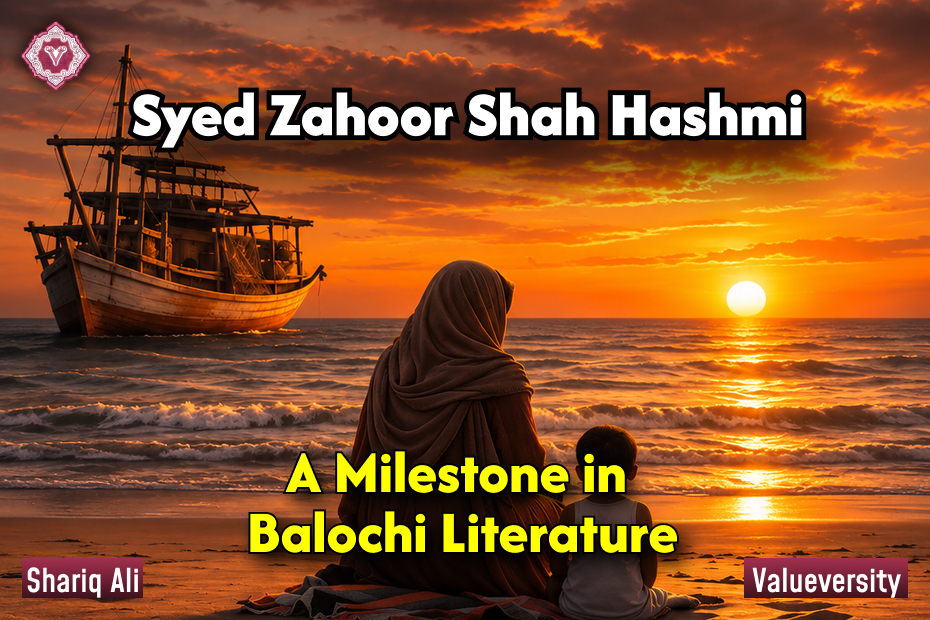
Syed Zahoor Shah Hashmi
:A Milestone in Balochi Literature
Shariq Ali
Valueversity
When a fishing boat puts out to sea from Gwadar, its voyage is bound up with the lives of the families who remain on shore. The fishermen depend on the sea for their livelihood. At home, their families wait for them to return.
It is in just such a coastal village in Makran that Syed Zahoor Shah Hashmi places Nazuk, the central character of his novel.
It is late at night. The wind whistles through the walls of the hut, and outside the rising waves can be heard. At the cock’s third crow, a few fishermen come to call their skipper, Meerin. No one wakes at the first call. When they call again, Nazuk sits up with a start. She recognises the voices of Meerin’s crew and sits silently, listening to the sea.
Nazuk’s first husband went out fishing and lost his life at sea. After his death, she remarried. Her second husband never returned from the sea either. She married a third time, but the sea took her third husband too.
The villagers blamed Nazuk for the deaths. She had children to raise and had to go on living among the very people who blamed her. When a fourth marriage was proposed, she set a condition. The man she married would have to earn his living on land.
Published in 1976, Nazuk is regarded as the first novel in Balochi. It was translated into Urdu by Ghaus Bakhsh Sabir and into Arabic by Asad Amir al-Husayni. Alongside Nazuk’s story, the novel depicts the life of the village as a whole. What fishing families can spend depends on how much fish the boats bring home. Those close to the ruler use their influence for personal gain, and those with access to the qazi demand bribes from people seeking justice.
Syed Zahoor Shah Hashmi, who brought this village to life in his novel, was born in Gwadar in 1926. He received his early education there and later worked on Radio Pakistan’s Balochi programming in Karachi. He wrote poetry and studied the classical Balochi poets. With the writer Abdul Samad Amiri, he travelled through different parts of Balochistan. Along the way, he met writers, listened to different dialects and recorded examples of how words were used. Much of that research eventually found its way into Sayad Ganj.
Sayad Ganj is regarded as the first comprehensive Balochi-to-Balochi dictionary. It defines Balochi words in Balochi. According to the linguist Adriano Rossi, the original manuscript contained around 20,000 words and expressions. Some entries give examples of how a word is used, while others briefly discuss its origins. Hashmi died in 1978. The Syed Hashmi Academy published an edited edition of the dictionary in 2000.
As Hashmi recorded words, he also had to consider how they should be written. In 1962, he put forward a set of spelling rules for Balochi. His poetry appeared in several collections, some of his short stories were included in Mirgand, and he helped write the Balochi film Hammal o Mahganj. His Urdu book, A Survey of the History of Balochi Language and Literature, appeared in 1986, introducing Urdu readers to Balochi poetry and prose.
In 2026, literary gatherings in Gwadar and Quetta marked the centenary of Hashmi’s birth. That same year, the literary magazine Himal Southasian published an excerpt from Nazuk in Fazal Baloch’s English translation. Through that translation, English-language readers can step into the same hut on the Makran coast. Outside, in the dark, the fishermen call for Skipper Meerin. Inside, Nazuk sits silently, listening to the sea.