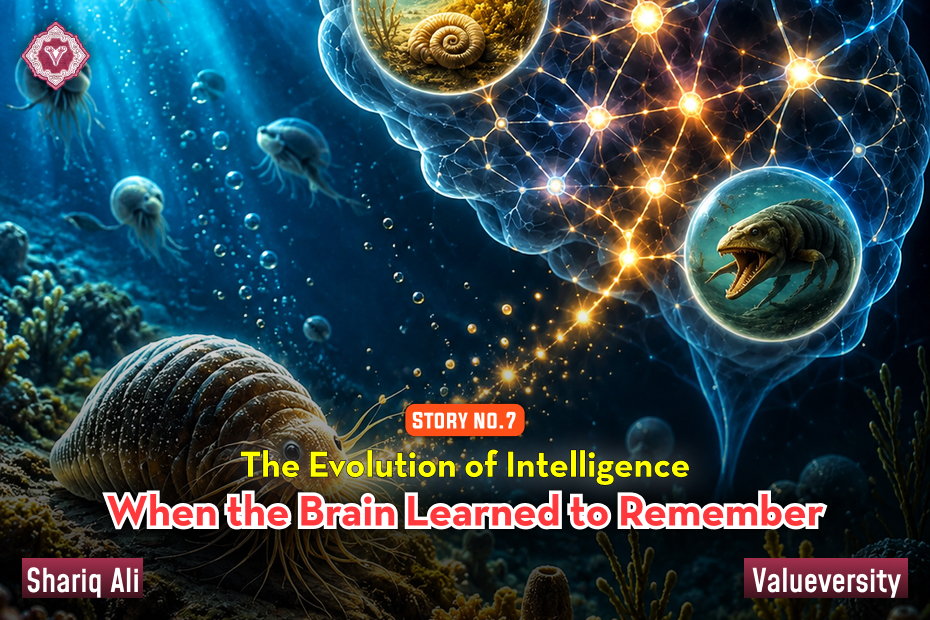
The Evolution of Intelligence
Story No. 7: When the Brain Learned to Remember
Shariq Ali
Valueversity
In the previous episode, we saw how the early brain began integrating information from different senses, gradually creating a primitive internal map of the world around it.
But one fundamental problem still remained.
If every experience disappeared the very next moment, an organism would have to understand the world all over again each time.
Imagine an ancient marine organism encountering a particular scent and finding food nearby.
If it could not remember that connection the next time, its previous experience would be of little use.
Similarly, if a certain movement, light, or smell was followed by the attack of a predator, but the organism could not recognise that warning again, experience would do little to improve its chances of survival.
This is where a new chapter in the evolution of intelligence began:
Memory.
Early memory was nothing like the complex memory we possess today.
There were no scenes from the past, no stories of remembered events, and no conscious effort to recall something.
It probably began with a much simpler ability: a change in behaviour as a result of experience.
If a harmless stimulus appeared repeatedly, an organism could gradually learn to respond to it less strongly. Scientists call this habituation.
Conversely, if a stimulus became associated with danger, the nervous system could become more sensitive to it the next time. This is known as sensitization.
These were among the earliest forms of learning and memory.
At the heart of this process were changes in the connections between nerve cells, known as synapses. Experience could strengthen some neural connections while weakening others.
The experience itself passed, but it left behind a trace within the nervous system.
Over time, another important ability emerged: linking different events together.
If a particular smell was repeatedly followed by food, that smell could become a signal for food. If a certain movement was repeatedly followed by danger, the movement itself could become a warning.
This is known as associative learning.
Now the organism was no longer entirely confined to the present moment.
Past experience had begun to influence present decisions.
In evolutionary terms, this was an enormous advantage. An organism that could remember where food was found, recognise signs of danger, or recall a successful route did not need to learn the same lesson again and again, each time at the risk of its life.
In this way, memory transformed experience into information, and information into a survival advantage.
Billions of years later, these same fundamental principles have reached astonishing levels of complexity in the human brain.
We remember faces, places, and languages.
We preserve events from childhood. We learn from the past and make plans for the future.
Yet the roots of this extraordinary ability reach deep into the history of life.
Memory was perhaps more than simply a way of preserving the past.
It was a way of making the past useful for the future.
But evolution now faced another challenge.
If an organism could retain many experiences and several possible paths lay before it, how would it choose which one to follow?
That question takes us to the next major step in the evolution of intelligence:
When the Brain Learned to Decide.