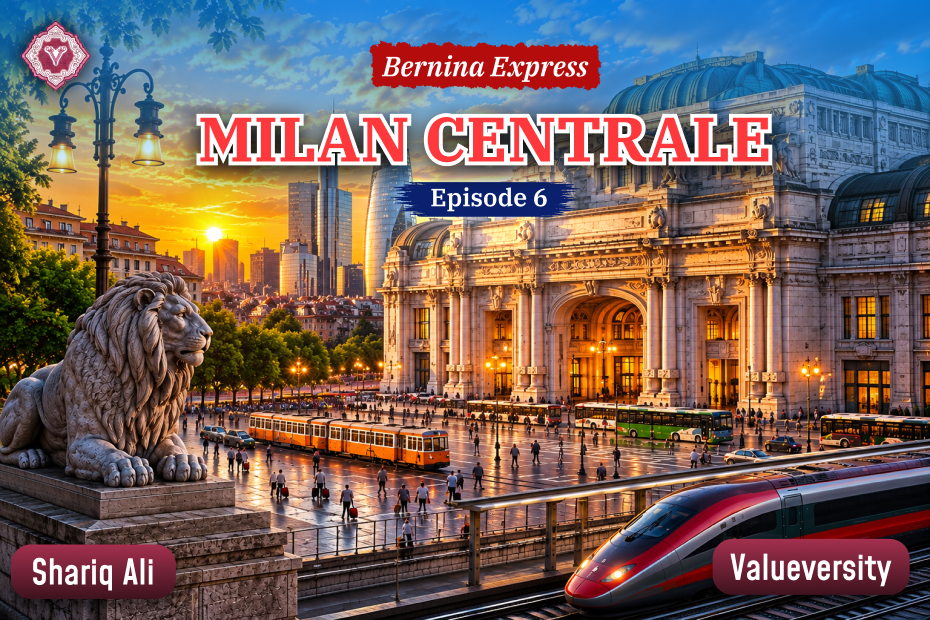
Bernina Express
Episode 6 – Milan Centrale
Shariq Ali
Valueversity
Our coach was now entering the heart of Milan. Through its large glass windows, the city unfolded before our eyes, while our guide continued introducing it in his characteristically engaging style.
Milan is not only one of Italy’s most important cities but also one of Europe’s leading economic and commercial centres. It enjoys a worldwide reputation for fashion, design, business, and modern industry. Yet, as our guide reminded us, beneath its contemporary appearance lies a history that stretches back nearly two thousand years.
At times, our coach glided along broad boulevards; at others, it passed through avenues lined with dense rows of magnificent trees. We drove past buildings whose weathered walls still bore the marks of centuries gone by. Ancient stone structures stood side by side with soaring towers of glass and steel, as though the past and the present had joined hands.
Pointing to the right, our guide drew our attention to the magnificent Sforza Castle. Built in the fifteenth century, it once served as the residence of Milan’s powerful rulers. Later, Leonardo da Vinci himself contributed to some of its decorative projects. Behind the castle stretches the vast Parco Sempione, a green sanctuary in the heart of the bustling city, where Milanese still come to enjoy moments of peace and relaxation.
A little further on, the scenery changed dramatically.
The ancient stone buildings gave way to gleaming glass skyscrapers. “This is Porta Nuova,” our guide explained. “If you wish to witness the heartbeat of modern Milan, this is the place.” Rising before us were the remarkable Bosco Verticale towers—an innovative attempt to bring nature back into the urban landscape.
Soon our coach headed towards one of Europe’s grandest railway stations—Milan Centrale.
Another feature that immediately caught our attention was the city’s remarkably organised traffic system. Trams glided silently along their dedicated tracks, buses followed their designated routes, and cyclists travelled safely in separate lanes. Wide, well-designed pedestrian walkways were everywhere.
Despite a population of millions, there was no sense of congestion or disorder.
Before long, the immense structure of Milan Centrale began to dominate the skyline. Even from a distance, its sheer scale was breathtaking. At first glance, it resembled a royal palace or a national monument far more than a railway station.
Constructed during the early twentieth century, Milan Centrale remains one of Europe’s greatest railway stations, serving millions of passengers every year. This was where our guide dropped us off.
Stepping down from the coach, we found ourselves in a vast open square. Massive stone platforms, imposing sculptures, and majestic lion statues flanking the entrance all added to the station’s extraordinary grandeur.
For a few moments, it felt as though we were standing before a historic monument rather than a transport hub.
After a brief discussion, we decided to have dinner in the city centre before returning to our hotel. Google Maps guided us to a nearby restaurant called Kashmir Grill. In the cool evening air, we walked through the streets of Milan until we reached our destination. The moment the restaurant door opened, the familiar aroma of spices greeted us, making the distance from home seem to disappear.
The shelves displayed an inviting selection of South Asian dishes, while the irresistible fragrance of freshly baked naan drifted from the tandoor.
Young chefs and waiters chatted with one another in Urdu. Pakistani and Bangladeshi staff served everyone with warmth and genuine hospitality. The entire atmosphere felt wonderfully familiar.
We ordered kofta curry, baghari daal, and chicken jalfrezi, accompanied by piping hot naan. Every dish was delicious. Each bite carried the comforting taste of home, reminding us how special familiar flavours become when one is far away.
As we left, we gladly tipped the staff, collected a takeaway meal for the following day, and walked back towards Milan Centrale.
The moment we entered through the station’s main entrance, the atmosphere changed completely. Outside stood the calm dignity of classical architecture; inside, the modern world pulsed with energy.
Towering ceilings, vast halls, eighteen railway platforms, electronic information boards, shops, cafés, restaurants, ticket offices, and thousands of passengers moving constantly in every direction created an atmosphere that was both organised and vibrant.
The platforms stretched seemingly without end.
Trains arrived from every direction, others departed, and passengers hurried to begin their journeys. Sleek high-speed intercity trains stood alongside regional and local services. Modern double-decker electric trains glided quietly into the platforms while others waited patiently for their next departure. Their size and elegance were equally impressive.
For anyone fascinated by railways, Milan Centrale was nothing less than a living railway museum. Every few moments another train arrived, another departed, announcements echoed across the station, and travellers speaking different languages continued on their respective journeys.
There was a remarkable harmony throughout the entire scene. Countless people, countless destinations, yet everything functioned with effortless precision.
Milan Centrale is truly the beating heart of the city’s—and indeed northern Italy’s—transport network. The underground metro, buses, trams, taxis, and numerous other transport services all converge here. We boarded our train back to the hotel and set off.
The following day was also devoted to discovering the many wonders of Milan. The magnificent Duomo, the fascinating world of the underground metro, and the endless shopping avenue of Corso Buenos Aires were all waiting for us. Milan, it seemed, was ready to reveal yet another chapter of its story.
To be continued…