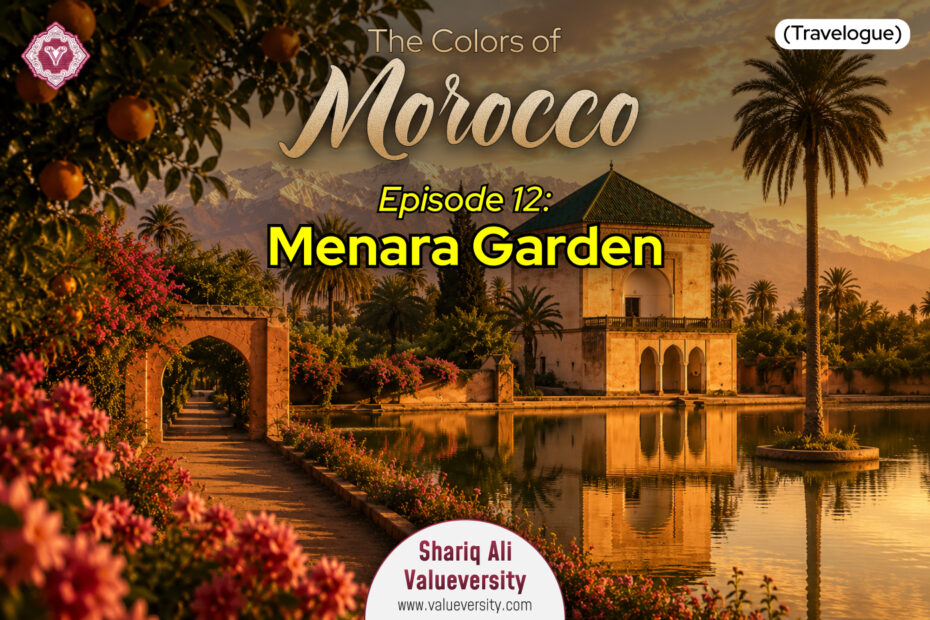
Menara Garden, Episode 12
Colors of Morocco
Shariq Ali
Valueversity
On our way back from the shopping plaza, we came upon a spacious square that could only be entered through a large reddish earthen gate, or bab. As soon as we stepped inside, it felt as though we had suddenly left the modern world behind and travelled nine hundred years back in time.
On the right side of the square stood a large iron gate, left open. It led into an immense garden. We entered and walked for a short distance before realizing that we were not strolling through an ordinary park but through a living chapter of history.
When the Almohad rulers made Marrakech their capital in the twelfth century, they launched a vast agricultural and hydraulic project to support the city’s growing population and its dry climate. This garden was one part of that ambitious undertaking. Its original name was Bassatin al-Manara—“The Gardens of the Pavilion”—which, over time, became simply known as Menara Garden.
It is said that nearly nine hundred years ago, engineers devised a remarkable system to bring water here from the Atlas Mountains through underground channels known as khettaras.
Amazingly, parts of this ancient system are still functioning today. At a time when many European cities lacked even basic drainage and water-supply networks, Moroccan architects and engineers were transporting water across miles of arid land and transforming it into fertile gardens.
The garden was not created merely for recreation.
Thousands of olive trees were planted here, producing oil for the royal court, the military, and the city’s residents. In this way, Menara became a centre of both beauty and economic productivity.
After wandering through the garden for some time, we sat on a bench surrounded by lush green trees.
Seated beneath the towering rows of palm trees, I found myself wondering about the people who had once walked these same paths. Perhaps Almohad sultans had passed here with their entourages. Perhaps, on some distant afternoon, a ruler had sat nearby contemplating affairs of state, or a poet had crafted a memorable verse beneath the shade of these very trees.
Over nine centuries, empires rose and fell, rulers came and went, wars were fought, and trade routes shifted, yet this garden quietly endured.
Particularly enchanting were the orange trees scattered throughout the grounds. Their delicate fragrance lingered in the air. Somewhere in the distance, a dove was calling, while small birds darted between the branches.
Morocco occupies an important biological corridor between Africa and Europe.
Every year, millions of migratory birds pass through this region. Gardens and green spaces such as these provide temporary refuge for these remarkable travellers.
I have always been drawn to places where nature and history join hands. Menara Garden was exactly such a place. On one side were the quiet whispers of trees; on the other, the story of centuries of human labour and creativity.
The garden served as a reminder that civilizations are not built solely through palaces and fortresses. They are also shaped by irrigation channels, orchards, trees, and the efforts of ordinary people who leave behind living monuments for future generations.
Leaving Menara Garden behind, we once again began walking toward our hotel. The sun was still gentle, and life flowed peacefully along the broad avenues of Marrakech. After only a short distance, we noticed a delightful fruit and vegetable shop by the roadside.
Outside the shop, wooden crates and wicker baskets overflowed with colour.
Red tomatoes, bright oranges, green apples, deep purple grapes, rosy peaches, golden apricots, crimson pomegranates, and many varieties of melons were arranged together like a painter’s masterpiece.
Nearby was an equally impressive display of fresh vegetables: green bell peppers, zucchini, aubergines, carrots, lettuce leaves, and fragrant herbs. The entire scene felt like a celebration of spring.
We stood there for a while simply admiring the abundance.
Morocco is blessed with fertile land and a generous climate. Its vast plains and favourable weather make it one of the important agricultural producers of the region.
Moroccan oranges and mandarins are exported throughout Europe. Olives form an essential part of both the country’s economy and its culture. Grapes, peaches, figs, pomegranates, and dates are also grown in abundance. It is little wonder that in
Moroccan markets, fruits and vegetables seem to be more than food; they are part of the nation’s cultural landscape.
We bought some fresh grapes, a few fragrant oranges, and several soft, juicy peaches.
The shopkeeper smiled warmly as he packed them into a bag for us, and we continued our walk back to the hotel.
Once in our room, we decided to skip a formal lunch and instead enjoy the fresh fruit we had purchased.
Our desert tour was due to begin at four o’clock that afternoon, and we had been informed that a lavish dinner would be served in the desert…..
To be continued