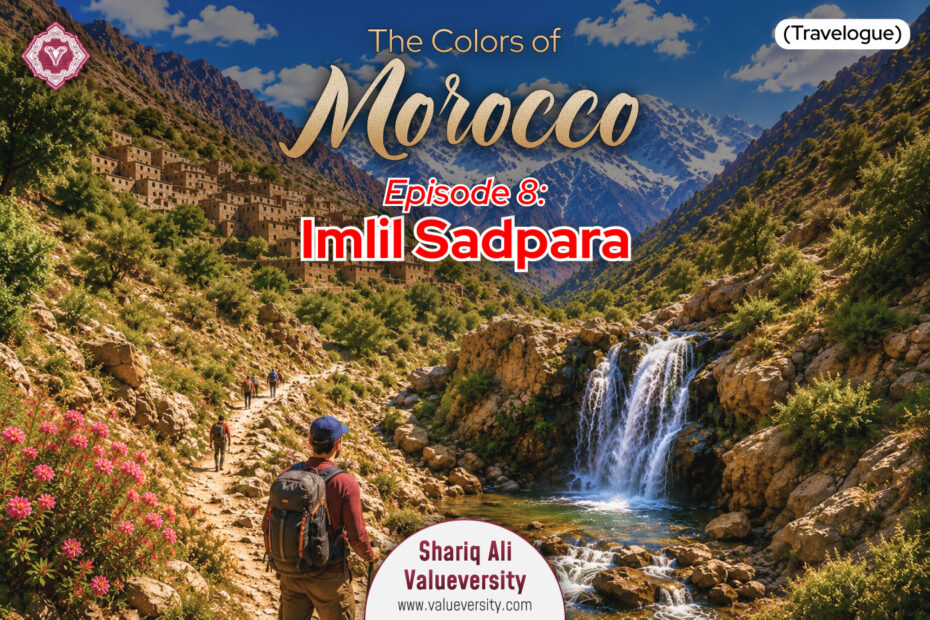
Imlil Sadpara,Episode Eight
The Colors of Morocco
Shariq Ali
Valueversity
A winding road twisting turn after turn — mountains on one side, a deep ravine on the other. Beyond the visible valleys rose towering peaks, reaching skyward. It felt like a journey through the northern regions of Pakistan. The same scenery. The same silent grandeur and mountainous dignity. We were heading toward the Moroccan village of Imlil.
At one point, we had to stop; rocks had fallen from the heights above, blocking the road.
Local workers and machinery eventually cleared the debris, and once the path was open, we moved forward again.
At last, we entered the small mountain town of Imlil. Situated at approximately 1,800 meters in the High Atlas mountain range,
Imlil is a small Berber village. You may think of it as a base camp. From here, expeditions begin toward North Africa’s highest peak, Jebel Toubkal (4,167 meters).
Our van stopped in front of a hotel, with glimpses of towering peaks visible ahead. There, our new guide Youssef was waiting.
From this point onward, we were to hike on foot to a waterfall located at a higher altitude — the same waterfall whose beautiful images adorned our travel brochure.
Youssef was a lean young man of about twenty-two, with bright, shining eyes. During his introduction, he told us that after completing tenth grade, he decided not to pursue further formal education.
“I made the mountains my school,” he said.
He belonged to a Berber (Amazigh) family. As we began hiking behind him, he shared insights about the Berber family system. Berber families still live collectively. Agriculture, livestock farming, and now tourism form the backbone of their economy. Respect for elders remains an important social pillar.
When he learned that we were from Pakistan, he suddenly stopped. His eyes lit up.
“Do you know Hassan Sadpara?” he asked.
Catching my breath, I smiled and replied, “I have heard about his achievements, but I never met him.”
“He is my hero,” Youssef said. “I often watch his videos. One day, I want to conquer the great mountains of the world just like him.”
Hassan Sadpara was one of Pakistan’s great mountaineers. Coming from a modest background in Gilgit-Baltistan, he never surrendered to poverty. He summited several of the world’s highest peaks, including Mount Everest. Sadpara taught the world that mountains are not conquered by physical strength alone, but by courage.
Hailing from the village of Sadpara in Skardu, this renowned Pakistani mountaineer climbed Mount Everest and several other eight-thousand-meter peaks. Despite his humble origins, he brought pride to Pakistan on the global stage through his determination and hard work. He passed away in 2016.
We resumed our hike, and I found myself reflecting.
Between Youssef of this Berber village at the foothills of the High Atlas and Sadpara of Skardu, there exists a shared dream. It became clear to me that mountains can unite people, dissolving distances and national boundaries.
Leaving behind the narrow lanes of Imlil, we advanced along rocky trails. We passed small Berber settlements — houses built of mud and stone, wooden beams overhead, and shy smiles of children watching us with curiosity.
At times, the path turned steep; at other times, it softened alongside a gently flowing stream. Youssef walked ahead, we followed behind. At every turn, he spoke of a tree, a field, or a mountain village.
We were exhausted.
Some among us had nearly given up and refused to go any further.
Youssef asked us to remain silent and listen carefully. We paused and strained our ears — and then we heard it: the sound of falling water.
We were close to our destination.
A small waterfall flowing from the embrace of the mountain. Crystal-clear water striking the rocks and forming a stream below. Greenery all around. Silence — broken only by the sound of flowing water.
We paused for a while to catch our breath, and then moved forward again…
To be continued.