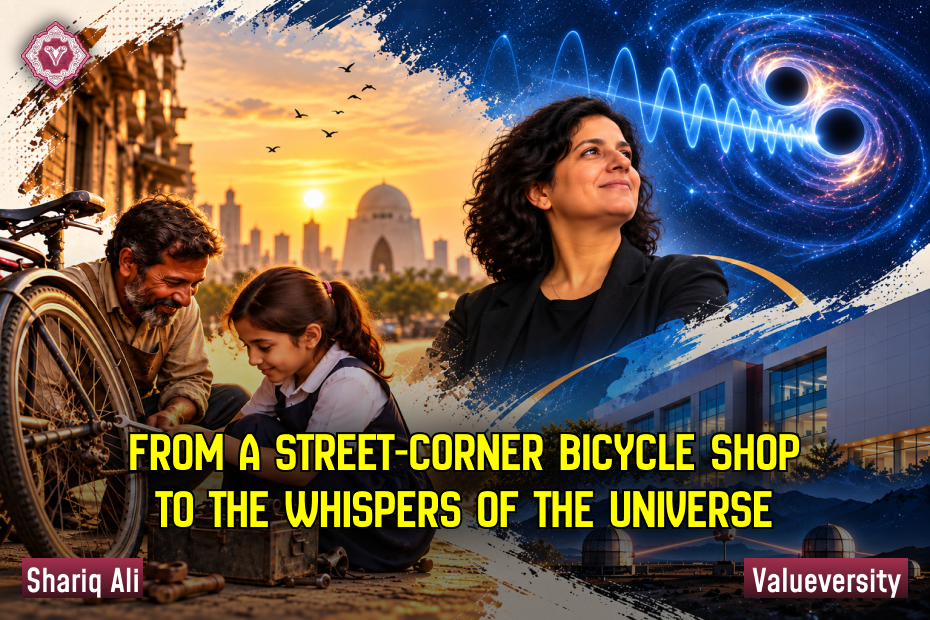
From a Street-Corner Bicycle Shop to the Whispers of the Universe
Shariq Ali
Valueversity
A small bicycle repair shop at the corner of a street.
An ordinary scene in Karachi.
A ten-year-old girl arrived with her bicycle to have it repaired. On her school report card, her teacher had written: Very intelligent, but talkative and difficult to control.
Something was wrong with the bicycle.
The girl did not simply say to the bicycle mechanic:
“Please fix my bicycle.”
Instead, she asked:
“What is wrong with it? And how can it be fixed?”
The bicycle mechanic was a good teacher. No classroom, no blackboard, no university degree.
He did not dismiss the girl’s curiosity.
He did not send her away by telling her that this was not something for her to do. Instead, he placed the tools in her hands and explained, step by step, where the problem was, how each part could be opened, and how it could be put back into place.
That day, the girl repaired her bicycle with her own hands.
After that, she no longer came to him simply to have her bicycle repaired. She began coming to borrow his tools.
That girl was Nergis Mavalvala.
Today, that same talkative and intelligent child is the Dean of the MIT School of Science and one of the world’s distinguished experimental physicists.
She was an exceptionally curious child who did not merely want to know that something was wrong. She wanted to know why it was wrong, and how it could be put right.
And there was an ordinary bicycle mechanic, but an extraordinary teacher,
who, instead of suppressing that curiosity, placed the tools in the child’s hands.
This is a story about how human potential grows.
Curiosity exists within a child, but for it to flourish, it needs a person, and an environment, that says:
“All right. Now try doing it yourself.”
Nergis was born in Lahore but spent her childhood in Karachi. She studied at the Convent of Jesus and Mary. At home, too, she grew up in an environment where the education of both daughters mattered, and her habit of taking things apart, building them, and trying to understand how they worked was not dismissed merely as mischief.
The journey of that curious child eventually took her from Karachi to Wellesley College in the United States, where she studied Physics and Astronomy. Financial assistance played an important role in making that journey possible.
Later, she arrived at MIT, where, under the guidance of Rainer Weiss, she worked on research related to the detection of gravitational waves and completed her PhD in 1997.
The bicycle tools had now been replaced by lasers, mirrors, and extraordinarily sensitive scientific instruments.
But perhaps the fundamental question remained the same:
How does this work?
That same question eventually led her to LIGO and to one of the great scientific endeavours of our time—an attempt to listen to a whisper of the universe that Einstein had predicted a century earlier.
When two black holes collide, they produce extraordinarily subtle ripples in spacetime known as gravitational waves.
By the time these waves reach Earth, their effect is almost unimaginably small.
Detecting them requires instruments sensitive enough to distinguish the true signal from the tiniest vibrations and surrounding noise.
In 2015, LIGO directly detected gravitational waves for the first time.
Humanity had begun not only to see the universe, but, in a new sense, to listen to it as well.
Nergis Mavalvala’s research has been particularly associated with precision measurement, lasers, and techniques for reducing quantum noise.
But to regard her story merely as the personal success of an exceptional scientist would perhaps mean missing its most important lesson.
Because intelligence does not travel alone.
It needs encouraging parents, good teachers, financial support, laboratories, intellectual freedom, research resources, room for failure, and institutions where asking questions is not regarded as a problem, but as the beginning of knowledge.
These days, Nergis Mavalvala is once again in Karachi.
I had very much hoped to attend her lecture at the University of Karachi and to meet her, but I am thousands of miles away in Britain.
Perhaps from this distance, one aspect of her life becomes even clearer.
We should certainly take pride in Nergis Mavalvala.
But it is not enough simply to say that Pakistan’s daughters, too, can become another Nergis.
The real question is more difficult.
Somewhere in one of our schools today, there may be a girl asking too many questions.
Another may be holding a broken toy in her hands.
Someone may be trying to open a computer just to see what is inside.
And on someone’s school report, perhaps a teacher is once again writing:
“Very intelligent, but far too talkative.”
Will our homes, schools, and universities recognise that curiosity?
The whisper of the universe had always been there.
To hear it, humanity had to build an instrument as sensitive as LIGO.
Potential, too, already exists within our children.
We simply need to build homes, nurture teachers, and create institutions sensitive enough to hear it.
And sometimes, the beginning of that journey is as simple as a bicycle mechanic standing at the corner of a street, placing a tool in the hands of a curious little girl and saying:
“All right. Now you try it yourself.”