Lake Como and the Bernina Express
Episode Seven: A Free Day in Milan
Shariq Ali
Valueversity
According to our tour itinerary, today was a free day. There was no need to wake up early or rush to reach a coach station, and no obligation to follow a guide’s instructions.
Today, Milan was ours to explore at our own pace.
Mona’s priority was clear: shopping for gifts for the children, for our home, and for friends. My wish was different. I wanted to see Milan’s world-famous cathedral, the Duomo di Milano, up close—to take its hand, so to speak, and stroll for a while through the lanes of history.
After breakfast, we left the hotel and took a train to Milano Centrale. From there, we took a taxi towards Corso Buenos Aires.
It is one of Milan’s longest shopping streets—rather like Milan’s version of Tariq Road in Karachi. A long avenue lined on both sides with shops, large stores, and countless possibilities for shopping.
We arrived at around eleven in the morning. It was a working day, yet surprisingly, compared with Tariq Road, there was hardly any crowd at all.
We browsed a few shops together. Then, in a spirit of friendly compromise, we decided that Mona would leisurely explore the shops at her own pace while I visited the Duomo and returned by lunchtime.
Two hours later, we were to meet again at a nearby four-star Lebanese halal restaurant recommended by TripAdvisor.
I headed towards the nearest Metro station. Once downstairs, I found the ticket machine, but the instructions were in Italian. Nearby, I noticed a small corner shop where a young South Asian man, probably Pakistani, seemed extremely busy.
I discovered that Metro tickets were also sold there.
When I explained my plans, he suggested buying a day pass. It seemed a sensible idea, so I immediately bought two passes. Soon, I was aboard the Metro, heading towards Duomo station.
As I climbed the stairs out of Duomo station, I emerged into an entirely different world.
Across the vast expanse of Piazza del Duomo, beneath the brilliant sunshine,
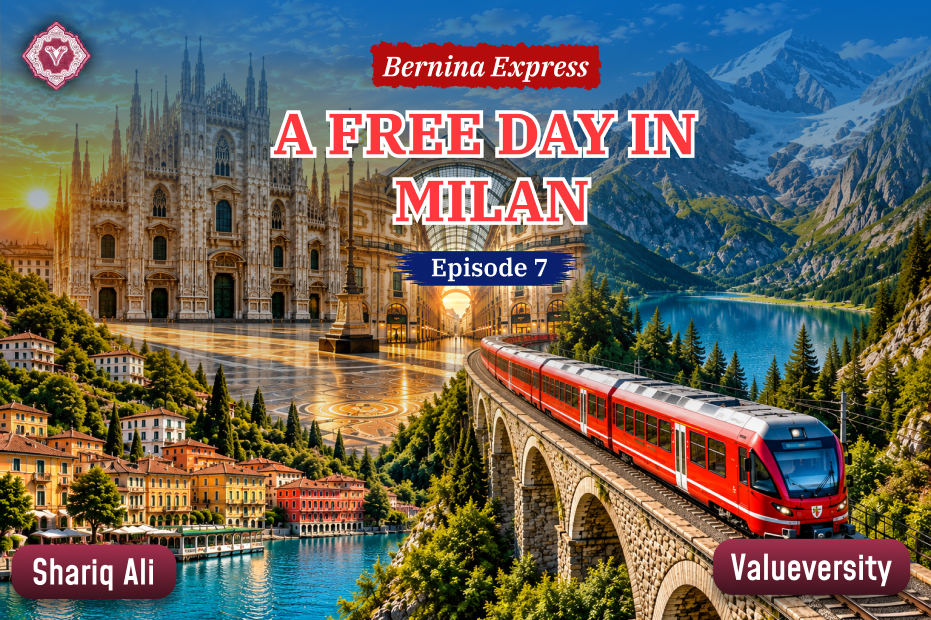
Milan’s magnificent cathedral stood before me in all its splendour.
I stopped some distance away and simply stood there, motionless.
This was a building that demanded, before anything else, to be admired from a distance for the sheer grandeur of its architecture.
My mother used to say the same thing about the Taj Mahal: even from afar, the very first sight leaves you spellbound.
The Duomo has that same quality.
The entire cathedral is built of pale marble. Soaring spires, pointed Gothic arches, intricate carvings, and countless masterpieces of stonework fill every direction in which the eye wanders. It feels less like a building made of stone and more like the creative masterpiece of some gigantic sculptor.
Its story is as extraordinary as its beauty.
Construction of the Duomo began in 1386. The following year, under the patronage of Gian Galeazzo Visconti, the Veneranda Fabbrica del Duomo was established to carry this enormous project forward. Instead of local brick, Candoglia marble was chosen, and architects, engineers, stonemasons, and artists began arriving from different parts of Europe to work on the cathedral.
That is why it is impossible to describe the Duomo as the creation of a single architect. It is a collective work of art, shaped by many generations over six centuries.
In the eighteenth century, the golden Madonnina was placed atop its great central spire.
Later, during the Napoleonic era, work on completing the façade gained new momentum.
Work on the doors and other architectural details continued well into the twentieth century.
Nearly six centuries of continuous construction.
Then I slowly began walking around the cathedral.
From every angle, the Duomo looks different. From one side, there is a multitude of statues; from another, soaring marble spires. Up close, the delicacy of the carvings is astonishing. Step back, and the entire structure becomes a single harmonious composition.
Around the piazza, people sat in cafés and restaurants.
Tourists studied maps. Families posed for photographs. Some people simply sat in the sunshine, enjoying their coffee.
Visitors had come from every corner of the world. Some were in a hurry; others were searching patiently for the perfect angle for a photograph.
The cathedral stood perfectly still, while the human world around it remained in constant motion.
After seeing the Duomo, I walked towards the right, where another surprise awaited me.
It was the Galleria Vittorio Emanuele II.
Beneath its magnificent roof of glass and iron stretches an elegant and extraordinarily expensive shopping arcade—more exclusive, perhaps, than even London’s Harrods.
Yet I was far more impressed by its architecture than by the splendour of its shops. Beautiful mosaic floors, soaring arches, elegant shopfronts, and above them a vast glass dome. It felt less like a shopping centre and more like the interior of a royal palace.
Its history is equally fascinating.
The foundation stone of the Galleria was laid in 1865, and it opened in 1867, although its monumental entrance arch facing Piazza del Duomo was completed a few years later. Its architect was Giuseppe Mengoni.
During the nineteenth century, glass-and-iron-roofed shopping arcades were becoming a new symbol of European urban life—cultural spaces where shopping, café culture, social interaction, and architecture came together beneath a single roof.
I spent quite some time wandering through the Galleria, admiring its architectural beauty. Shopping there held little interest for me.
Eventually, I left the arcade and walked back towards the Metro.
The Metro itself is part of Milan’s modern history. Its first line, the red M1, opened on 1 November 1964. The original route ran for 12.3 kilometres from Lotto to Sesto Marelli and had 21 stations. Over time, the system continued to expand, and today its underground network connects different parts of the city.
With my day pass safely in my pocket, I arrived back at Corso Buenos Aires a few minutes before our agreed meeting time.
I was pleased to learn that the shopping mission had been successfully completed.
Now we shared a common interest: lunch.
We reached the Lebanese halal restaurant we had chosen earlier, and both the food and the hospitality turned out to be even better than expected.
We thoroughly enjoyed ourselves.
The following day would bring the main reason for this entire journey: the Bernina Express.
We enjoyed the Lebanese food so much that we ordered some takeaway as well, planning to keep it in the hotel refrigerator for later.
After lunch, we abandoned any idea of another adventure. We decided instead to return to the hotel, rest for a while, take a short evening stroll around the neighbourhood, and then have an early night.
We had to wake up early the next morning.
A journey was waiting for us—a red train running through the mountains of Switzerland, between snow-covered peaks, lakes, and valleys.
Tomorrow, we would board the Bernina Express…
To be continued…