THE EVOLUTION OF INTELLIGENCE
Episode Nine: When the Brain Learned to Predict the Next Moment
Shariq Ali
Valueversity
In the previous episode, we saw how memory gave living organisms the ability to learn from past experience.
But the real advantage of learning was not simply the ability to remember what had happened.
Something even more important was emerging: the ability to use the past to anticipate what might happen next.
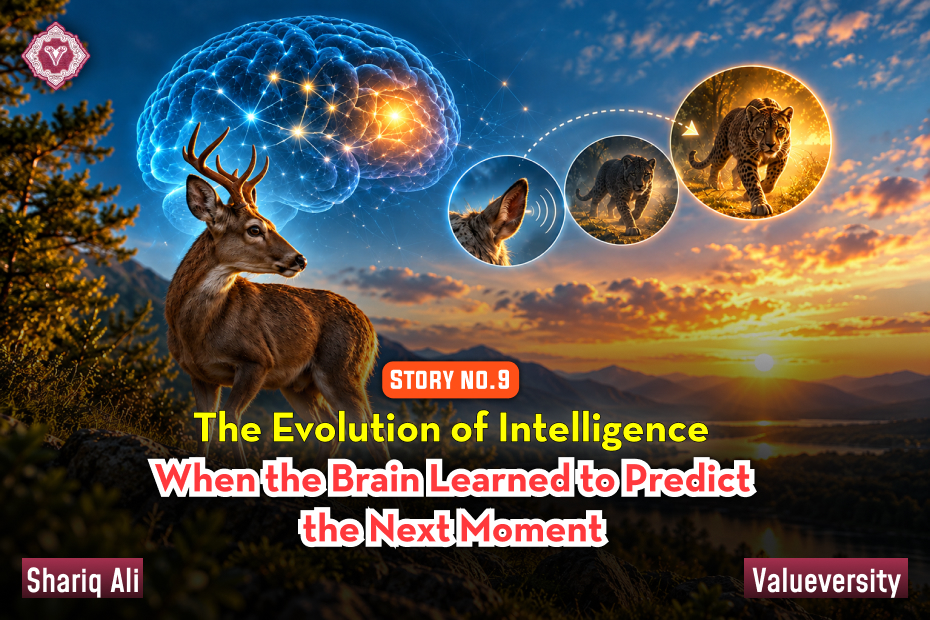
Imagine an animal that repeatedly sees a predator appear immediately after hearing a particular sound. If this experience is repeated several times, the animal will gradually become alert as soon as it hears that sound.
The predator has not yet appeared.
The danger is not yet present.
But the brain has already predicted what might happen in the next moment.
This was an early form of prediction.
Nature offers countless examples of this ability.
A predator does not look only at where its prey is at that particular moment. By observing its speed and direction, it estimates where the prey is likely to be next.
Similarly, an animal being hunted observes the predator’s movement and chooses an escape route. It must not only respond to the immediate danger but also anticipate the direction from which that danger is approaching.
The world, therefore, was no longer merely a sequence of events for the brain.
The brain began to discover relationships between those events.
If this happens, what might happen next?
The question may not have existed in words, but the behaviour of living organisms was already searching for an answer.
This ability increased the chances of survival.
An organism that reacted only after danger had fully appeared was often too late. But one that could recognise an early warning sign and respond in advance had a better chance of surviving.
The same was true when searching for food. Information about the present alone was not enough.
Sunlight, weather, a particular smell, the movement of other animals, or recognition of a familiar route could all become clues suggesting where food might be found ahead.
In this way, memory of the past gradually became a means of anticipating the future.
Modern neuroscience tells us that even today, the brain is not simply a machine that receives information from the outside world. It is constantly making predictions about what is likely to happen next and then comparing those predictions with the sensory information that actually arrives.
When a prediction proves correct, the world remains familiar and understandable to us.
But when something happens contrary to expectation, the brain immediately becomes alert.
A sudden sound, an unexpected movement along our path, or an unusual expression on a familiar face instantly captures our attention.
Because a difference has appeared between what the brain expected and what actually happened.
This was an important step in the long journey of evolution.
Life was no longer merely preserving the past.
It was beginning to use the past to prepare for the future.
But predicting the future was still not the final destination of intelligence.
Another ability had yet to emerge.
What happens when a new problem appears and an old response no longer works?
Can an organism choose between different possible paths?
Can it discover a new way of reaching a goal?
This is where the next great ability of intelligence begins to emerge.
Problem-solving.
More in the next episode.