Lake Como and the Bernina Express
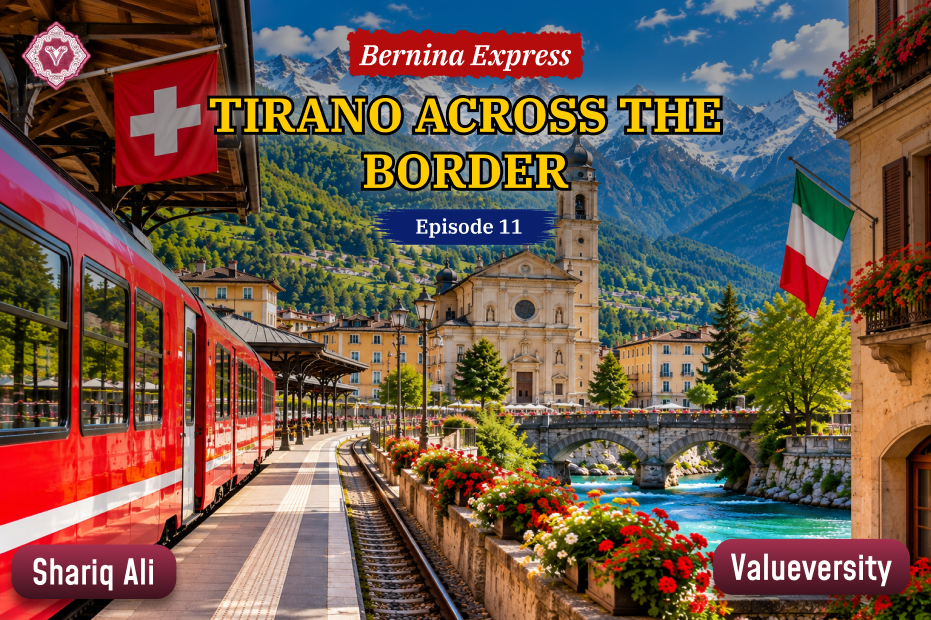
Episode Eleven: Tirano Across the Border
Shariq Ali
Valueversity
The train gradually began to slow down. The snow-covered mountains visible through the window had fallen behind us. The altitude was decreasing, and the weather was becoming milder. We could feel the landscape beginning to change.
A short while later, the train pulled into a small station and came to a stop.
Tirano — Tirano.
We had left Switzerland and arrived in Italy.
The platform where the train stopped was geographically in Italy, but the station was the final point in the network of Switzerland’s famous Rhaetian Railway (RhB).
It was as though a slender line of Swiss railway had crossed the mountains, entered Italy, and ended here.
When we left the platform and stepped outside the station, we saw another railway station across the square in front of us. Trains departed from there for various Italian cities. On one side were the red RhB trains heading toward Switzerland, and on the other were Italian trains traveling deeper into Italy.
From one station, you could set off toward St. Moritz and the Swiss Alps, and after walking just a few steps, you could catch an Italian train from the other station toward Sondrio, Lake Como, and Milan.
Two countries, two railway systems, and only a few steps between them.
The moment we left the station and entered Tirano, our first impression was that the world had truly changed.
Just a few hours earlier, we had been in St. Moritz, Switzerland’s extremely affluent, refined, and expensive mountain resort. Magnificent hotels, luxury shops, impeccably arranged streets, and that distinctive Swiss prosperity visible in everything from the buildings to the way people dressed.
Tirano had a different character.
Life here felt simpler and perhaps more relaxed.
Small shops, cafés, grocery stores, ordinary houses, local people walking through the streets, and the bustle of everyday life were completely different from the polished quiet of St. Moritz.
It felt as though a few hours of rail travel had not merely taken us from one side of a mountain to the other, but had placed us between two distinct social temperaments of Europe.
There was Swiss order.
Here, there was Italian informality.
There was quiet prosperity there.
Here, there was the sound of the marketplace and the warmth of everyday life.
And that was Tirano’s charm.
An Ancient Border Settlement
Tirano is not a new town.
Evidence of human settlement in this area dates back to ancient times, while written records mention Tirano as early as the eleventh century. In the twelfth century, it became an independent commune, and later it continued to pass under the control of the changing political powers of northern Italy.
At the end of the fifteenth century, when the threat of attacks from the north increased, Milanese ruler Ludovico il Moro had walls and defensive structures built here. Some sections of those old walls and ancient gates can still be found in Tirano’s historic center today.
Two rivers, the Adda and the Poschiavino, are also connected with the town. One ancient interpretation of the name Tirano links it to the Latin phrase inter amnes, meaning “between the rivers.”
The most famous event in Tirano’s history took place in 1504.
According to local tradition, a man named Mario Omodei had a vision of the Virgin Mary here. The magnificent Basilica della Madonna di Tirano was later built at that very site, gradually becoming an important religious center for the entire Valtellina region.
Pilgrims began to arrive, followed by merchants. Fairs were held, and Tirano gradually became an important center not only of worship but also of trade.
While walking around Tirano, one thing struck us as particularly interesting.
The border between Italy and Switzerland exists on the map, but in everyday life its strictness is barely noticeable. People move freely in both directions.
Switzerland is an expensive country, so for many Swiss residents living near the border, groceries and other everyday purchases in Italy are cheaper and more attractive. Shops in towns like Tirano therefore serve not only local residents; shoppers arriving from across the border also become part of this economic life.
In the morning, the flow moves in the opposite direction.
Many people who live in Italy travel to Switzerland for work, where wages are generally higher.
This phenomenon is not limited to Tirano. Along the entire Italian-Swiss border, the lives of thousands of people are connected to this daily movement.
Thus, an interesting economic relationship emerges:
Work in Switzerland, life in Italy.
And sometimes,
Swiss income, Italian shopping.
This is not merely a catchy phrase; it is an economic reality of borderland Europe.
As we walked through Tirano’s streets, we thought that borders may be drawn as straight lines on political maps, but human life is not so straightforward.
Tirano is a symbol, a gateway between two worlds.
The Bernina Express journey had ended in Tirano. The journey back to Milan was still ahead of us…
To be continued