Lake Como and the Bernina Express
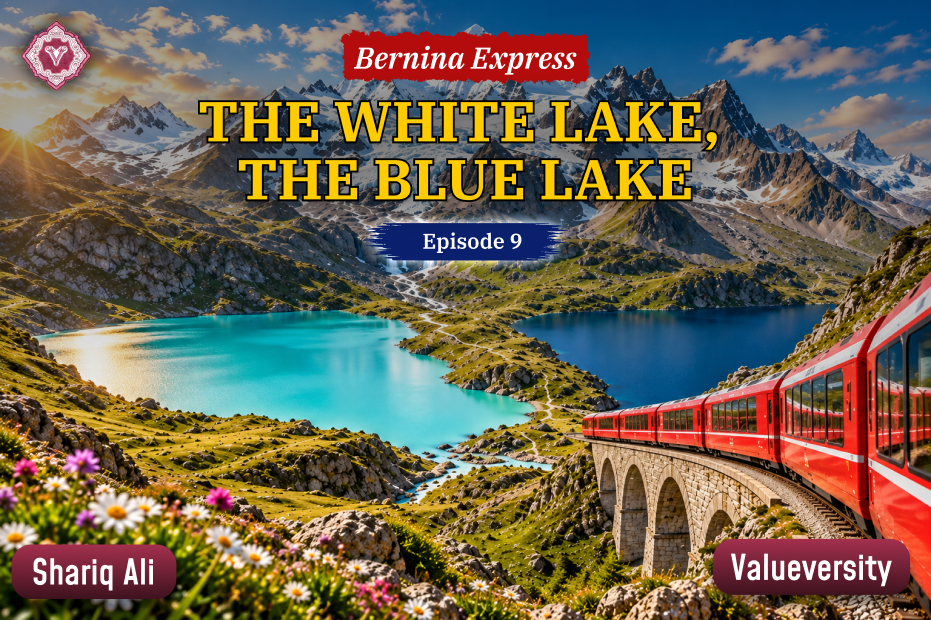
Episode 9: The White Lake, the Blue Lake
Shariq Ali
Valueversity
After spending a few hours wandering through the beautiful streets of St. Moritz, we were now walking back towards our meeting point.
We crossed the town centre and began making our way towards the designated spot. The route was the same, but our state of mind had changed. In the morning, there had been the excitement of discovering a new town; now, as we prepared to leave, there was a quiet sadness at saying goodbye to this beautiful place.
The enchanting lake of St. Moritz, its immaculate streets, the elegant modern buildings set among the mountains, and all the picturesque glimpses of a prosperous Swiss town were now stored in our memories, travelling onward with us.
When we reached the meeting point, our guide and several other travellers were already there. Once the group was complete, we followed our guide to the nearby St. Moritz railway station.
This was where our journey on the Bernina Express was to begin.
The bright red train was waiting for us at the platform.
The Bernina Express.
This world-famous train stands out among Switzerland’s snow-covered and green mountains as though an artist had drawn a vivid red line across a canvas of white, green and blue.
It is not merely a train, but a journey regarded as one of the world’s most celebrated panoramic railway experiences.
The Bernina route crosses the Alps from St. Moritz to the Italian town of Tirano. It forms part of the historic Rhaetian Railway network, whose Albula and Bernina lines were inscribed as a UNESCO World Heritage Site in 2008.
Built across extraordinarily difficult mountain terrain, this railway system is a remarkable example of engineering working in harmony with the natural landscape.
Our guide was busy making arrangements on the platform.
In her hand was a list of passengers and seat numbers, and on her face was the calm assurance of someone who knew exactly which door each passenger should enter through and where everyone was supposed to sit.
The group gathered, and one by one we boarded the train and settled into our seats.
The moment we stepped inside, it became clear why the Bernina Express is considered so different from an ordinary train.
Comfortable seats, tables in front of us, and above all, enormous panoramic windows extending upwards towards the roof. It felt as though the walls of the train, rather than obstructing the landscape, had been designed to open it up before us.
Most of the travellers around us appeared to be from Western Europe and the United States. We were perhaps the only South Asians in the entire carriage.
The languages were different, the countries were different, yet there was a sense of friendliness and harmony in the atmosphere. Most eyes were fixed on the scenery beyond the windows.
Once everyone had taken their seats, there was a gentle jolt, and the train began to move.
St. Moritz gradually slipped behind us, while the Alps began unfolding one new landscape after another.
At times the train passed between lush green slopes. At others, the mountains came so close that even the texture of their rocks could be clearly seen. In the distance, snow-covered peaks glittered beneath the sky, while waterfalls emerging from the mountains descended towards the valleys like slender and broad white ribbons.
This constantly changing landscape is the true beauty of the Bernina Railway.
It is undoubtedly an engineering masterpiece as well. Tracks laid across such high and difficult mountain terrain, bridges constructed along the route, and tiny stations perched at great elevations leave one amazed at human ingenuity.
But perhaps the most beautiful thing about it is that those who built this railway did not try to conquer the mountains. Instead, they shaped the route according to the character of the landscape.
The train would curve, climb, follow the edge of a valley, and at times it seemed as though this vivid red train had itself become part of the magnificent Alpine landscape.
Our train was travelling along the route that climbs towards the heights of the Bernina Pass and then descends from Switzerland’s cold Alpine world towards the comparatively warmer Italian town of Tirano.
For everyone aboard the Bernina Express, the destination seemed far less important than the journey itself and the extraordinary route through which we were travelling.
After some time, we reached a place high in the Alps where the train stopped briefly.
We were told that we would have approximately fifteen minutes at this small station.
Take photographs, enjoy the scenery, but make sure you return on time. This train waits for no one.
We stepped outside.
The scene before us left us speechless for a few moments.
High above stood the great peaks of the Alps, covered with glaciers. Ice accumulated over centuries glittered in the sunlight.
Meltwater flowed from the edges of the glaciers, running across the rocks in small streams before joining together at lower levels and cascading down as waterfalls.
Further below, these waterfalls became streams, joined along the way by smaller cascades and rivulets arriving from different directions.
Snow.
Melting water.
Waterfall.
Stream.
And finally, a lake.
The entire natural cycle of water seemed to be alive before us, like an illustration from a textbook transformed into reality. Amid the lush green Swiss meadows, it was a living landscape unlike anything we had perhaps ever witnessed before.
For a long while, we simply stood there, mesmerised.
I have seen mountains in my life, glaciers too, waterfalls and lakes.
But perhaps this was the first time I had seen all of them together in a single frame, so intimately connected with one another.
In this same high Alpine region lie two remarkable lakes, close to each other.
Lago Bianco — the White Lake.
And
Lej Nair — the Black Lake.
The water of Lago Bianco appears milky white or pale turquoise. One important reason is the presence of extremely fine mineral particles carried by glacial meltwater, known as glacial flour.
Nearby lies Lej Nair.
In Romansh, Lej Nair literally means “Black Lake.” Because its water contains far less glacial sediment, it appears deep blue and, from certain angles, almost black.
And so, in the same high valley, two lakes lie close together.
One milky white.
The other deep blue.
But the wonder does not end with their colours.
This region lies close to one of Europe’s important watersheds.
Water flowing in one direction eventually enters the River Inn and then the Danube system, ultimately reaching the Black Sea. Water flowing in the other direction descends towards Italy and travels through the Po river system towards the Adriatic Sea.
In other words, a distance of only a few steps on a mountain can determine whether water ultimately reaches two different seas thousands of kilometres apart.
I looked towards Lago Bianco, then towards the dark waters of Lej Nair.
And it occurred to me that the beauty of travel lies not only in seeing new places.
Sometimes a journey reveals connections that remain hidden from us in everyday life.
A particle of snow melts.
It becomes a drop of water.
The drop joins a waterfall.
The waterfall becomes a stream.
The stream enters a lake.
And then that same water begins a long journey of its own — towards a river, through a country, and ultimately towards a distant sea.
Fifteen minutes passed remarkably quickly.
We took a few farewell photographs and once again boarded the vivid red train.
The Bernina Express still had much more to show us…
To be continued…