Lake Como and the Bernina Express
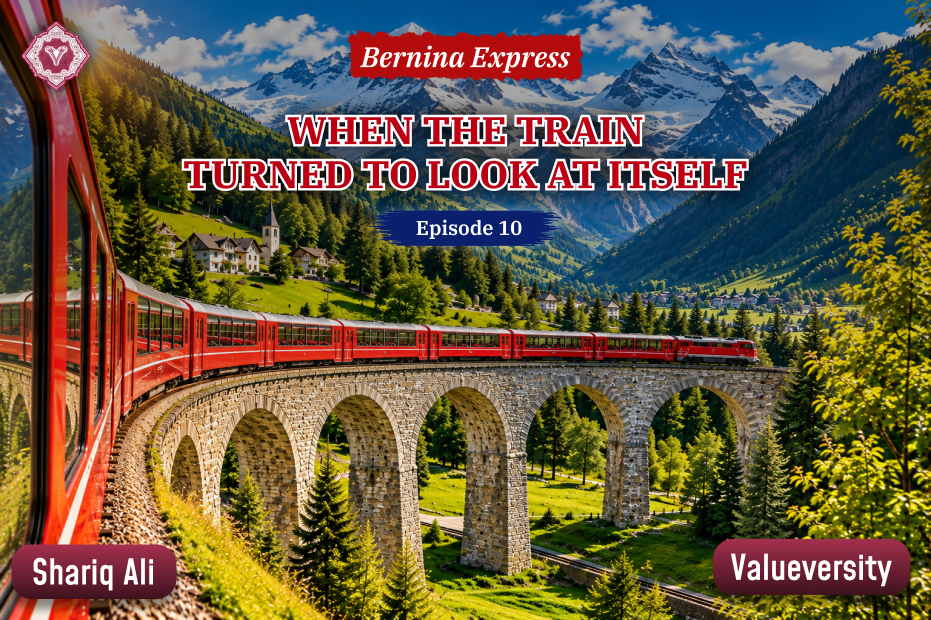
Episode 10: When the Train Turned to Look at Itself
Shariq Ali
Valueversity
The brief fifteen-minute stop seemed to pass in the blink of an eye.
After taking a few memorable photographs amid snow-covered mountains, cascading waterfalls, and green slopes, we boarded the Bernina Express once again. We returned to our seats, and before long, the red train was on the move again.
Outside the window, the enchanting landscape of the Alps came alive once more.
Green meadows, houses large and small scattered across mountain slopes, white streaks of melting snow here and there, and streams flowing through deep valleys.
On the Bernina Express, the journey somehow feels more important than the destination.
Then suddenly, we came upon a sight that drew every passenger towards the windows.
We had reached the Brusio Circular Viaduct.
Here, the railway line forms an astonishing circular curve. The train keeps turning until there comes a moment when, looking out of the window, you can actually see your own train curving around in front of you.
If you are sitting in one of the front carriages, the red coaches behind form a beautiful sweeping curve. If you are towards the rear, the coaches ahead can be seen bending around the viaduct, as though the train itself were turning back to look at itself.
A long line of red carriages, a green mountain landscape stretching in every direction, and a magnificent curve unfolding across a stone-arched viaduct.
For a moment, it seemed as though the train were not travelling at all, but that an artist had drawn a moving red line across the canvas of the mountains.
Behind this beauty lies an extraordinary piece of engineering ingenuity.
The famous Brusio viaduct was not built simply to create a spectacular view. The real challenge was to bring the train down a considerable difference in elevation within a relatively short distance. Had the railway descended directly, the gradient would have been too steep for safe operation.
The engineers devised an ingenious solution.
They made the railway line loop around in a large circle.
As the train curves around the stone-arched viaduct, it gradually descends. This increases the distance travelled while keeping the gradient within an acceptable range.
That is why, at one point, when you look out of the window, you can see the front or rear carriages of your own train forming a graceful curve before you.
Interestingly, the gradient here reaches around seven per cent, which is unusually steep for a conventional railway. Yet the Bernina line manages this demanding mountain terrain without the assistance of an additional cog or rack rail, relying instead on adhesion between its wheels and the tracks.
On one side is the natural splendour of the Alps; on the other, the ingenuity of engineering more than a century old.
For a few moments on the Brusio viaduct, the two come together in a single unforgettable scene.
Another remarkable feature of the Bernina line is that its roughly sixty-one-kilometre mountain route passes through dozens of bridges, viaducts, tunnels, and galleries. It is this extraordinary harmony between landscape and engineering that has earned the Albula and Bernina railway lines their place on UNESCO’s World Heritage List.
Brusio was soon behind us, and the train continued its steady descent.
The mountains themselves were beginning to change.
The vast expanses of snow were now far behind. The greenery grew deeper and richer, a southern softness could be felt in the climate, and the scenery beyond the window was gradually changing from the Swiss Alps into the atmosphere of northern Italy.
Then, somewhere along the way, we crossed a border without even realising it.
No soldiers.
No queue for passport control.
No barriers and no questioning.
Switzerland and Italy are both part of the Schengen Area, so routine border checks are not normally carried out along this route.
One country had quietly ended and another had begun, without the slightest interruption to the rhythm of our journey.
Eventually, the Bernina Express began to make its way into its final destination: Tirano.
We were now in Italy.
When the train stopped, we collected our belongings and stepped onto the platform.
The train we had just left belonged to Switzerland’s Rhaetian Railway, which has its own station and platforms in Tirano, even though geographically we were now firmly on Italian soil.
It was as though the Swiss railway had crossed the border simply to deliver us into Italy before saying goodbye.
The moment we stepped outside the station building, the atmosphere felt completely different.
Only a few hours earlier, we had been surrounded by the beautiful and prosperous Swiss setting of St. Moritz.
Since then, the white lake, snow-covered peaks, waterfalls, green valleys, and the astonishing Brusio viaduct had all passed before our eyes.
And now we stood at the threshold of an entirely different world.
Tirano.
A small town in northern Italy.
The language had changed.
The architecture had changed.
Even the atmosphere of the streets had changed.
Perhaps this is one of the most beautiful things about travel: sometimes, within just a few hours and a few footsteps, it can carry you from one world into another.
We stepped out of the station.
Our journey on the Bernina Express had come to an end.
But the story of Tirano had only just begun…
To be continued…