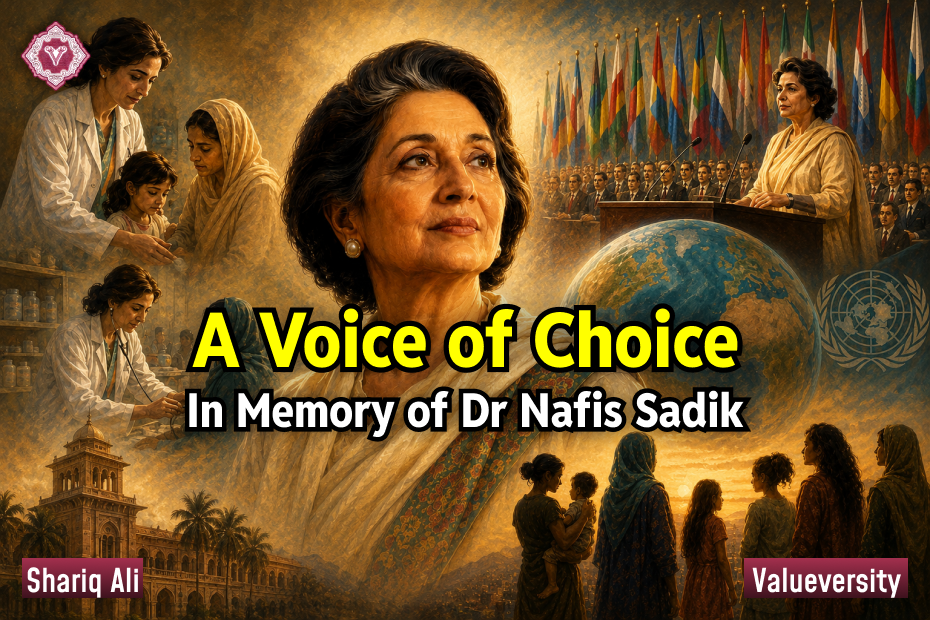
A Voice of Choice
In Memory of Dr Nafis Sadik
Shariq Ali
Valueversity
Pakistan in the 1950s.
A young woman doctor returns home after receiving advanced medical training abroad. She is intelligent, talented, and eager to serve her patients, yet she needs her husband’s permission to take up employment.
That young doctor was Nafis Sadik.
Time would complete a remarkable circle.
Nearly four decades later, the same woman stood in Cairo before representatives of 179 countries. The question was no longer whether she herself had permission to work. It was about the autonomy, health, dignity, and participation of women across the world in making decisions about their own lives.
Nafis Sadik was born on 18 August 1929 in Jaunpur. After the creation of Pakistan, her family moved to the newly established country. She studied medicine at Dow Medical College in Karachi and later received further training in maternal and child health in the United States.
When she returned to Pakistan in 1954, she began treating women and children in various military hospitals.
Perhaps this was the period when, before encountering statistics, she encountered human lives at close quarters.
Women struggling through the difficulties of pregnancy and childbirth. Children facing health problems. Families in which poverty, limited educational opportunities, and inadequate healthcare shaped the choices available to women.
A doctor can treat one patient at a time. But Nafis Sadik’s gaze was gradually rising towards a much larger landscape—one inhabited by millions of women.
In 1964, she became head of the Health Section of the Government of Pakistan’s Planning Commission. She later joined the Pakistan Central Family Planning Council and eventually became its Director-General.
But for her, the issue was never simply how many children a family should have.
The real questions were far more fundamental.
Where does a woman stand when decisions about her own life are made?
Does she have access to education?
Does she receive adequate healthcare?
Does she have a say in deciding when to have children and how many?
And above all, does she possess the autonomy to make choices about her own life as a complete human being?
In 1971, Nafis Sadik joined the United Nations Population Fund, UNFPA. Her ability and sustained dedication carried her steadily forward until, in 1987, she was appointed its Executive Director.
It was a historic moment.
She became the first woman to lead one of the United Nations’ major global programmes.
Yet perhaps the most significant scene of her life was still to come.
In September 1994, the International Conference on Population and Development was held in Cairo. Nafis Sadik served as Secretary-General of this landmark global conference.
This was no ordinary gathering.
Countries representing different religions, cultures, and political systems had come together around one table to discuss deeply sensitive issues: population, family, reproductive health, and women’s rights. Disagreements were intense. Religious and political groups strongly objected to several aspects of the proposed agenda.
Nafis Sadik faced an extraordinary challenge.
She had to persuade the world that population was not merely a matter of numbers.
At its centre was a human being.
And very often, that human being was a woman.
The Cairo Conference played an important role in changing the direction of global thinking. The focus began to shift away from numerical targets for reducing population growth and towards women’s health, education, human rights, gender equality, and their right to participate in decisions concerning their own lives and reproductive health.
Nafis Sadik’s vision can perhaps be captured in one simple sentence:
Healthy families are created by choice, not by chance.
This was an idea far broader than family planning.
It was about human dignity.
Nafis Sadik was not suggesting that family was unimportant. She herself was part of a family, was married, and was the mother of five children.
Her message was far more balanced.
A woman can be a mother, a spouse, a doctor, an intellectual, and a global leader.
The question is not which role she chooses.
The question is: who gets to make that choice?
Even after retiring from UNFPA in 2000, her journey did not end. She continued to serve as a Special Adviser to the United Nations Secretary-General and as Special Envoy for HIV/AIDS in Asia and the Pacific. In 2001, she received the United Nations Population Award.
On 14 August 2022, at the age of 92, Nafis Sadik passed away.
Looking back at her long journey, one can see a remarkable circle reaching completion.
A young Pakistani doctor who once needed permission to take up a job ultimately became a powerful global voice for women’s dignity and right to choose.
For me, there is also a personal connection to her story.
Nafis Sadik studied medicine at Dow Medical College in Karachi—the same institution where, many years later, I too had the privilege of studying medicine.
One medical college. Two different generations.
To see a graduate of my own college step beyond Pakistan and make such a profound contribution to humanity on the global stage is both a source of pride and a reminder for the generations that follow.
Graduating from a great institution is not, in itself, a great achievement.
The real question is how many lives we illuminate with the light we receive there.
Nafis Sadik spent her life trying to carry that light to women across the world.