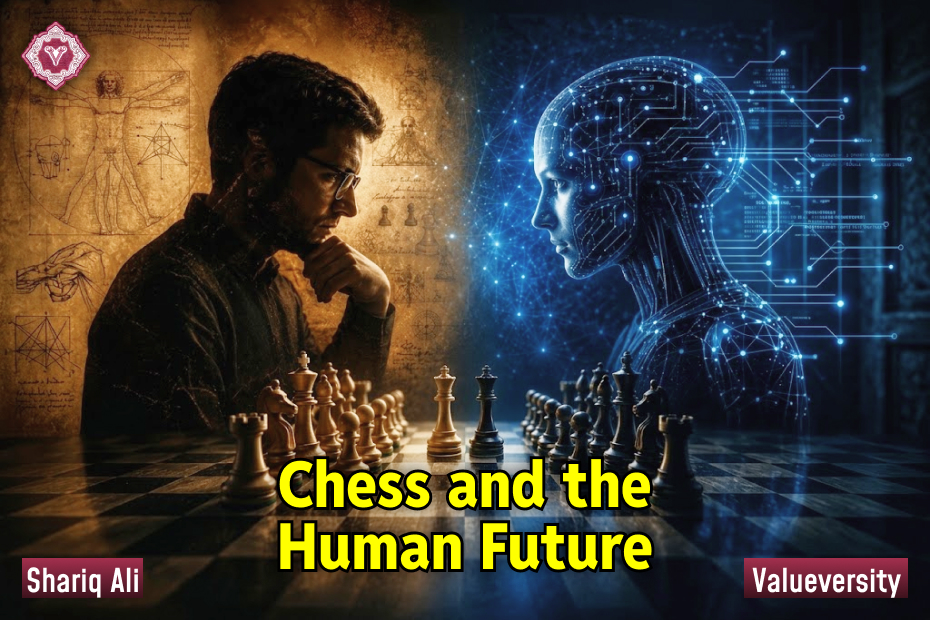
Chess and the Human Future
Shariq Ali
Valueversity
The chessboard was set, and all was silent.
Sixty-four squares. White and black pieces. Kings, queens, knights and pawns. The rules of the game were the same ones humanity has known for centuries.
This was no contest between two ordinary players.
On one side was Stockfish, one of the most powerful chess computer programs in the world.
On the other was AlphaZero, an artificial intelligence that had learned chess not by imitating human games, but by knowing its basic rules and playing countless games against itself over and over again.
On the surface, this was a contest of chess.
But on this small board, one could glimpse something of humanity’s future.
Two different forms of intelligence.
The traditional chess engine, Stockfish, analysed possible moves through human-designed algorithms, evaluation methods and extremely fast search.
It would not be accurate to say that Stockfish simply contained the moves of all the world’s grandmasters. The reality is far more interesting.
Human engineering and human understanding of chess played an important role in its underlying architecture, algorithms and methods for evaluating chess positions.
AlphaZero took a different path.
It knew the basic rules of the game. Then, through self-play, it played countless games against itself and developed its own strategy. It had not been trained in the conventional way on games played by human grandmasters.
Thus, on one side stood an extraordinarily powerful, human-made chess engine.
On the other was a self-learning system that was, to a large extent, discovering for itself how to understand chess.
The results were astonishing.
AlphaZero did not merely win.
Its style of play surprised chess experts.
It independently discovered some of the same strategic concepts that humans had reached after centuries of chess experience: king safety, pawn structure, the importance of position, and certain ideas about sacrifice.
At the same time, it adopted some unconventional strategies that felt distinctly different from the familiar style of computer chess.
In a later, more extensive evaluation,
AlphaZero played one thousand games against Stockfish, winning 155, losing only 6, while the remaining games were drawn.
But the real point here is not 155 and 6.
The real question is one of logic.
AlphaZero did not need to approach the problem from the same perspective through which humans had viewed it for centuries.
Its objective was clear:
Win the game.
It had to find the path for itself.
There is a quiet limitation inherent in human knowledge: we generally think about new things on the foundations of what came before.
A teacher passes on to a student the knowledge received from a teacher before him.
A scientist advances from previous research.
A doctor combines clinical experience with knowledge accumulated by thousands of other doctors and scientists.
This is our great strength.
Every generation does not have to begin from zero.
But perhaps this very strength can sometimes become an invisible limitation.
We usually search for new paths somewhere near the paths humans have already travelled.
Some newer artificial intelligence systems create a different possibility.
They can be told:
Here is the problem. These are the constraints. This is the desired outcome. Now find a way.
And it is entirely possible that they may discover a path beyond our present intuition.
For a moment, think beyond the world of chess.
Chess itself is unimportant.
The real question is: what happens if the same principle is applied to a far more important human problem?
What if artificial intelligence is told:
Here is a disease. Find a treatment.
Here is an energy problem. Find a more efficient solution.
Here is the climate system. Find a path that works better than our existing models.
Here is a complex scientific or mathematical problem. Find its solution.
Then perhaps the machine would do more than simply increase the speed at which work is done.
It might take a direction different from the way we think.
And here, a difficult question arises.
If artificial intelligence arrives at a conclusion that is correct, but the full logic by which it reached that conclusion is not easily understandable to humans, what should we do?
Should we accept it?
Can we trust a decision simply because its results repeatedly prove correct?
And what if that decision concerns not a chess piece, but a human life, a medicine, an economy or a society?
At that point, the question of artificial intelligence is no longer merely a question of intelligence.
It becomes a question of human responsibility.
Perhaps, in the future, humanity’s most important task will not be to find the answer to every problem ourselves.
Perhaps our real task will be to decide what the question should be, what the boundaries should be, what the objective should be, and when we should trust the answer given by a machine.
On this small chessboard, a much larger game may already have begun.
Who knows whether the final move in this game will be made by a human or by a machine?
Perhaps the real question is this:
When a machine sees a move that we cannot see, will we be ready to understand it, evaluate it, and use it responsibly?