The Seeds of Morality
Shariq Ali
Valueversity
We often think of morality as a uniquely human achievement. Yet modern biology invites us to ask a remarkable question: were the first seeds of morality sown long before the appearance of our own species, deep within the evolutionary history of animal life?
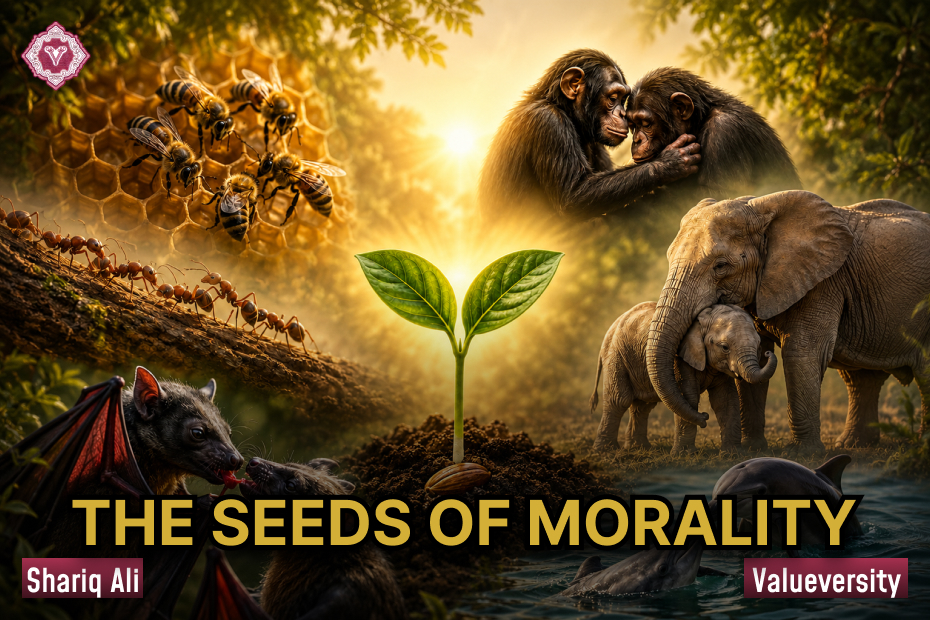
In the colonies of honeybees and ants, countless workers devote their entire lives to the welfare of the community. They never reproduce, instead sacrificing their own reproductive potential for the survival of the colony. This is not a conscious moral decision but an evolutionary adaptation.
Nevertheless, it offers a striking glimpse of the biological origins of selflessness.
Among our closest relatives, chimpanzees and bonobos, the picture becomes even more compelling.
They comfort distressed companions, console the injured, share food, and seek reconciliation after conflict. Elephants help raise orphaned calves, dolphins support wounded companions at the water’s surface so they can breathe, and vampire bats regurgitate blood to feed hungry members of their group. Across the animal kingdom, such behaviours reveal the evolutionary roots of empathy, cooperation, and mutual trust.
Animals, of course, do not ponder questions of right and wrong or construct ethical philosophies.
Their behaviour has been shaped by natural selection over millions of years rather than by conscious moral reflection. Yet these ancient behavioural patterns provided the raw material from which human morality eventually emerged. With the evolution of consciousness, language, reason, culture, and law, these inherited tendencies were transformed into ethical principles and moral values.
Morality, then, may not be a concept that appeared suddenly or descended fully formed from above. Rather, it is the flowering of seeds planted by evolution over immense stretches of time. Humanity did not invent morality from nothing; it cultivated nature’s earliest impulses into the enduring ideals of justice, compassion, cooperation, and responsibility that define our civilization.