Who Is an Intellectual?
Shariq Ali
Valueversity
I was perhaps in my final year of school, or my first year of college. Around that time, I made friends who shared my appetite for reading beyond the prescribed textbooks.
The Islamic Centre and the Sadat-e-Amroha Centre in our neighbourhood often hosted literary and intellectual gatherings. A scholar would be invited to speak, and I began attending with my friends. It was there that I first heard Professor Syed Karrar Hussain. I loved his gentle, eloquent manner. There was such courtesy in the way he explained things that one wanted to keep listening.
Had someone asked me then what an intellectual was, his face would probably have come to mind.
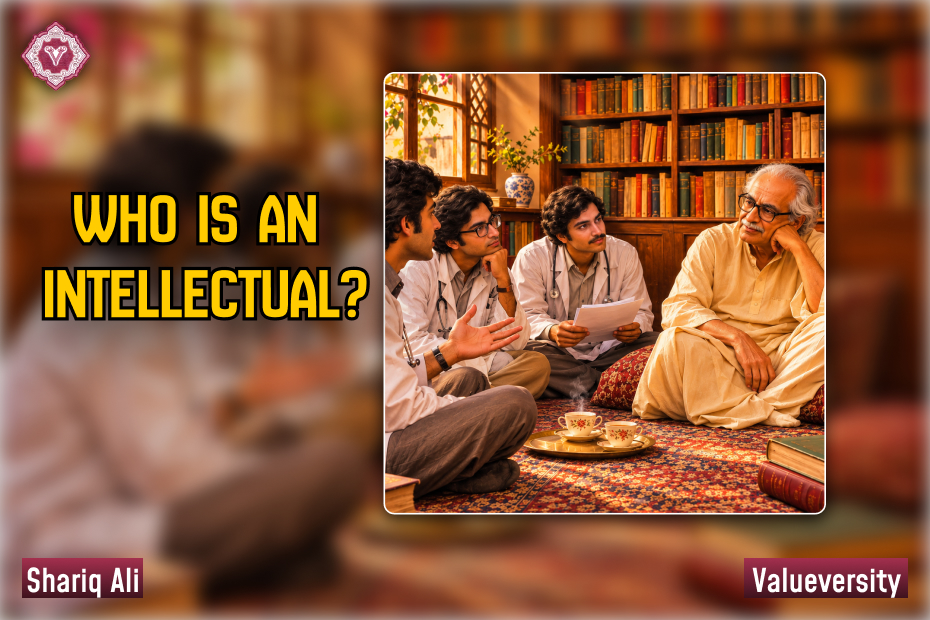
Later, at Dow Medical College, we began taking part in literary and social activities alongside our studies. A few of us decided to organise a seminar on “Women’s Freedom in a Patriarchal Society.” As part of the preparations, three of us from the student organising committee visited Professor Karrar Hussain at his home.
I still remember that meeting in his library. There was a seating area on a carpet, surrounded by shelves filled with books. We sat down beside him. With the books behind him, we laid out the details of our proposed programme.
His son-in-law, Ghazi Salahuddin, was also present. In those days, he wrote the “Karachi Diary” column for Dawn. For us students, this was a special and memorable occasion. A scholar we had previously listened to from a distance at public gatherings was now sitting with us, helping us finalise a programme. The meeting was brief, but it found a lasting home in my memory.
Sadly, the seminar never took place.
A reactionary student organisation at the college threatened us: “If this programme goes ahead, we will break your legs.”
Frightened, we backed down.
When I recall the incident today, I remember how helpless we felt. We wanted to discuss women’s freedom, yet could not summon the courage to exercise our own freedom to speak. In Karrar Sahib’s library, reason had carried the conversation forward. At college, a threat had brought it to a halt.
At the time, my idea of an intellectual was largely associated with literature and social debate. Later, I came to Britain for further education and training, and had opportunities to travel to other countries. I listened to people from different fields, read books, and visited libraries, museums and centres of learning. Gradually, the word acquired a broader meaning for me.
Today, I think of an intellectual as someone who understands their field deeply and can explain it in ways that help ordinary people make better sense of the questions arising in their own minds. Some questions may find answers; others may become easier to frame. Where the answer is unknown, acknowledging that uncertainty is also part of such wisdom.
A historian shows us that a custom we imagine has always existed arose under particular circumstances. This opens up room to understand a social arrangement and consider the possibility of changing it. Understanding the past helps us make decisions in the present.
A novelist allows us to spend a little time inside someone else’s life. Reading about a woman, a labourer or a homeless person, we come to understand their constraints and desires. Someone we once judged readily may give us pause once we know their story. That pause, too, is valuable to society.
An astronomer explains that light from a distant star takes years to reach us. When we look at the sky, we are looking into the past. This knowledge changes our sense of our place in the universe, awakens curiosity and invites us to think beyond our limited experience.
An economist can explain why the same rate of inflation affects two households differently. A doctor can help people make better decisions by explaining the evidence behind illness and treatment. Such understanding influences everyday life, collective priorities and public policy.
I no longer feel the need to divide intellectuals into a fixed number of categories. Perhaps the measure is how much someone’s knowledge deepens the understanding of others, and how closely it encourages them to examine their world.
The memory of Karrar Hussain’s library remains part of this idea. There was a deep wisdom, too, in listening to three students seated before his books and making time for their question. Perhaps that is why, after so many years, that brief meeting is still with me.