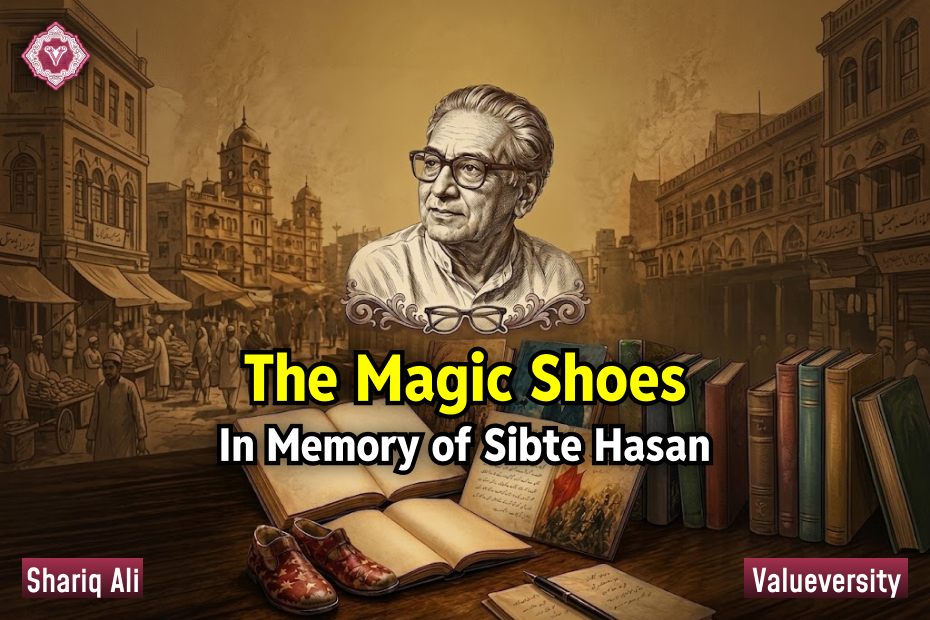
The Magic Shoes
In Memory of Sibte Hasan
Shariq Ali
Valueversity
Karachi’s Saddar was somewhat different in those days from what it is today.
Instead of multiplex cinemas and sprawling shopping malls, there were small shops, stalls selling everyday goods, lively pavements—and, among them, a few distinguished bookshops.
I must have been about ten or eleven years old. I had gone shopping in Saddar with my elder brother.
Once we had finished our usual shopping, we made our way to the Friendship House bookstall, which was located in Saddar in those days.
Behind the counter sat a gentleman in simple but neat clothes. The moment my brother saw him, he stepped forward respectfully, shook his hand warmly, and said to me:
“Say hello. This is Mr Sibte Hasan.”
The name meant nothing to me. I greeted him and remained silent.
Little did I know that the unassuming man sitting before me was one of Urdu’s important intellectuals—someone who had devoted himself to explaining complex questions of history, civilisation, and society in a language accessible to the ordinary reader.
Sibte Hasan was an important figure in the progressive intellectual tradition, as well as a journalist and writer. He had passed through the scholarly environment of Aligarh, became associated with the Progressive Writers’ Movement, and spent much of his life reading, researching, and writing.
But that day, I knew none of this.
My elder brother had received training in Moscow and was a member of Friendship House. For a while, the two of them remained absorbed in conversation.
Then Sibte Hasan turned towards me.
After exchanging a few words, he rose from his chair and took me over to the bookshelves.
Perhaps he understood that, rather than a lesson in history or philosophy, a story would be a more appropriate gift for a child.
He took a children’s book from the shelf. Its title was:
The Magic Shoes
It was an Urdu translation of a story by a Russian writer.
A child puts on a pair of magical shoes and travels to different countries, discovering new things about their people, places, and ways of life.
Sibte Hasan gave me the book as a gift.
I read it two or three times with great interest and treasured it for many years.
Looking back now, I see a curious significance in that small incident.
In a way, Sibte Hasan gave the same gift to his readers.
Magic shoes.
Books that allow the mind to travel across centuries.
Mazi Ke Mazar takes us deep into the layers of ancient civilisations, beliefs, and human societies.
Musa Se Marx Tak attempts to trace the long historical journey of social thought, while Pakistan Mein Tehzeeb Ka Irtiqa views the identity of this region not merely through a few decades of political history, but through thousands of years of civilisational continuity.
Naveed-e-Fikr, Adab aur Roshan Khayali, Marx aur Mashriq, and his other writings explore different subjects, yet behind them all one can sense a common desire:
The desire to understand human beings and society through the mirror of history.
One does not have to agree with Sibte Hasan’s intellectual interpretations.
Indeed, any serious thinker should be read not with unquestioning reverence, but with a mind prepared to ask questions.
Yet one of his major contributions is difficult to deny.
He showed the ordinary Urdu reader that history is not merely the story of kings, wars, and empires. Behind it lie economics, labour, beliefs, relationships of power, the evolution of civilisation—and, above all, the lives of ordinary people, with their hopes, desires, and aspirations.
His gift was to bring knowledge out of the exclusive circles of the intellectual elite and place it within the reach of the ordinary reader.
Sibte Hasan died in Delhi on 20 April 1986. His physical journey came to an end, but the journey of his books continues.
Several decades have now passed since that brief encounter of my childhood.
I no longer remember the details of Sibte Hasan’s face.
Nor do I remember what my elder brother and he discussed that day.
But one scene remains preserved in my memory.
An unassuming elderly man rises from his chair.
He takes a child to a bookshelf.
He picks out a book.
And places it in the child’s hands.
The Magic Shoes.
For Sibte Hasan, it may have been an insignificant moment. Perhaps he had forgotten it by the very next day.
But that child kept the book safe for many years, and the memory of it remains with him even today.
Some encounters acquire their importance not from how long they last, but from the impression they leave behind.
I do not know where my copy of The Magic Shoes is now.
The book has been lost, but the journey continues.
And sometimes, the person who gave us the book is long gone—but the habit of asking questions remains.