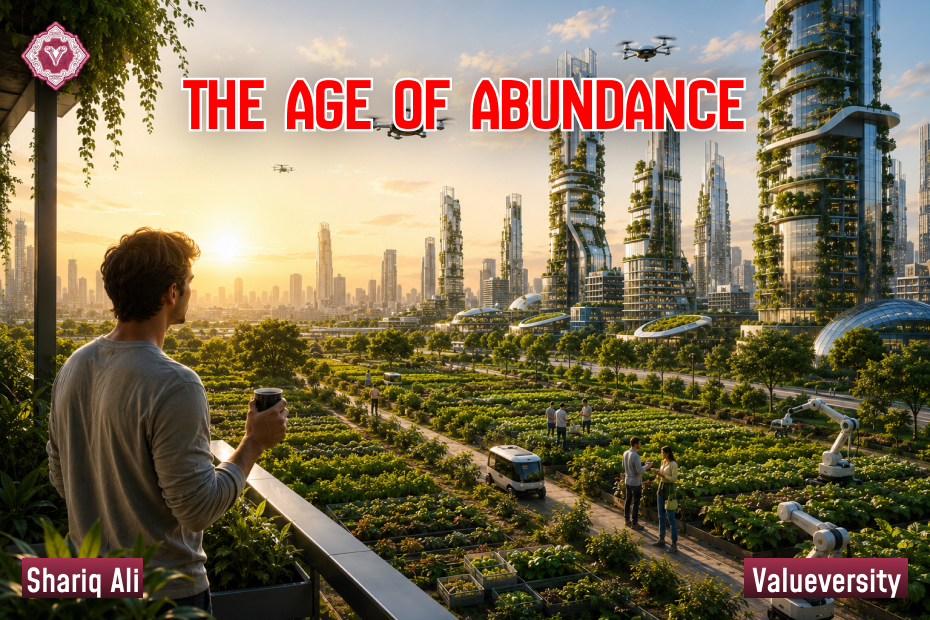
The Age of Abundance
Shariq Ali
Valueversity
One morning in 2035.
Dr Haris opens his eyes. At the slightest movement of his eyelids, the curtains in his room have already drawn themselves open. Outside, the gentle September sunlight spreads across the city. The city is awake, but the old sense of urgency is nowhere to be found in Haris’s morning.
The clock says eight, but no alarm has gone off. Dr Haris no longer needs one.
He does not have to go to the hospital.
A few years ago, he worked in an extremely busy department of a busy hospital.
Waking early to an alarm, getting ready in a rush, making his way through heavy traffic, seeing patients, making decisions, sometimes saving a life, and finally returning home late at night, exhausted—this was the routine of his life.
Then came the artificial intelligence revolution, and change spread first gradually, and then with astonishing speed.
At first, AI began assisting doctors with diagnosis. Then it took over the interpretation of scans and blood tests. After that, robotic systems began performing many medical procedures. By 2035, humans are still present in hospitals, but they are needed far less often.
Most routine medicine is managed by automated systems, while human doctors become involved only in complex or unusual cases.
Haris now spends a few hours each week volunteering at a community centre.
He has little need for money.
Every citizen now receives a basic income from the government. Food and healthcare are almost free. Automated farms and factories have drastically reduced the cost of food and everyday goods. Electricity is cheap, and driverless transport is available around the clock.
Dr Haris gets out of bed, makes himself a coffee, and sits by the window.
Once again, there is nowhere he has to be today.
And that is precisely his problem.
He wonders:
What should I do today?
This may sound like nothing more than an imaginary scene, but the question behind it is no longer entirely imaginary.
The speed at which artificial intelligence, robotics, and automation are advancing has given rise to the vision of a future that some call the Age of Abundance.
If machines can manage farms, run factories, drive vehicles, construct buildings, handle accounts, and perform much of our intellectual and creative work, then one of the fundamental questions of human history may change:
Why should every human being still need to work simply to stay alive?
The dream itself is very old.
For thousands of years, human beings have spent much of their lives securing food, shelter, and safety.
The Industrial Revolution multiplied the power of the human body through machines. Computers accelerated the work of the human mind. Artificial intelligence and robotics may now represent the next step in that journey.
But here, another enormous question stands in our way:
If machines create an abundance of wealth, who will own it? The owners of the machines—or ordinary people?
This may be the most important question of the AI revolution.
Imagine a factory that once employed ten thousand people. Now the same factory, operated by a handful of engineers and thousands of robots, produces ten times as much as before.
Society has undoubtedly become wealthier.
But have those ten thousand former workers become wealthier too?
Not necessarily.
If robots, algorithms, data centres, and automated factories are owned by a small number of giant corporations and extremely wealthy individuals, a strange kind of world may emerge.
Production may be limitless, while prosperity remains restricted.
It will be an Age of Abundance—but not for everyone.
Creating abundance may be a technological problem; distributing it is a human one.
Throughout human history, one major cause of poverty has been our inability to produce enough for everyone.
The tragedy of the future could be far stranger:
We may have enough for everyone, and yet everyone may still not have enough.
At this point, the question of AI ceases to be merely technological. It becomes a question of politics, economics, and ethics.
Perhaps in the future, Universal Basic Income, social dividends, universal healthcare and education, or some other mechanism will allow the wealth generated by an automated economy to reach ordinary people.
If that happens, then perhaps for the first time, millions of human beings will have the freedom not to spend most of their lives simply earning a living.
But then another problem will emerge—perhaps an even deeper one.
The same problem confronting Dr Haris on this morning in 2035.
If I no longer need to work, what am I supposed to do?
Work is more than a salary.
Work gives structure to our lives. It organises our days. It gives us a reason to get up in the morning. It connects us with other human beings. It gives us the feeling that someone needs us.
And perhaps most importantly, work becomes part of our identity.
When we meet a stranger, after a few questions we often ask:
“What do you do?”
The answer comes:
I am a doctor.
I am a teacher.
I am an engineer.
I am a shopkeeper.
The question asks what we do, but our answer tells others who we are.
For centuries, our profession has been the shortest introduction to our identity.
If one day technology removes the need for our “doing”, what will become of the meaning of our “being”?
This is where the economic question of the Age of Abundance becomes a philosophical one.
Perhaps human beings will have to learn again that the purpose of life is not merely to be productive. Raising a child, sitting with ageing parents, reading a book, learning music, growing a garden, helping a friend, conducting research, painting a picture, travelling, teaching a young person, or simply sitting quietly and contemplating the universe can all be meaningful forms of human activity.
Perhaps, in the future, the word “work” itself will change its meaning.
There will be one kind of work that human beings do to earn their bread.
And another that they do because it makes life feel meaningful.
But on the road towards this beautiful future—this Age of Abundance—my question remains the same:
Abundance for whom?
If the wealth created by artificial intelligence and robots becomes concentrated in a few hands, ordinary people will not gain leisure; they will gain unemployment. They will not gain the freedom to search for purpose; they will remain preoccupied with survival.
But if ordinary people are given a share in the wealth created by an automated economy, human civilisation may enter an entirely new phase.
For the first time, the question may no longer be:
“What work must I do in order to survive?”
But instead:
“What purpose should I devote my life to?”
Outside the window, the sunlight has grown brighter.
Dr Haris finishes his coffee and prepares to leave the house.
No hospital rota has called him in today.
No clinical director has assigned him a new responsibility.
Nor does he need to go anywhere to earn money.
He is going to the community clinic because he chooses to.
A few elderly people are waiting for him there.
AI may be able to diagnose illness better than Haris can, but among them is an old man who needs something more than a diagnosis. He needs the presence of another human being—someone who will sit across from him for a few moments, listen to what he has to say, and remind him that he is more than a clinical case.
Dr Haris smiles to himself.
Perhaps he has found a small answer to his question.
Machines may take over much of the work human beings once had to do.
But perhaps the work of being human will still remain ours.