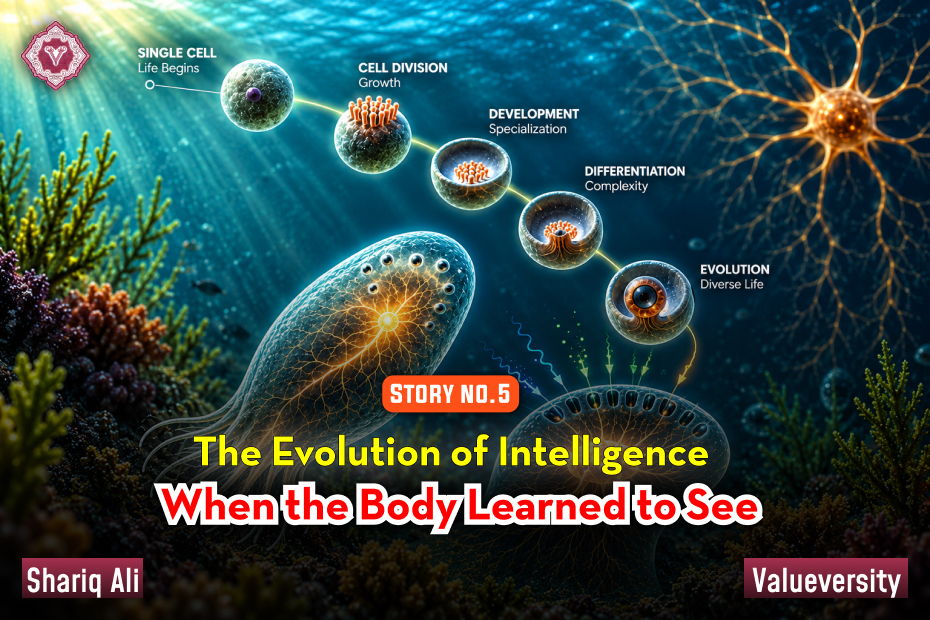
The Evolution of Intelligence
Story No. 5: When the Body Learned to See
Shariq Ali
Valueversity
In the previous episode, we saw how evolution created the first neural center to organize nerve cells. For the first time, the body had something like a “control room.”
But a new problem emerged.
The control room existed, but where would it get its information?
Imagine a city with an excellent mayor and a modern administrative office, yet no one knows what is happening in the city. There are no reporters, no cameras, and no messengers.
In such a situation, even the best administration would be ineffective.
Early living organisms faced a similar challenge.
By this stage, life in the oceans had become more complex.
Predators were beginning to appear, and so were prey animals. Simply being able to move was no longer enough.
To survive, organisms needed a more accurate way to sense their surroundings.
Evolution responded with a remarkable innovation.
Some cells became sensitive to light.
At first, these were not eyes.
They were merely cells capable of detecting the difference between light and darkness. Yet even this simple ability could mean the difference between life and death.
Over time, these light-sensitive cells formed small pits that allowed organisms to determine the direction from which light was coming.
Other cells became capable of detecting chemical substances dissolved in water. Some evolved to monitor balance and movement.
For the first time, living creatures were not merely reacting to stimuli. They were sending an early “picture” of the outside world to their neural centers.
This was the moment when the foundations of the primitive brain began to emerge.
Nature was, in a sense, building a computer that not only received signals but also started combining information from different sources to make better decisions.
And that brings us to the next chapter
When the primitive brain began combining different streams of information to create a map of the world.