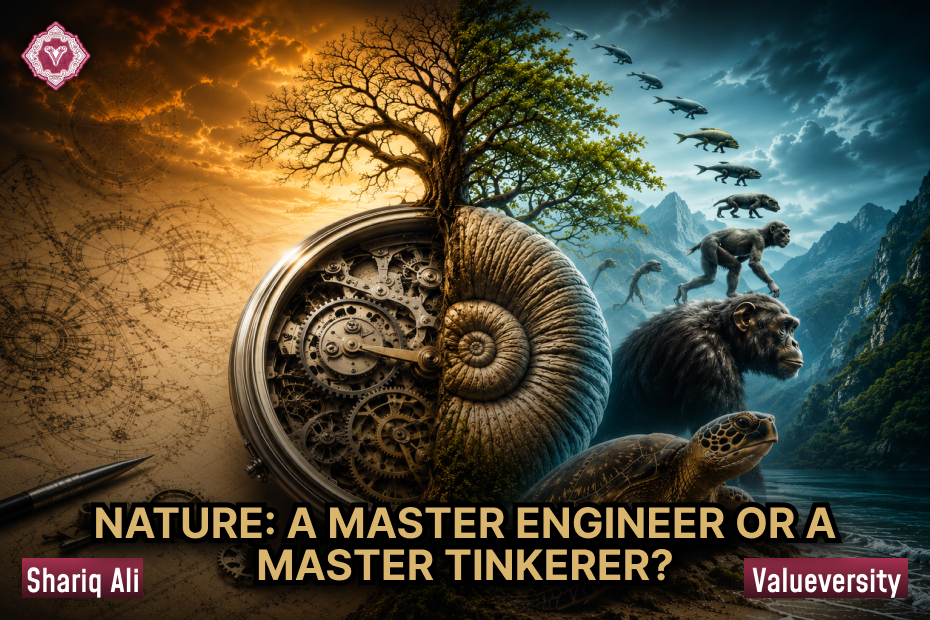
Nature: A Master Engineer or a Master Tinkerer?
Shariq Ali
Valueversity
Imagine you are walking through a forest when you suddenly come across a watch that keeps perfect time.
Your immediate conclusion would be that it was carefully designed and built by a skilled engineer. It would never occur to you that the watch had somehow grown on a tree by chance.
For centuries, this same line of reasoning was used to explain the astonishing complexity of living organisms and the universe. Such an orderly, balanced, and intricate system, it was argued, must be the work of a perfect designer.
Evolutionary biology, however, presents a very different picture.
According to evolutionary theory, nature rarely starts from scratch. Instead, it builds upon structures that already exist, making small modifications, adapting them to new circumstances, and, over millions of years, giving rise to new forms of life. Each generation inherits the biological legacy of its ancestors and advances through only minor alterations and refinements.
In this sense, nature resembles not an engineer who designs every solution from the ground up, but an extraordinary tinkerer who solves new problems by reshaping and repurposing existing parts rather than inventing entirely new ones.
The sea turtle provides a beautiful illustration.
Its broad, powerful flippers are superbly adapted for swimming through the oceans. Yet those very same flippers become remarkably inefficient when the female crawls onto the shore and digs a nest in the sand for her eggs. The task is slow, laborious, and awkward.
If every organism had been designed from the beginning for each specific purpose, one might expect separate, highly specialized structures for swimming in the sea and nesting on land. Evolution, however, does not work that way. It always works with the material already available.
The human body tells the same story.
During embryonic development, the testes initially form near the kidneys before descending into the scrotum, where the temperature is a few degrees lower than the body’s core—a requirement for healthy sperm production. This solution serves its purpose well, but it also leaves behind a relatively weak area in the abdominal wall, making inguinal hernias possible later in life.
Evolution solved one problem, but at the cost of creating another vulnerability. It appears less like the product of perfect planning and more like an ingenious compromise built upon an inherited design.
Examples like these are found throughout biology.
They remind us that evolution does not strive for absolute perfection. Instead, it produces solutions that are sufficiently effective for survival and reproduction. Evolution always builds the future upon the foundations of the past; it cannot discard its inheritance and begin anew.
That is why nature often resembles not an engineer who redesigns every component from scratch, but a brilliant craftsman who achieves astonishing results despite working with limited materials.
Perhaps that is why living organisms are, at the same time, extraordinarily effective and unmistakably imperfect.
And perhaps nature’s greatest miracle lies precisely here: it does not begin with perfection, but with imperfection. It transforms inherited flaws into opportunities, builds beauty upon incomplete foundations, creates ever greater complexity, and enables life to continually adapt to new challenges.
That is the true masterpiece of evolution.