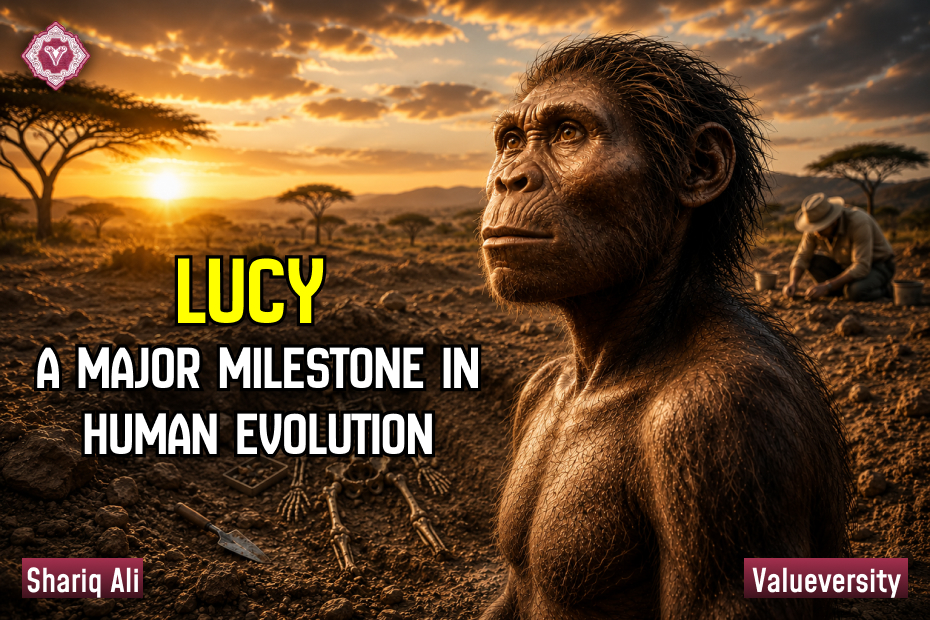
Lucy:
A Major Milestone in Human Evolution
Shariq Ali
Valueversity
It was a hot afternoon in 1974.
In the dry and desolate region of Hadar, Ethiopia, a group of scientists were quietly searching the ground for bones. Dust swirled in the air, the sun burned fiercely overhead, and the rocky landscape around them seemed completely silent.
Suddenly, the eyes of the American paleoanthropologist Donald Johanson fell upon a small bone lying on the ground.
First, they found one fragment…
Then another…
Then a third…
Soon, the team realized this was no ordinary discovery.
It was the skeleton of a creature that had lived millions of years ago.
Over the next few hours, they uncovered many more parts of the body — arms, ribs, legs, spine, jaw. Remarkably, all of them belonged to the same individual.
At that time, it became one of the most complete ancient hominin skeletons ever discovered in the history of human evolution.
That night, the camp felt almost festive.
A tape recorder kept playing the song Lucy in the Sky with Diamonds again and again.
At some point, someone said:
“Why don’t we call her Lucy?”
And that is how this ancient being came to be known as “Lucy.”
Then began the journey of an astonishing discovery.
When scientists studied her body, they found that she had lived around 3.2 million years ago. Her brain was still small — about the size of a chimpanzee’s.
She was not an intelligent being like modern humans.
But a revolutionary change had already taken place in her body.
She walked upright.
The structure of her legs, hips, and spine clearly showed that in human evolution, walking on two legs had begun long before the human brain became large.
This discovery was both a shock to science and the opening of an entirely new window.
Scientists now began to view human evolution differently.
It was as if time itself had started turning backward…
Imagine Africa 3.2 million years ago.
Forests were shrinking.
The climate was becoming drier.
The world of dense trees was breaking apart, replaced by vast grasslands and open savannas.
Lucy was a creature of these changing lands and climates.
She was neither fully human nor fully ape.
She stood barely three and a half feet tall.
She lived in small groups, searched for food, avoided danger, and travelled long distances across the African plains.
Perhaps it was this new world that forced her to stand upright.
Walking on two legs allowed her to see farther into the distance. Her hands became free. She could travel farther while using less energy.
Yet the old world still lived within her.
Her arms and fingers were still suited for climbing trees.
And perhaps one day, that very habit became both her final refuge and her tragic end.
According to scientists,
Lucy’s skeleton showed signs of severe fractures. Modern research suggests that she may have fallen from a great height — most likely from a tree. Her arms, shoulders, ribs, and legs were badly damaged.
Perhaps she had climbed the tree to escape a predator.
Perhaps she had fallen asleep there.
Perhaps her grip simply slipped.
And then…
She fell nearly twelve meters to the ground below.
In a single moment, her life came to an end.
But her story did not.
Millions of years later, the same silent earth returned her bones to humanity — so that we could look upon an ancient image of ourselves.
Lucy taught us that the journey of becoming human was not merely the story of a growing brain.
It was first the story of walking, step by step, on two feet.
That moment…
When a small creature stood upright for the first time, and slowly began walking toward the future human race.