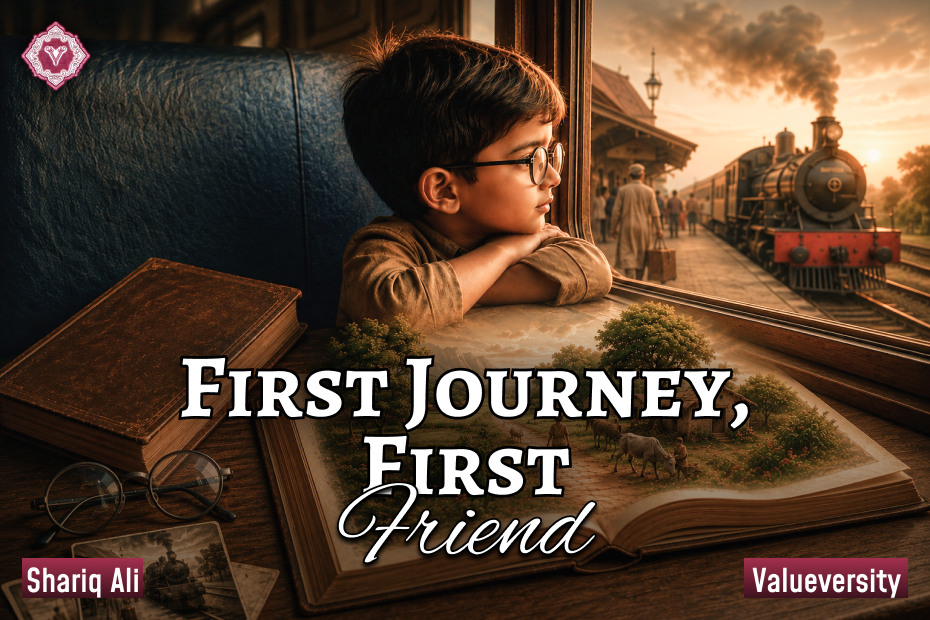
First Journey, First Friend
Dr. Shariq Ali
Valueversity
It must have been sometime between the late afternoon and evening prayers.
The whistle of a steam locomotive echoed across the small railway station of Mirpur Khas.
Holding tightly to the hands of his father and elder brother, a four-year-old boy stepped aboard the train from the platform.
It was the first train journey of his life.
His first journey without his mother.
She had stayed behind at home, while his other brothers and sisters were still at school and could not accompany him.
In the little boy’s eyes, there was less sorrow at the separation and far more wonder.
The black engine billowing clouds of smoke, the piercing whistle, the rhythmic clatter of the rails, the voices of travelers, and the bustle of the platform all seemed part of a magical new world.
As the train slowly pulled away, he sat quietly by the window, watching the ever-changing landscape.
Once the fascination of trees and fields racing past had begun to fade, the same question returned to his mind:
“What is wrong with me?”
There was a story behind that question.
His nursery teacher had noticed that he held books unusually close to his eyes while reading. She informed his parents.
The doctor at the railway dispensary examined him and even tried treating the problem by covering one eye with a patch.
When there was no improvement, the local doctor wrote a referral letter to one of his former teachers in Karachi and advised the family to take the boy there.
This journey was part of that search for answers.
Late that night, the train arrived in Karachi.
From the railway station they climbed into a horse-drawn carriage.
The bright lights, noise, and vastness of the big city were unlike anything the little boy from a small town had ever experienced.
They spent the night at his uncle’s home.
The following day, they visited the clinic of one of the city’s renowned ophthalmologists.
The doctor welcomed the child with a warm smile and seated him comfortably.
He chatted gently to put him at ease.
But when eye drops were instilled, the boy burst into tears as they stung sharply.
His vision became blurred, and the doctor’s face suddenly appeared much larger than before.
After a thorough examination, the doctor turned to his father.
“The eye itself is perfectly normal,” he said. “However, the vision in one eye is weaker than the other. Some children are born this way. Fortunately, his other eye is completely normal.”
The worry on his father’s face was unmistakable.
Almost instinctively, he pleaded,
“Doctor, if an operation is necessary, please do it. I only want my son’s eye to be cured.”
The moment the little boy heard the word operation, his heart began to pound.
A wave of fear swept through his tiny mind.
The doctor smiled reassuringly.
“No,” he said gently. “This condition cannot be treated with surgery. He simply needs to wear glasses, and he can live a completely normal life. It is called a lazy eye.”
On their way back from the clinic, noticing the boy’s gloomy face, his father stopped at a hotel and bought him an ice cream to cheer him up.
Pistachio ice cream topped with soft, shimmering dark-green jelly, a taste and memory that would remain with him for years.
A few days later, the boy returned to Mirpur Khas wearing his new glasses.
The plastic spectacles resting on his nose became the object of curiosity—and amusement—not only for his classmates but for the entire school.
New nicknames quickly appeared: “Blind boy,” “Four Eyes,” and “Specs.”
Some children borrowed the glasses for a few moments to see what the world looked like through them.
Others were satisfied simply touching them.
Many laughed.
By then, the boy had become convinced that there really was something wrong with him.
He was different from everyone else.
That same year, an agricultural exhibition was held at Gamma Stadium in Mirpur Khas.
There were exciting horse and bull races, a livestock fair, and rows of colorful stalls.
Among them stood a small bookstall.
There, the boy’s eyes fell upon a book with a beautifully illustrated cover.
Its title was Abdal’s Village.
It was love at first sight.
He persuaded his mother to buy it for him.
It became the very first book he could truly call his own.
He had not yet learned to read fluently.
He would study each illustration, slowly sound out the words, and piece the sentences together.
Alongside Abdul, he wandered through village lanes, fields, and the simple rhythms of rural life, losing himself completely in that world.
That day, he found the most faithful friend of his life.
Books.
From then on, the two companions would walk hand in hand through the rest of life’s journey.
Nature had limited the vision of one of his eyes.
But in doing so, it had also opened the door to an entirely different world.
The world of books…
A world where perfect eyesight is not the price of admission.
Curiosity is.
To be continued…