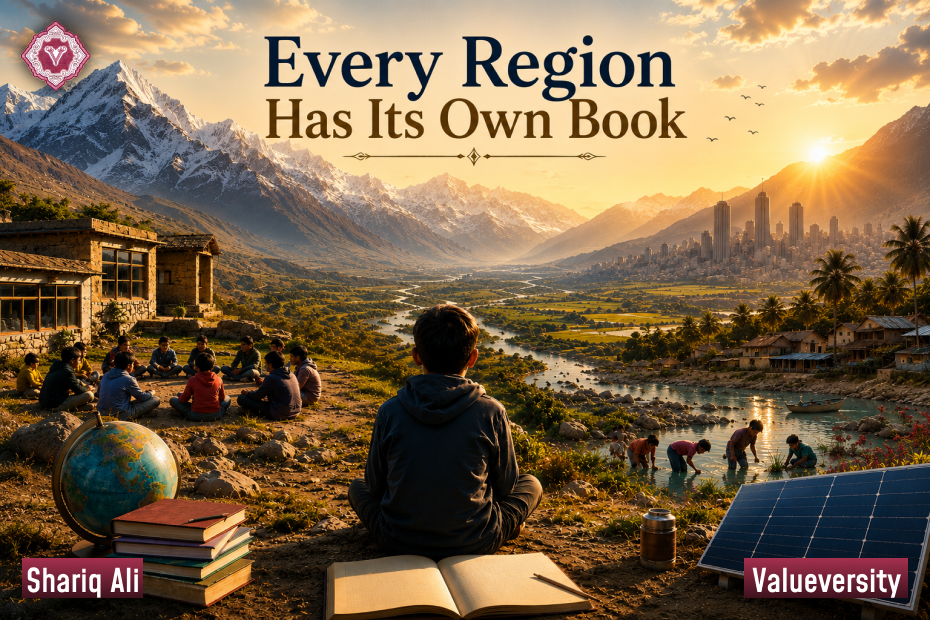
Every Region Has Its Own Book
The Fourth and Final Story
Shariq Ali
Valueversity
SECMOL (Sonam Wangchuk’s educational institute, Ladakh)
It was my last day here.
I stood on the edge of a hill, looking down at the valley spread out below.
The morning sunlight was slowly descending onto the snow-covered peaks. The air was cold, yet it no longer felt unfamiliar to me. Ladakh had taught me its language.
I could now tell the time by the movement of the sun. By the colour of the snow, I could judge when a trail would soften. Even a thin stream of water could tell me where it should be stopped and where it should be allowed to flow freely.
None of this was written in any textbook.
Yet it was education.
Sonam Wangchuk came and stood beside me. For a while, we silently looked across the valley together.
Then he said,
“Stanzin, if this school were beside the sea, it would probably look very different.”
I turned towards him.
He continued,
“If it were in a desert, children would learn how to conserve water. If it were in a forest, the trees and animals would become their lessons. If it were in a large city, pollution, traffic, and waste would become the pages of their textbook.”
I remained silent.
For the first time, I realised that SECMOL’s true strength did not lie in its buildings, solar panels, or mud walls.
Its real strength lay in an idea.
Education should be connected to the place, the environment, and the real problems where children actually live.
Here, we did not simply memorise answers.
We observed problems, understood them, and then worked together to solve them.
When the sun warmed our classrooms, we learned about energy.
When water was scarce, we learned its value, fair distribution, and conservation.
When we cooked our own meals, we learned responsibility, planning, and teamwork.
When we made mistakes, we did not hide them. We tried again.
Perhaps this was the fundamental principle behind Sonam Wangchuk’s philosophy of education.
A child should not merely be prepared to pass examinations, but should be equipped to solve the problems of life and society.
That evening, I returned to the hostel and found a map of South Asia lying on my desk.
My eyes first rested on Ladakh, then slowly wandered towards other regions.
I thought about the deserts, mountains, and coastal communities of Pakistan.
A child growing up in Thar probably understands water, livestock, heat, and the desert far better than I ever could.
Children in Gilgit, Chitral, and Swat understand mountains, snow, rivers, and the dangers of landslides through lived experience.
Children living along the coasts of Sindh and Balochistan learn something new every day from the sea, the fish, the weather, and the changing tides.
Then my eyes moved to Bangladesh.
Why shouldn’t the education of children growing up among rivers, floods, and the delta include lessons about water, resilient settlements, agriculture, and climate change?
And why shouldn’t children in the mountain villages of Nepal learn about local construction techniques, earthquake resilience, forests, and mountain farming?
I began to wonder if the real problem was not that these children lacked intelligence.
The real problem was that their intelligence was often measured by questions that had little or nothing to do with their everyday lives.
We hand every student the same textbook.
We ask them the same questions.
We judge them all by the same standard.
Then we wonder why some children fall behind.
Suddenly, I remembered my old report card.
The same red ink.
The same single word.
FAIL
Once, I believed that this one word was the final verdict on who I was.
But SECMOL taught me something different.
An examination can only tell me how many questions I answered on a particular day, in a particular language, and in a particular format.
It cannot tell whether I understand the path of water.
Whether I can repair something that is broken.
Whether I can solve problems by working with others.
Or whether I truly understand my land and the life I live.
The following morning, I picked up my backpack.
Sonam Wangchuk was standing near the entrance.
I greeted him with “Julley.”
He smiled and replied,
“Do not simply remember what you have learned here. Wherever you go, first learn to recognise the questions that place is asking.”
I began walking down the mountain path.
When I looked back, SECMOL’s mud buildings glowed warmly in the morning sunlight.
They did not look like the grand campuses of famous institutions.
Yet it was there that I learned a profound truth:
The greatness of a school is not determined by the size of its buildings, but by whether it enables its children to understand their own world—and gives them the ability to make it better.
Ladakh was now behind me.
But one question continued to walk beside me.
If the mountains, snow, sunshine, and valleys of Ladakh can become a child’s teachers, then can our own cities, villages, deserts, rivers, and mountains also teach our children what no textbook alone ever can?