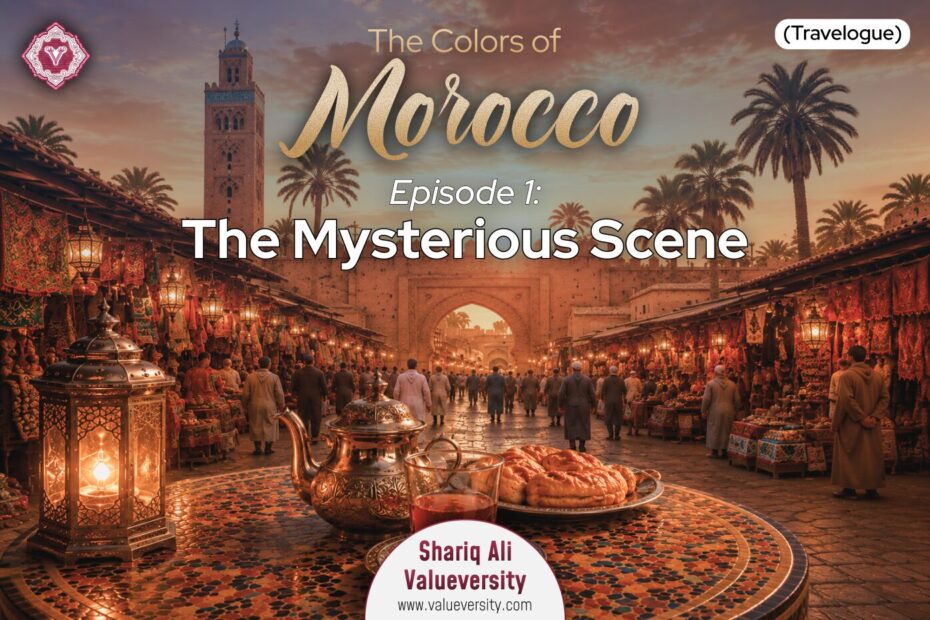
Episode One: The Mysterious Scene
The Colors of Morocco (Travelogue)
Shariq Ali
Valueversity
The restaurant called Lyon was still lively, even though the clock showed half past four in the morning. Dawn had not fully spread yet, but the quiet footsteps of the coming day were clearly audible.
In front of me sat only a cup of tea. My sleep was incomplete, yet I had no appetite at all. Mona, however, was thoroughly enjoying the breakfast items. We had left home for the airport at around three in the morning.
Stansted Airport is barely a ten-minute drive from our home, and our flight to Morocco was scheduled for six in the morning. While waiting for the gate announcement, we decided to have breakfast.
The Ryanair aircraft was not packed to the brim, but it was certainly quite full.
On that morning of 17 December 2023, our destination was Morocco’s central city—Marrakesh.
We were traveling toward a land where history and the present appear to converse with one another.
Most of the passengers were European and other tourists like us, but there were also local Moroccans on board. Moroccans belong to Africa, yet they are generally not Black. Most had wheatish complexions—some tall and broad-shouldered, some of average build, and others slender—an elegant blend of generations and lineages.
Perhaps some of them were returning home, while others were stepping toward new responsibilities.
And us?
We were traveling toward Morocco carrying many questions in our minds: its history, culture, modern life, its people, their way of living, and their aspirations. It is this very curiosity that becomes a traveler’s provision when setting out toward new destinations.
Morocco is a unique country located in North Africa. To its north lie the Atlantic Ocean and the Mediterranean Sea, Algeria borders it to the east, and the Sahara stretches to the south. Its capital is Rabat, while Marrakesh, Casablanca, and Fez are among its major cities.
Now our flight from London toward Morocco was moving forward with the morning light. Mona was seated by the window. Both of us were drawn to a strange and unusual scene visible outside.
Below the aircraft, countless small white and pale blue fragments appeared scattered—almost as if the clouds or the sea had transformed themselves into a mosaic. At first glance, they seemed like broken patches of clouds, but as the angle of light changed, the scene began to resemble a vast sea covered with melting ice floes stretching far into the distance. Yet geographically, this was impossible.
Gradually, it became clearer that these might be cloud shadows, sunlight reflecting off the sea’s surface, or salt flats along coastal regions—earthly formations that, when viewed from above, look more like dreams than reality.
Both of us leaned toward the window and spent some time discussing the mystery of that view.
We finally concluded that it was not a single, clearly defined form, but rather a shared illusion created by light, distance, and the human eye.
In the fleeting moments of a morning flight, earthly geography hides its true identity and becomes nothing more than a sensation.
Morocco’s population is approximately 37 million. Arabic, Berber (Amazigh), and French are spoken here.
Moroccan culture is shaped by a beautiful blend of Arab, Berber, and Andalusian civilizations.
This country is not merely a region on a map—it is a living experience made of history, colors, fragrances, and sounds. Its markets are not just places of trade; they carry within them the echoes of centuries-old stories۔۔۔۔۔.
To be continued…