THE EVOLUTION OF INTELLIGENCE
Episode Eleven: When the Brain Learned to Understand Others
Shariq Ali
Valueversity
In the previous episode, we saw that the brain had learned not only to remember past experiences but also to find solutions to new problems.
But nature presented another major challenge.
Living creatures did not exist alone.
Around them were other living beings, some rivals, some companions, some predators, and some members of their own group.
It was no longer enough simply to know where food could be found or how danger could be avoided. It also became important to understand what another creature might do next.
This was an important step towards social intelligence.
For animals living in groups, understanding the behaviour of others could become a matter of life and death.
Who is powerful? Who is a rival? Who is safe to stay close to? Who might steal food? And who might offer help in difficult circumstances?
Monkeys and other primates provide interesting examples. They can recognise relationships among members of their group. They appear to understand who is close to whom, who holds a higher social rank, and with whom forming an alliance might be useful.
Here, intelligence began to move in a new direction.
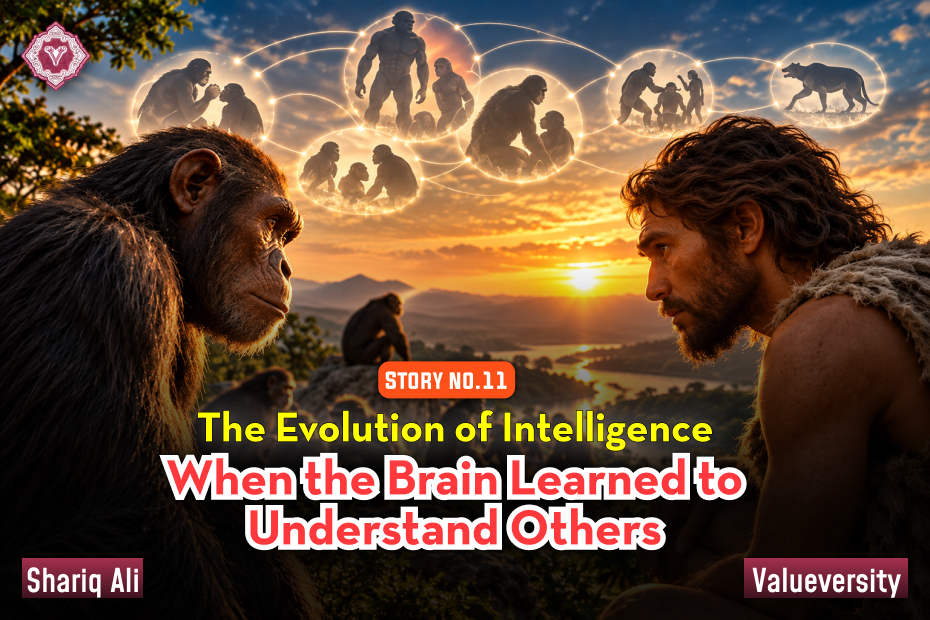
The brain was no longer simply building a map of the physical world outside. It was also beginning to make sense of other minds.
If an animal could predict another animal’s next move from its behaviour, it gained a clear advantage.
This ability mattered in hunting, defence, competition, and cooperation.
Some animals can even understand the direction of another animal’s attention. They notice where another individual is looking, what it is afraid of, or which source of food it is approaching.
In human evolution, this ability became far more complex.
Our ancestors lived in small groups.
Hunting, caring for children, sharing food, and defending against danger all required cooperation.
As a result, the brains that proved most successful were not necessarily those belonging to the strongest or fastest individuals, but those better able to understand the behaviour of others.
Gradually, gestures, facial expressions, tone of voice, and body movements began to carry meaning.
A glance could signal danger. A particular sound could summon companions. A gesture could tell an entire group to remain silent.
This was not yet fully developed human language.
But perhaps the world in which language could emerge was already taking shape.
Intelligence was no longer an ability confined to a single brain. It was becoming part of relationships, cooperation, and shared experience.
And this evolutionary journey brings us to the next and final stage.
The moment when humans learned not only to understand others, but also to communicate their own thoughts through words.
That was where an entirely new world of intelligence was about to begin.