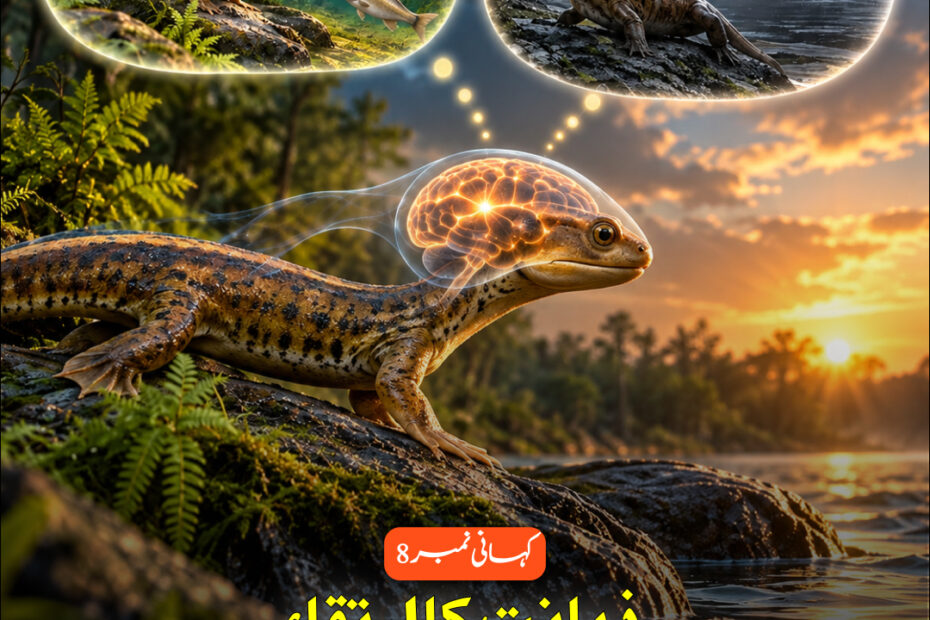
The Evolution of Intelligence
Episode 8: When Experience Became the Teacher
Shariq Ali
Valueversity
In the previous episode, we saw that during life’s long evolutionary journey, there came a time when the brain learned to preserve events from the past.
This was the beginning of memory.
But remembering alone was not enough.
The real revolution began when living organisms started changing their future behaviour on the basis of past experience.
This was the beginning of learning.
Imagine an ancient organism searching for food. It reaches a particular place and finds nourishment there. If, on a later occasion, that previous experience makes it more likely to return in the same direction, its behaviour is no longer simply an immediate sensory response.
The past has now become part of its present decision-making.
Similarly, if it encounters a predator somewhere, experiences pain or senses danger, and later begins to avoid that place, experience has changed its behaviour.
This change was enormously important for survival.
It was no longer necessary for every response to every situation to be predetermined from birth. An organism could acquire new information from its environment during its lifetime and adapt its behaviour accordingly.
Evolution, in other words, had given the organism not merely a ready-made program, but also the ability to modify that program to some extent.
One basic example of this is conditioning.
If an otherwise unimportant signal repeatedly appears alongside food, danger, or another significant event, the brain can learn to associate the two. Eventually, the signal alone may begin to influence future behaviour.
Different forms of this ability can be observed even in organisms with relatively simple nervous systems.
But perhaps the most important part of this story was that the organism was no longer a prisoner of the present moment.
It now carried within itself a small map of the past.
Which place is safe?
Where might food be found?
Which smell is followed by danger?
Which route proved successful before?
Such information meant that every new moment was no longer entirely new. Past experience had begun to guide future decisions.
Here, intelligence took another important step.
To sense, to remember, and then to learn and change behaviour.
Together, these three abilities allowed organisms to do more than merely respond to their environment.
They could now adapt themselves to it more effectively.
But one great leap still remained.
Could the brain only learn what had happened?
Or would it one day begin to anticipate what was going to happen?
This is where the next chapter in the evolution of intelligence begins.
More in the next episode.