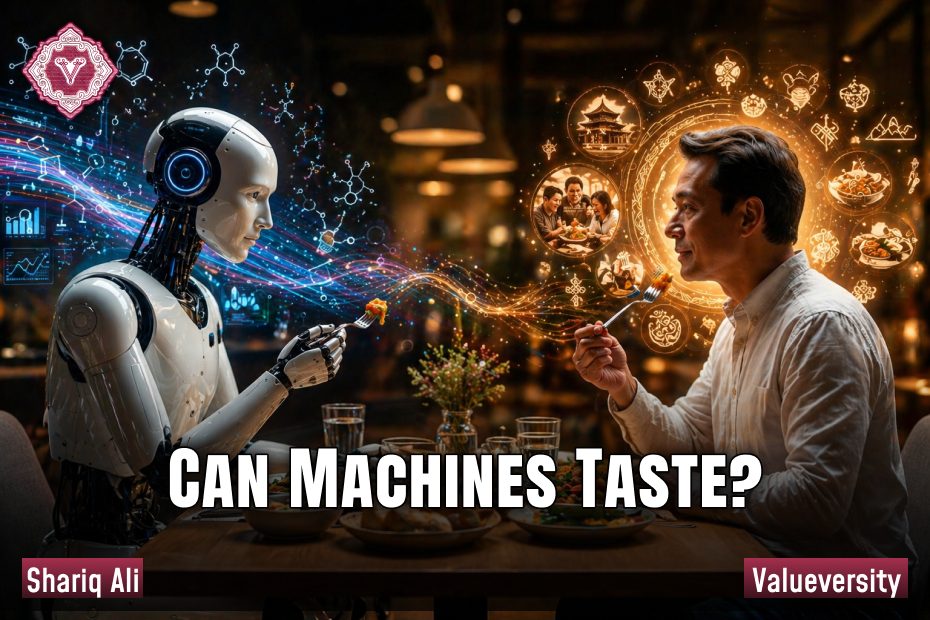
Can Machines Taste?
Shariq Ali
Valueversity
Imagine that you and I are sitting together at a dinner, and I ask you, “How does the food taste?” For you, the answer would come naturally and instantly. You might say it is delicious, or perhaps that it needs a little more salt, or even that it lacks the warmth of home-cooked food.
But your response is not coming from taste alone. It carries your personal likes and dislikes, the food you grew up with, your memories, and your cultural background—all quietly shaping your judgment.
The question, then, is this: can a machine do the same?
In today’s world, Artificial Intelligence (AI) has made remarkable progress.
Scientists are developing systems equipped with specialized chemical sensors that can detect basic tastes such as sweet, sour, bitter, and salty. These machines can analyze the composition of food and estimate how it might taste.
Yet, an important difference remains. For humans, taste is not just a chemical experience—it is an emotional and sensory one. It involves aroma, environment, memories, and feelings. The same dish may remind one person of childhood, while for another it may feel entirely ordinary.
Artificial Intelligence cannot fully experience this depth of human perception. However, by analyzing large amounts of data, it can identify patterns and trends in taste.
This is why AI is increasingly being used in the food industry—to develop new flavors and better understand consumer preferences.
It seems that machines are getting closer to “understanding” taste, but truly “feeling” it remains a uniquely human ability.