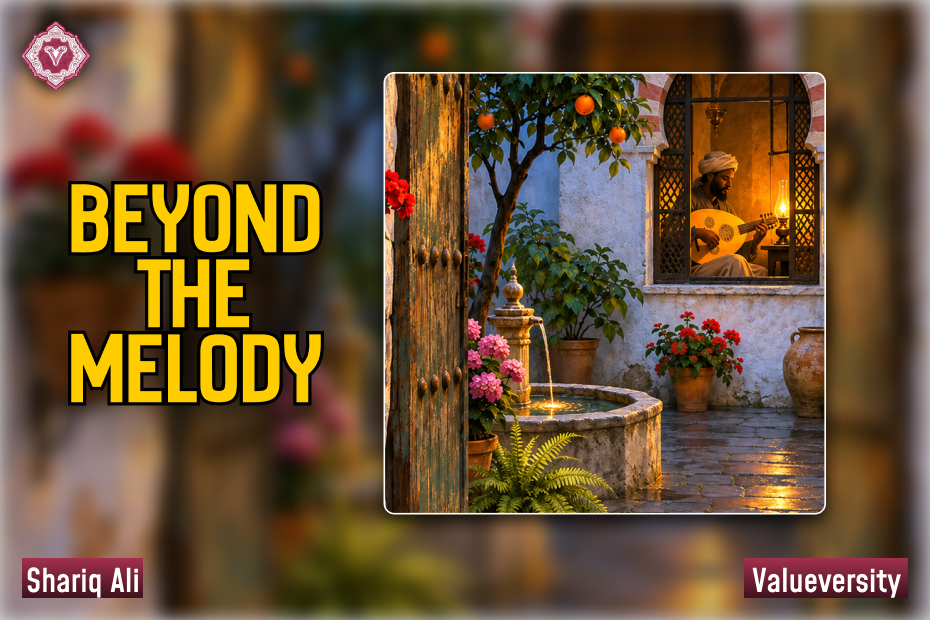
Beyond the Melody
Shariq Ali
Valueversity
Evening was falling in a narrow lane in Córdoba. Sunlight still caught the upper storeys of the white houses on either side, and shadows were lengthening in the lane. Between the walls, a thin strip of blue sky was visible.
Pedro and I were silently following a Black musician. Pedro was an elderly local guide. For a reasonable fee, he had spent the day showing me around Córdoba.
A little earlier, the musician had been playing his guitar on the long stone ledge along the outer wall of the Mosque of Córdoba. I had stopped to listen with the other tourists. As his fingers moved over the strings, the melody would sometimes settle into a familiar Spanish rhythm. Then he would linger on a note, and the tune would take a turn I could never anticipate until I heard the next one.
When the tune ended, he gathered his coins, slipped the guitar into its case and set off in the shadow of the wall. We followed. Sometimes I caught sight of his shoulder, sometimes of the guitar case, and sometimes both vanished around a bend.
At the end of the lane he went through an open wooden door. Beyond it lay a courtyard, its walls hung with pots brimming with flowers.
‘Who is he?’ I asked.
‘Wait a moment. The story will unfold in its own time. Some of it is history, some of it is hearsay. The rest, let’s say, is my own imagining.’
Pedro stepped over the threshold. I followed him inside.
Water had been sprinkled over the courtyard floor. We heard music coming from inside and peered through a window. A single lamp burned in the dim room. Beneath an arch sat the same musician. He now had a different instrument in his lap.
‘An oud,’ Pedro whispered.
I turned to look back towards the lane. A mule went past, followed by a man carrying a bundle of cloth. Someone inside the house called for the door to be shut.
‘Where are we?’
‘Córdoba. Think of it as ninth-century Córdoba. And that’s Ziryab.’
The musician’s face was beyond the reach of the lamplight. He plucked the strings of the oud.
‘Ali ibn Nafi,’ Pedro said softly. ‘He learned to sing in Baghdad. His travels brought him here in 822. Emir Abd al-Rahman II gave him a place at his court.’
‘Why did he leave Baghdad?’
‘One story goes that his teacher feared his pupil would surpass him. There are other stories about why he left.’
The musician’s finger rested on a string. I thought I might hear the tune I’d heard earlier by the mosque wall. Pedro fell silent too.
The musician rose and carried his oud into the adjoining room, where a cloth was being laid out for the meal.
‘People say he also introduced a new order for serving meals in Córdoba,’ Pedro said. ‘Soup first, then the other dishes, and fruit or sweets at the end. He’s also credited with introducing clothes suited to each season and new ways of wearing the hair.’
‘Did he start all of that?’
‘That’s the difficulty. Liking something, making it fashionable and inventing it are three different things. Storytellers often roll them into one.’
We took a few more steps across the courtyard. Through a second window, I saw Ziryab again. A boy sat facing him. Ziryab plucked a note on the oud. The boy kept his eyes fixed on the musician’s fingers.
‘They say he added a fifth string to the oud, too,’ Pedro said.
I moved a little closer. Just then someone put out the lamp.
I heard a few footsteps in the dark. Then the door inside closed. I peered through the window. The room was empty. So was the courtyard. Pedro was gone too.
I crossed the courtyard and stepped out into the lane. Night had fallen. The lights had come on, and a yellow electric glow fell across the wall of the Mosque of Córdoba. A tourist’s mobile phone rang.
I sat down on the same stone ledge by the mosque wall. Somewhere in the distance, a guitar was playing. I stayed there and listened.
Ziryab and the Traditions Associated with Him
This piece blends literary nonfiction with fiction. Pedro, the guitarist, the dialogue and the shift in time are imagined. Ziryab was a historical figure.
Ali ibn Nafi, better known as Ziryab, was a ninth-century singer and oud player. He received his musical training in Abbasid Baghdad. He travelled through North Africa and arrived in Córdoba in 822, where Emir Abd al-Rahman II gave him a place at his court. He is regarded as a prominent figure in the musical history of al-Andalus.
The story of his teacher’s jealousy and the addition of a fifth string to the oud are among the best-known traditions associated with him. He is also credited with influencing the order in which meals were served, the clothes people wore in different seasons and the way they styled their hair.
Music historian Dwight F. Reynolds has compared the writings of the eleventh-century Ibn Hayyan and the seventeenth-century al-Maqqari. Ibn Hayyan gives different versions of the same event. In al-Maqqari’s account, the same material becomes a single continuous story. That makes it difficult to separate historical fact from tradition.