An Unfinished Song
Shariq Ali
Valueversity
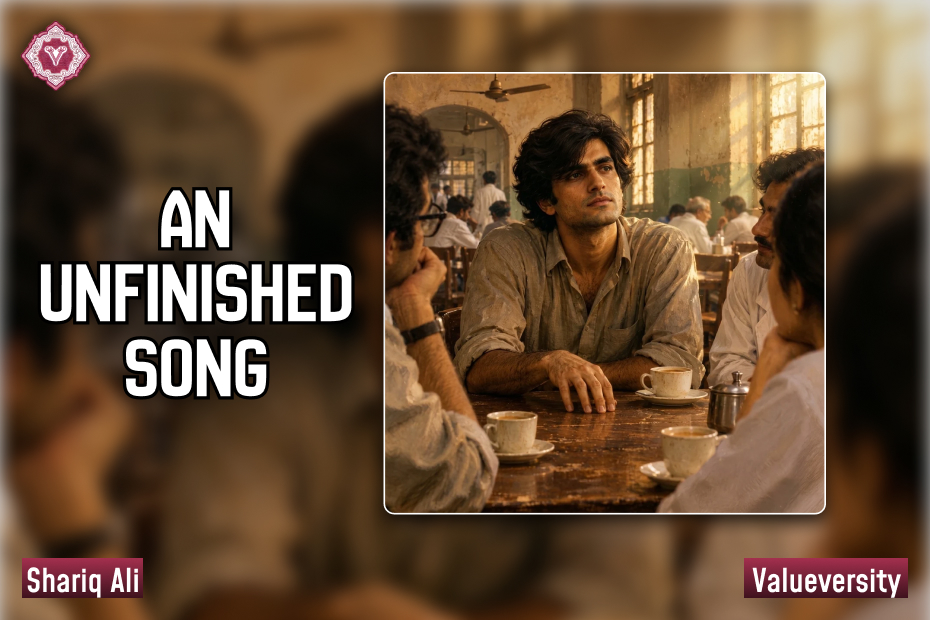
A few of us were sitting in the doctors’ cafeteria at Civil Hospital. Amid the clink of teacups and the idle chatter, Asim tapped out a rhythm on the table with his fingers and suddenly began to sing.
“You are the song of moon and stars. What do you know of a smouldering heart?”
He sang so tunefully that our conversation fell away. Then he stopped as suddenly as he had begun. For a moment, we waited for the next line.
“What happened, Asim? Why did you stop?” one of our friends asked.
“Someone left me unfinished too.”
There was such sadness in the way he said it that we assumed he was talking about a love affair that had ended too soon. A few days later, in a room at the student hostel, he told me something about his life that none of us had guessed.
Asim is the name I’ll use for him here. He was a little taller than average, with thick hair that fell halfway down his forehead. He ran a shop in Kharadar. His parents had died, and the worry of seeing his three sisters married had passed to him from his mother. Between the demands of the shop and his responsibilities at home, he still found time to help patients.
I was grieving in those days. We had lost our dear classmate, Afaq Muzaffar Butt, to cancer. Some of the money we had raised for his treatment was still left, and it fell to me to find a way to use it to help other patients. That was how I met Asim. Within a few meetings, we were already at ease with each other.
One day, when the two of us were alone in the hostel room, Asim handed me his medical report. I read it, then read it again. It described a difference in his sex development that he had been born with. I was an inexperienced medical student then. I had a medical report in my hands, and across from me sat a friend who had trusted me enough to let me read it.
Forty years have passed since then. Looking back, I can see more clearly the difference between what the report could tell me and what Asim could tell me himself. A congenital difference in sex development concerns physical characteristics. Being transgender concerns a person’s gender identity. The report could tell me something about Asim’s body. Only Asim could tell me how he understood his identity, if he chose to speak about it.
In January 2022, I read about Dr Sara Gill. She had completed her medical training in Karachi, and the Pakistani press introduced her as the country’s first transgender doctor. The coverage also described the difficulties she faced in continuing her education and finding acceptance in her family. I was glad to read of her achievement. It brought Asim back to mind, and I thought about how readily we form an opinion about someone before hearing what they have to say.
For a transgender child, a first experience of equality might be as ordinary as going to school and sitting at ease in the classroom. As they grow older, they should be able to study a subject they love, apply for a job that matches their abilities, and have the name and identity they introduce themselves with respected at home and beyond.
Even now, when I pass the doctors’ cafeteria at Civil Hospital, the first thing I hear in my mind is the rhythm of Asim’s fingers on the table. Then comes his voice, and then the pause in which we all waited for the next line.
Sometimes I think about how closely we listened to him sing that day. I wish we’d had the courage to listen just as closely to what he had to say