Aladdin’s Lamp, Episode Four
The Colors of Morocco
Shariq Ali
Valueversity
Leaving behind the central bustle of Jemaa el-Fnaa, we now entered its inner, narrow, and winding bazaars. These lanes were not straight or planned in any conventional sense; time and necessity had shaped them without a map. It felt like the set of an Arabian Nights film. At every turn, a new world unfolded before our eyes.
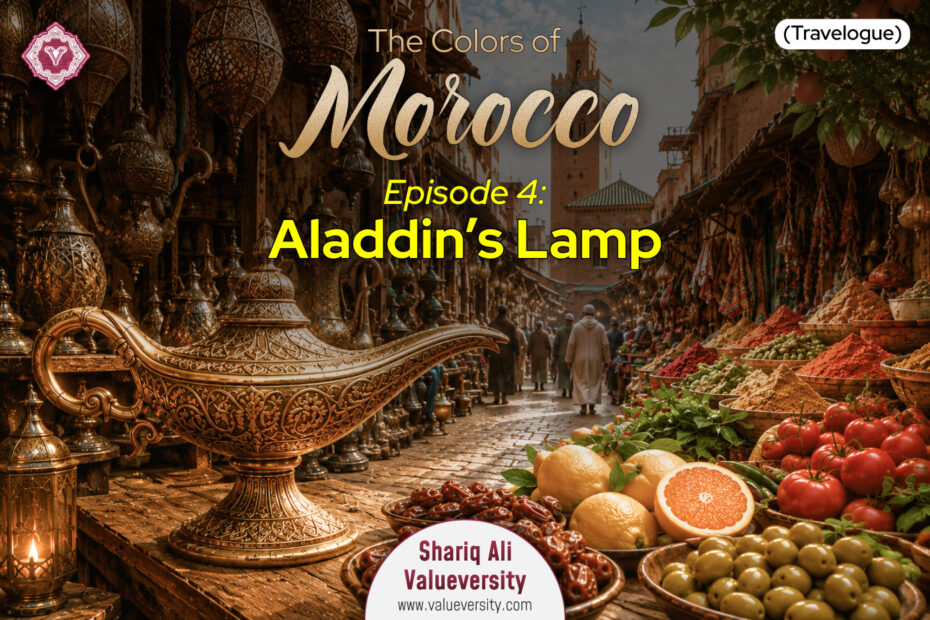
My gaze paused at one shop. In its small wooden showcase were countless vessels of brass, bronze, and copper—resembling Aladdin’s lamp—adorned with delicate engravings. One lamp, in particular, stood out. It was not lit, yet it felt as if light was emanating from its very being. For a moment, I was startled. This could not be mere decoration. This had to be magic—the magic of centuries-old craftsmanship. A craft that keeps aesthetics alive even in cities settled at the edge of the desert.
A few steps ahead, another wonder welcomed us—this time drenched in color. At the corner of the market stood a fruit and vegetable shop, where everything was arranged as if a painter were exhibiting a palette of colors. Bright oranges, lemons, red tomatoes, green chilies, heaps of olives, and different varieties of dates—everything was visually enchanting.
Seeing this scene, a question arose in my mind:
How can there be such abundance of colors, fruits, and vegetables in this desert country?
The truth is that Morocco is not geographically just a desert; it is a diverse land. The Atlantic Ocean, the Mediterranean Sea, the Atlas Mountains, and the Sahara Desert—all coexist within the same geography.
The Atlas Mountains serve as a natural reservoir of rain and snowfall. The water that melts flows down into valleys and plains. Ancient irrigation systems, known as khettara or qanat, carry water to distant farmlands through underground channels. These systems are centuries old and are still functional in many regions today.
Morocco’s major agricultural produce includes oranges, mandarins, olives, dates, pomegranates, figs, tomatoes, potatoes, onions, coriander, and mint. Olives hold a central place in Moroccan cuisine and economy; olive oil is present at every level—from homes and markets to exports.
In areas close to the desert, date palm oases are not merely crops but complete systems of life. They provide shade, food, employment, and culture. That is why it is more accurate to see Morocco as a living oasis settled at the edge of the desert—where, despite harsh climates, agriculture has been made possible by understanding the land’s secrets, managing water wisely, and blending tradition with knowledge.
After purchasing our favorite fruits, we realized that the local currency we had obtained at the airport had run out. Nearby was a money changer. The man seated behind the glass exchanged the required amount within moments.
With shopping bags in hand, we headed toward a nearby taxi stand to return to the hotel. We were now walking along the pavement of a relatively wide road.
Morocco’s economy stands on several pillars. Tourism is considered its backbone; millions of people visit each year, drawn by its history, markets, cities, and the allure of the desert.
Agriculture is the second major support—citrus fruits, olives, dates, and vegetables not only meet local needs but also earn foreign exchange through exports. Alongside this, Morocco’s phosphate mines, which are of exceptional global importance, give the country a prominent position on the map of natural resources. Remittances from Moroccans living abroad also form a steady part of the economy.
This country is neither fully wealthy nor traditionally poor. Prosperity and simplicity walk side by side here. Major cities have modern infrastructure, trains, roads, and tourist facilities, while the life of the common person remains careful, labor-intensive, and simple. This balance gives Morocco its unique identity. The atmosphere is different from Gulf countries—there is less noise of wealth and more flow of life.
As we walked toward the taxi stand along the pavement, we observed with interest the orange and lemon trees lining the road, heavy with fruit.
Upon reaching the stand, we got into a taxi, and the city began to slide away behind us.
We were on our way back to the hotel…
To be continued