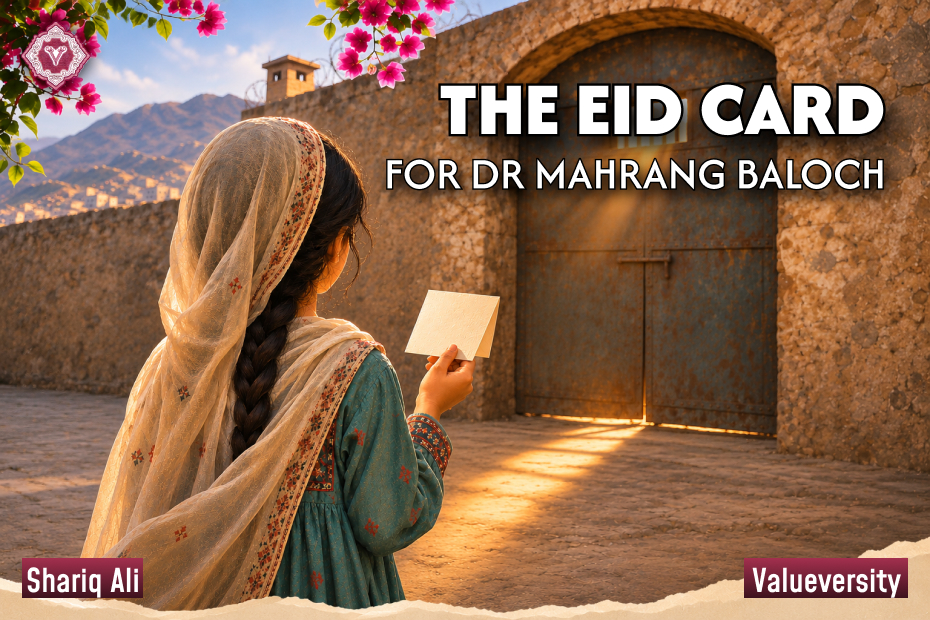
The Eid Card
For Dr Mahrang Baloch
Shariq Ali
Valueversity
An Eid card usually carries a message of happiness: a greeting, an expression of love, or the wish to meet again. But when that same card reaches a prison gate in a little girl’s hand, its meaning changes. It carries the pain of separation and the longing to see her father return home.
In a letter written from prison, Dr Mahrang Baloch recalled taking Eid cards when she visited her imprisoned father as a child. Now she is confined in that same prison, remembering her childhood within its walls.
I do not know what was written on that card. Yet I feel that this small piece of paper also carried a question for us all:
Do we all have an equal right to peace, freedom, and justice?
For a child, a father’s presence brings a familiar sense of security. Holding his hand on the way to the market, hearing his voice at home, sitting beside him when something is troubling you: these everyday experiences build a child’s confidence. In Mahrang’s life, waiting and protest became part of that bond.
Her father, Abdul Ghaffar Langove, disappeared in 2009. In 2011, his body was found bearing signs of torture. What the family endured cannot be contained in a few sentences. While someone is missing, the possibility of their return remains. Confirmation of death takes away even that hope.
Despite this trauma, Mahrang continued her education and qualified as a doctor at Bolan Medical College in Quetta. This brief account cannot adequately convey the years of hard work and the struggle to build a future amid such difficulties.
Medical education teaches us to attend to suffering. Where does it hurt? How long has it been hurting? A good doctor listens carefully to the answers. The suffering within a society deserves the same attention. When a mother’s son disappears, the waiting affects her sleep, health, livelihood, and entire household.
Mahrang connected her own grief with the suffering of such families. Through the Baloch Yakjehti Committee, she became active in the campaign against enforced disappearances and extrajudicial killings.
You may have seen her in a news report, surrounded by families holding photographs of their loved ones. We can look at the picture and move on. Those families must continue living with the uncertainty of where their loved one is and what condition they are in.
In late 2023, Mahrang played a prominent role in the protests that began in Turbat and the long march that reached Islamabad. Many women joined her. Travelling with them were the unanswered questions their families had carried for years.
Seeking news of a loved one, asking about the legal grounds for their detention, and requesting justice are basic civil rights. In Balochistan’s traditional social environment, women’s public participation in these demands requires sustained courage.
In 2024, Mahrang was included in TIME100 Next and the BBC’s list of 100 inspiring and influential women. But international recognition did not bring her difficulties to an end.
She was arrested in March 2025. In June 2026, an anti-terrorism court sentenced her to life imprisonment in a case concerning the death of a security officer during the July 2024 protests in Gwadar. She was accused of inciting a crowd to violence, an allegation she denied. Amnesty International and independent United Nations experts raised serious concerns about the fairness of the trial and her opportunity to mount an effective defence. According to an October 2026 report, her appeal against the conviction remained pending.
The human cost of imprisonment includes separation from family, passing time, and uncertainty about the future. While valuing someone’s steadfastness, we should also recognise their suffering.
Mahrang’s life invites us to consider the paths people choose after personal tragedy. Listening to others, checking information, and working peacefully for justice are possibilities open to us all. We can support a person’s dignity and right to a fair trial without agreeing with every political position they hold.
I return once more to that Eid card.
I do not know what the little girl wrote on it. Today, I would like to write this prayer on that card:
Lord, let no child have to wander from place to place seeking news of someone they love. And keep us steadfast in the continuing struggle towards justice and equality.
References
[1] Human Rights Foundation — 25 October 2026
Dispatches from Detention: Dr. Mahrang Baloch�
Source for her published prison letter, including her recollection of visiting her father in the same jail with Eid cards. This is her personal account, rather than independent verification of those events.
[2] Human Rights Watch — 28 July 2011
“We Can Torture, Kill, or Keep You for Years”: Enforced Disappearances by Pakistan Security Forces in Balochistan�
Report documenting Abdul Ghaffar Lango’s disappearance in December 2009 and the discovery of his body in July 2011.
[3] TIME — 2 October 2024
Mahrang Baloch — TIME100 Next 2024�
Source for her inclusion in TIME100 Next, her medical background and her role in the 2023 march to Islamabad.
[4] Dawn Images — December 2024
Mahrang Baloch, Hadiqa Kiani make it to BBC 100 Women 2024 list�
Report confirming her inclusion in the BBC’s 100 Women list and describing her campaigning alongside families of missing people.
[5] Amnesty International — 23 June 2026
Pakistan: Authorities must immediately release Baloch activists handed life sentences following secret trial�
Source for the June 2026 sentences and Amnesty International’s concerns about trial fairness and opportunities for an effective defence. These concerns represent the organisation’s assessment.
[6] Dawn — 16 July 2026
Balochistan High Court admits Dr Mahrang’s plea against life sentence�
Report that her appeal against the sentence was admitted for regular hearing. This reference does not establish the appeal’s current status.
Author’s Note
This essay addresses human dignity, the suffering of families and the right to a fair trial. Sources for historical and legal information are listed above. The literary reflections and concluding prayer are the author’s own. No determination of the final legal outcome of a matter subject to appeal is intended.