From Sand to Canvas: Shukrullah Baloch’s Artistic Journey
Shariq Ali
Valueversity
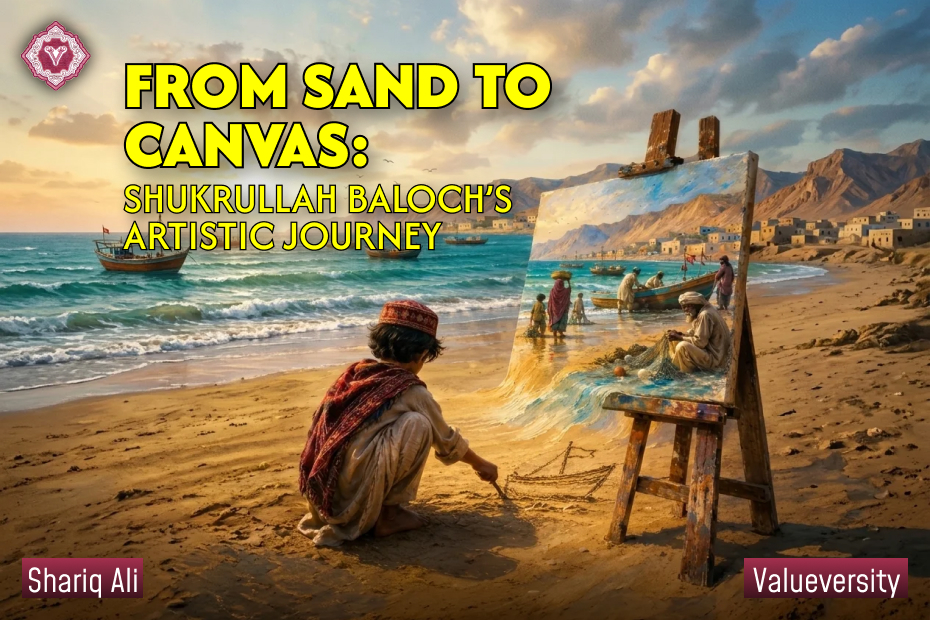
The sand along Pasni’s shore is a playground for local children and, at daybreak, a pathway for fishermen making their way towards their boats to earn a living.
For Shukrullah Baloch, it became a canvas for creative expression while he was still a child.
A biographical account describes how, from childhood, he began turning thoughts inspired by his surroundings into pictures on walls and beach sand. Long before a conventional canvas came within reach, his desire to express himself through images had already found a way.
Every artist first observes the world, then wishes to recreate it in an individual way. A line is drawn; a shape emerges. Some practically minded people ask, “What does this achieve?” without pausing to discover what the artist is trying to show them.
Shukrullah was born in Pasni. After completing his secondary schooling, he moved to Karachi for further education. This journey from a small coastal town to a large city marked an important turning point in his life. While studying, he began illustrating children’s books and designing magazine covers. Later, he also painted for commercial organisations, and art became his means of earning a living.
In a city like Karachi, a young painter encountered many different demands. Illustrations had to capture children’s attention, a cover had to draw a reader in, and commercial work had to meet a client’s expectations. Alongside imagination, such work required discipline, practice and the ability to communicate with others. Shukrullah’s journey offers a glimpse of the sustained effort it takes to turn a passion into a profession.
Even while undertaking commercial work, the artist within him remained connected to his homeland. His paintings reveal a deep affection for ordinary Baloch people, their culture and local life.
Sketches, line drawings and landscapes formed part of his artistic expression. Even as he worked in the great city, the subjects of his pictures continued to draw him towards his own people.
Balochistan has a long tradition of creating beauty. The decorated pottery and clay figurines of the ancient civilisation of Mehrgarh show that, thousands of years ago, the people of this region were already finding room for aesthetic expression in everyday life. A pot serves a practical purpose, but decorating it expresses a human instinct and desire for art. Giving meaning and beauty even to the things we use is part of our nature.
It would therefore be mistaken to assume that a society burdened by poverty and hardship has little connection with art. Where livelihoods are uncertain, buying a painting, arranging art lessons for a child or providing lasting support for an artist can certainly be difficult. Yet an appreciation of art remains, even when the resources needed to sustain it are scarce. In such circumstances, artists are often expected both to pursue their creative expression and to provide for themselves entirely through their own efforts.
Writing about Shukrullah, Mahikan Maqbool mentions his financial hardship. This makes his artistic journey all the more worthy of attention.
When paints, paper, time and peace of mind are available, creative ability has a better chance to flourish. Every thriving society should respect an artist’s perseverance while also considering how to ease the difficulties surrounding it.
Shukrullah’s influence extended beyond his pictures. Nazir Ahmed, an artist who creates art in the sands of Pasni, acknowledged him as his teacher and mentor. In a 2017 report, he attributed his abilities to Shukrullah’s guidance and training. Here is a living continuation of a teacher’s work: the skill he passes on continues to grow in other hands.
Remembering Shukrullah Baloch brings the mind back to that childhood shore. A picture drawn in sand will eventually disappear. But if the desire to create pictures reaches another person, that is surely a considerable achievement.
If our schools, cultural institutions and communities could offer such children a little space and opportunity, a few colours and some attention, who knows how many potential artists might discover the means to express themselves?
Somewhere along a shore, a child is still drawing lines in the sand. Perhaps he is waiting for someone to stop and look.