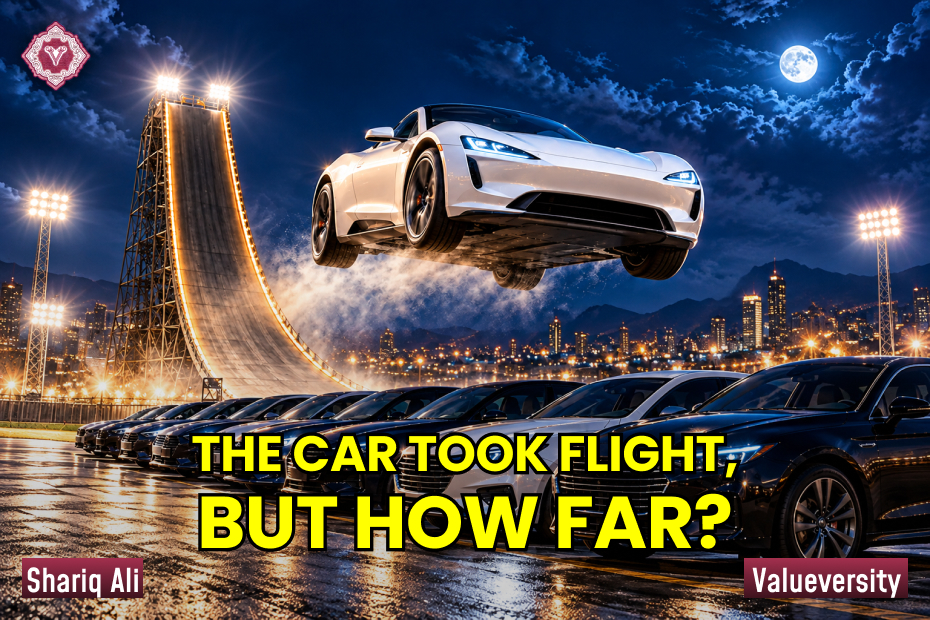
The Car Took Flight. But How Far?
Shariq Ali
Valueversity
Imagine this: you are stuck in traffic. Ahead lies a queue of cars; behind you, horns are blaring. You press a button, and your car rises above them all and flies ahead. For years, we have watched this dream unfold in films. Now, one of Elon Musk’s cars has brought it back into the conversation. But how much distance remains between the dream and reality?
On 15 October 2026, Tesla’s new Roadster gave a remarkable demonstration in Texas. The car climbed a curved ramp, turned upside down, then twisted through the air, passing over other vehicles before landing. Tesla and Musk’s space company, SpaceX, collaborated on the prototype. Reuters also reported on the demonstration.
But should we really call it a flying car?
An interesting distinction matters here. Lifting off the ground for a few moments and maintaining flight like an aircraft to reach a destination are two different capabilities. The demonstration did not establish the latter. According to People magazine, the car used compressed-air thrusters to lift itself into the air. The demonstration took place without a driver.
The Indian Express also explained that the vehicle shown remains a prototype. It would be premature to assume that the capabilities demonstrated will be available in a car built for ordinary customers. The company has announced a target of starting production in 2028.
Perhaps that is the real fascination of this event: a familiar machine did something unfamiliar, and for a few moments, our everyday world felt like science fiction.
Curiosity has its place, but thoughtful news reading means asking: What was shown? What was claimed? And what remains to be proved?
For now, the car has made a spectacular leap. The dream of turning our daily journeys into flights still awaits its next test.