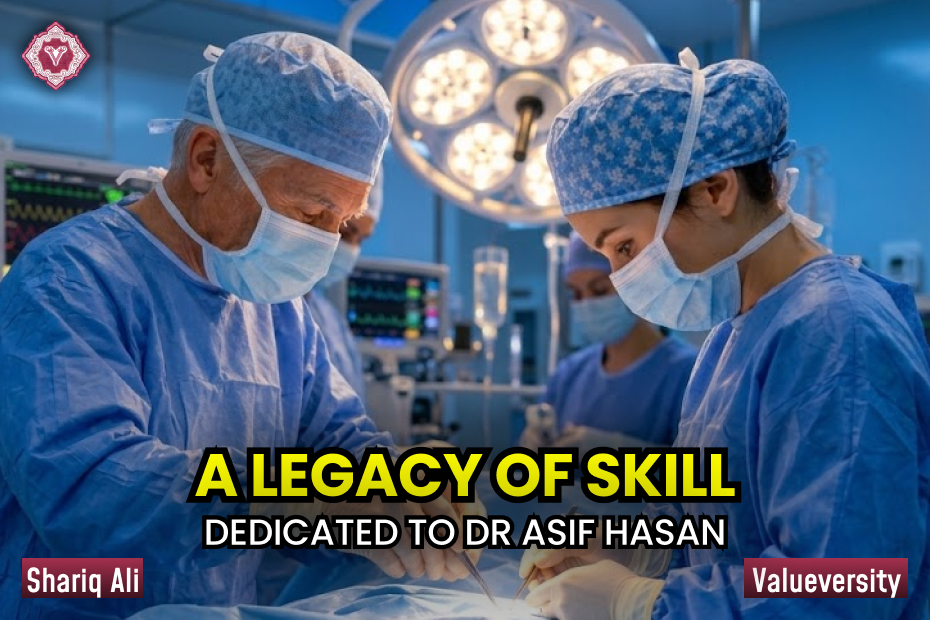
A Legacy of Skill
Dedicated to Dr Asif Hasan
Shariq Ali
Valueversity
The ceremony is being televised across Britain. One by one, nineteen former patients come onto the stage. Children and young adults gather with love and respect around the white-haired surgeon who once stood beside them in their struggle between life and death. Today, in their radiant faces, life itself pays tribute to the doctor who helped it prevail.
The hands that never trembled through the most demanding moments of surgery are trembling today with joy and gratitude. His eyes are moist, and a white handkerchief cannot conceal the depth of his emotion.
Dr Asif Hasan, a specialist in children’s heart surgery, embraces his former patients. Years of work by him and his medical team now stand before them in the form of human happiness.
This is the 2026 Pride of Britain Awards ceremony, where he is receiving a Lifetime Achievement Award.
One of his former patients is now a mother of two daughters and works in the children’s cardiac department at the Freeman Hospital. Her own experience of treatment inspired her to serve others.
For me, and for the entire Dow Medical College community, this scene is a source of pride. It was there that Asif Hasan’s medical journey began.
Doctors and healthcare workers around the world can rightly share in this happiness. Every day, they bring their knowledge, skill and compassion to the service of patients facing difficult times.
Dr Asif Hasan graduated with an MBBS from Dow Medical College in 1979. His early training included work at Civil Hospital Karachi. He came to Britain in 1981. In time, the Freeman Hospital in Newcastle became the centre of his professional life, with an association spanning approximately thirty-six years.
In 1995, he was appointed a consultant cardiothoracic surgeon there. He played an important role in developing services for children with complex heart conditions and those requiring transplantation. According to the hospital, his career included more than four thousand open-heart operations, with him serving as the lead surgeon in approximately three thousand. These figures did not include numerous emergency and out-of-hours procedures.
For a child’s parents, an operation is never merely a number. Bound up with it is their child’s tomorrow: the first morning at school, running across a playing field, friendships, growing up, and the ordinary joys that healthy people often experience without pausing to notice them.
By his own estimate, Asif Hasan performed approximately four hundred transplants. His team also treated critically ill children whose operations were considered exceptionally high-risk by other centres. He shared the leadership of the Berlin Heart programme, which used mechanical pumps to keep children alive while they waited for a suitable donor heart. Among the innovations attributed to him is the “bootlace closure” technique, developed to address the difficulty of closing the chest after implanting a relatively large donor heart.
Among all these achievements, one aspiration particularly draws me to him. He wanted to leave behind surgeons fully capable of taking over his responsibilities, and of doing even better than he had. He regards preparing such successors as his proudest accomplishment.
There is such generosity in wanting a pupil to surpass you. Passing on a skill acquired over a lifetime requires time and patience. A young surgeon must be given room to ask questions, think independently and gradually take responsibility. Then, one day, the teacher stands back, and the pupil steps forward with confidence.
In this way, one person’s skill grows as it passes into many hands. The surgeons he has trained work in different cities and countries. They, in turn, train pupils of their own. The journey of service reaches beyond the span of a single professional life.
When speaking of his achievements, Asif Hasan also acknowledges his fellow doctors, nurses and the NHS. A child’s recovery depends on the efforts of many people: in the operating theatre, beside the intensive care bed, within donor families and in the child’s own home. A good teacher also passes on an understanding of this shared responsibility.
At the ceremony, nineteen former patients stand before their surgeon. They have moved forward in their lives, but a crucial turning point in each of their stories remains connected to this man.
Beyond them are children Asif Hasan may never meet. They will be treated by the surgeons he has trained. Somewhere in an operating theatre, a young surgeon’s hand will move forward with confidence. In that surgeon’s judgement and skill, the teacher’s years of work will also be present.
Beyond the hands holding a white handkerchief on the stage, this journey of service will continue in those younger hands. This is Asif Hasan’s legacy of skill.م