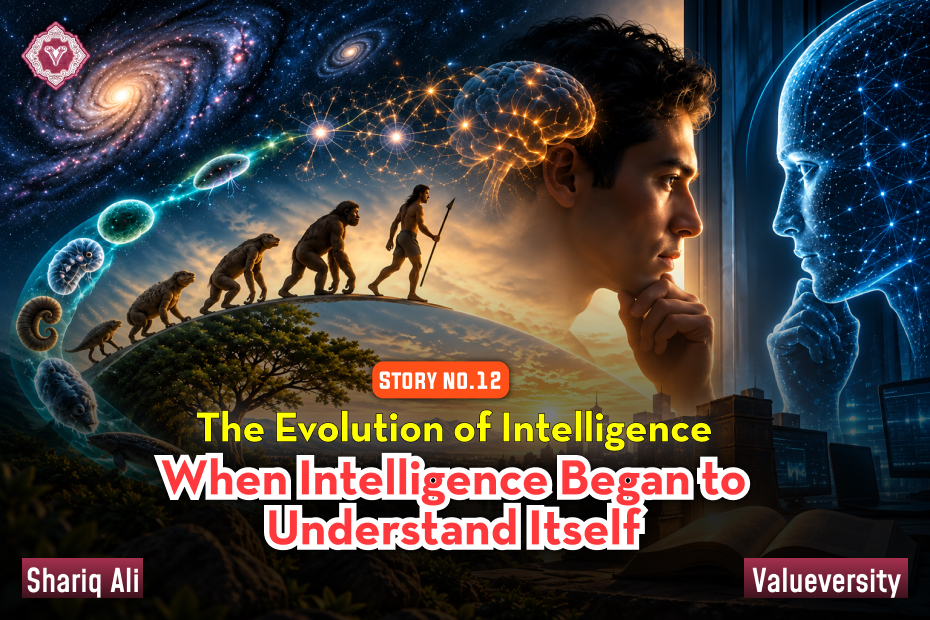
The Evolution of Intelligence
Episode Twelve and Final: When Intelligence Began to Understand Itself
Shariq Ali
Valueversity
In the previous episode, we saw that for creatures living in groups, understanding their environment was no longer enough. They also had to understand the intentions, behaviours, and relationships of other living beings.
This was an important step towards social intelligence.
But the journey of evolution did not end there.
Over millions of years, a brain emerged in the human lineage that could not only understand its environment and other human beings, but could also communicate its thoughts, experiences, and plans to others.
Language gave this ability extraordinary power.
Now, one person’s experience was no longer confined to a single lifetime. People could tell others where prey could be found, which plants were poisonous, which routes were dangerous, and which methods had proved more successful.
Knowledge began to pass from one mind to another.
And then from one generation to the next.
This was a major turning point in the history of human intelligence.
Other animals also learn. Some acquire new skills by observing others. But humans developed this ability much further.
Language, storytelling, symbols, images, and eventually writing freed information from the limits of human memory.
A discovery no longer had to be rediscovered by every generation.
One generation could reach a certain point, and the next could begin from there and move further ahead.
This process can be described as cumulative culture — the gradual accumulation of culture and knowledge across generations.
From the earliest stone tools to agriculture, from cities to books, and from mathematics to modern science, human progress has been the result of this collective intelligence.
At this point, the nature of intelligence changed once again.
Intelligence was no longer simply an ability contained within a single brain.
It had spread between human beings.
An individual might know relatively little, but an entire society could know an enormous amount. One person understood farming, another made tools, another observed the stars, while someone else learned how to treat illness.
Then came writing, libraries, centres of learning, the printing press, and eventually computers and the internet.
Each new invention expanded the boundaries of human memory and knowledge.
Today, we stand at a point where humans have also created artificial intelligence, machines capable of analysing information, using language, recognising patterns, and helping us solve certain complex problems.
But artificial intelligence is not the most remarkable part of this entire story.
The truly remarkable thing is that life, which began billions of years ago, eventually produced a brain capable of asking questions about its own intelligence.
We want to know how we think.
Why we learn.
What consciousness is.
And how far the limits of intelligence might extend.
This journey did not begin with a philosopher, a scientist, or even a human brain.
It began when early life first responded to a signal from its environment.
From there came nervous systems and senses. Brains began to build maps of the world. Memory preserved the past. The ability to solve problems emerged.
Social intelligence developed. And eventually, language and collective knowledge gave rise to human civilisation.
The journey is not over yet.
Perhaps the greatest characteristic of intelligence is its constant attempt to move beyond its own limits.
And now, for the first time, intelligence is trying to understand its own evolution.