The Evolution of Intelligence
Episode Ten, When the Brain Learned to Solve Problems
Shariq Ali
Valueversity
In the previous episode, we saw how memory enabled living organisms to use past experience to anticipate what might happen next.
But in nature, prediction alone was not enough.
Sometimes a completely new problem appeared—one for which an old solution no longer worked.
Food might be within sight, but an obstacle stood in the way. Prey might be visible, but the direct route was blocked. An animal might need to escape danger, only to find that its usual path was no longer safe.
In such situations, the brain had to find a new way forward by choosing among different possibilities.
This was the beginning of problem-solving.
We can still see fascinating examples of this ability in nature today.
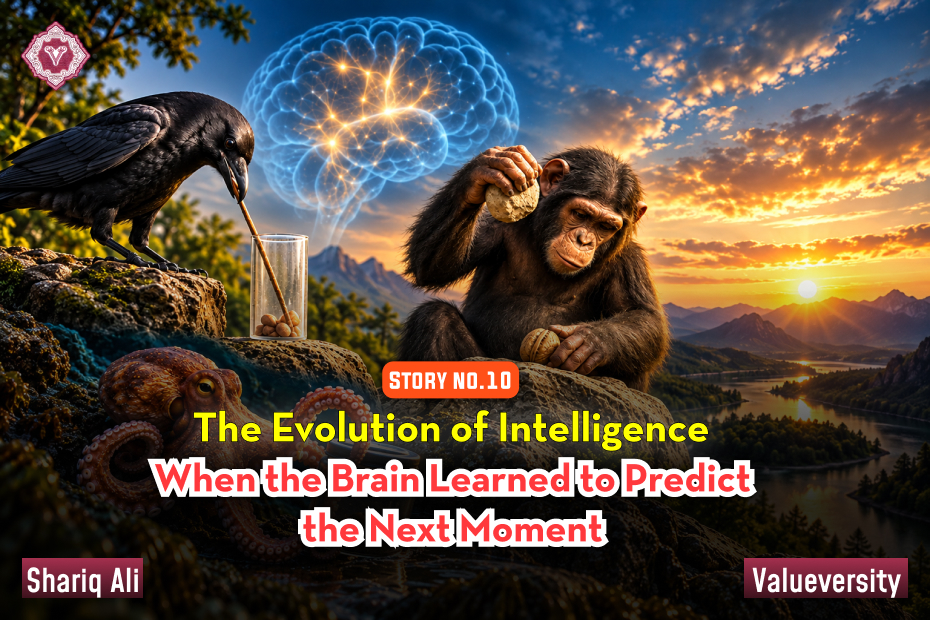
Crows use twigs as tools to obtain food. Some monkeys use stones to crack hard nuts. Octopuses try different strategies to reach something inside a closed shell or container.
These behaviours have something important in common.
The organism is not simply reacting to its environment. It is changing its behaviour in order to achieve a goal.
Here, trial and error became important. If one method failed, another could be tried, and a successful method could become part of memory.
In this way, memory, prediction, and experience began to work together.
Some animals went even further. They could move around an obstacle, pull an object closer, or use one object as a tool to reach another.
It was as if the brain had begun to search for possibilities within the world around it.
What can I do?
Which route is better?
If this method does not work, what else might?
These questions did not exist in words, but their earliest answers were already present in behaviour.
Natural selection favoured organisms that could adapt their behaviour more flexibly to changing circumstances.
Because in a changing world, strength or speed alone was not always enough.
Sometimes finding a better solution mattered more.
But if every organism had to solve every problem entirely on its own, learning would remain limited.
What if it could also learn by watching others?
What if one individual’s discovery could become useful to another?
This was the next major step in the evolution of intelligence.
Learning from others.
More in the next episode.