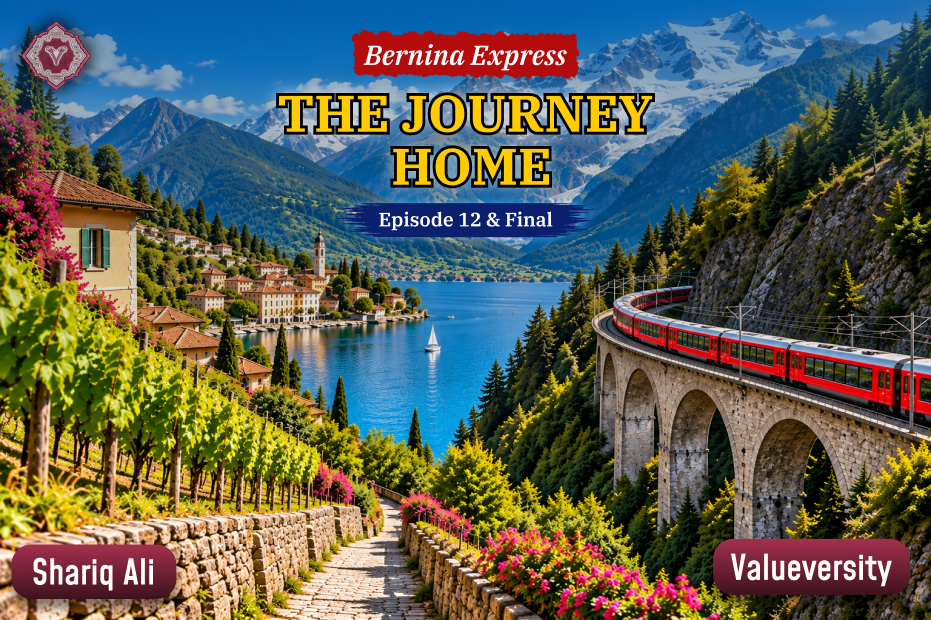
LAKE COMO AND THE BERNINA EXPRESS
Episode Twelve and Final: The Journey Home
Shariq Ali
Valueversity
Tirano was now behind us.
A little while earlier, our guide had once again gathered all the passengers and ushered us onto the coach. We were now settled into our seats, heading back towards Milan.
That morning, we had travelled by train towards the heights of the Swiss mountains, and now, seated in the coach, we were descending from those very mountains, returning towards the plains of Italy.
The scenery outside the coach window was constantly changing.
Small towns appeared here and there, followed by fields, stone houses with red-tiled roofs, and, on the mountain slopes, rows of grapevines stretching into the distance.
This particular sight caught my attention.
The mountain slopes had been divided into small terraces where grapes were cultivated. The vines climbed neatly along supports made of wood and bamboo. In places, small farmers’ houses could be seen beneath or close to these vineyards.
It seemed as though land, home and livelihood were not three separate entities here, but interconnected parts of a single way of life.
During the journey, our guide shared an interesting detail.
Some of the slopes in this region are so steep and difficult to access that growing grapes there is itself an extraordinary labour. Once the harvest is ready, bringing heavy crates of grapes down from these heights can be extremely difficult. In some of the more inaccessible vineyards, helicopters are occasionally used to transport crates filled with grapes down from the mountainsides.
Naturally, all this effort and organisation comes at a price.
One of the region’s famous wines is called Inferno. It is produced from dark grapes grown in the mountain vineyards of Valtellina.
Its name is interesting too.
The rocky slopes become intensely hot under the sun, and it is this fierce heat that gave the wine its name: Inferno — hell.
Perhaps, then, the price reflects not merely the drink inside the bottle, but the land, the climate, generations of experience and human labour that have all gone into producing it.
The coach continued onwards.
We were seeing an Italy that appears less often on tourist postcards.
Small towns, local shops, fields, roadside cafés, old buildings and ordinary people going about their daily lives.
One fascinating characteristic of Italy that I noticed is that the past and the present do not exist separately here. A modern café may sit beneath a centuries-old building. Contemporary Italian fashion exists alongside traditional cuisine. Grapes and olives have been cultivated here for generations, yet those same agricultural products continue to shape Italy’s identity around the world today.
Fashion, design, automobiles, cheese, coffee, pasta, olive oil and wine.
These are not merely products, but different expressions of the Italian way of life.
And perhaps this is part of Italy’s beauty: beauty is not confined to art galleries and museums. It is woven into everyday life.
The coach was now approaching Milan.
Gradually, the mountains receded into the distance.
The roads grew wider, the traffic became heavier, and rural landscapes gave way to the buildings of the great city.
Eventually, we arrived at Milano Centrale.
From there, we took a train and, tired after the long day, returned to our hotel.
The journey was almost complete.
We spent the night at the hotel. The following morning, we had breakfast, packed our luggage and, at eleven o’clock, left for the airport in our pre-booked taxi.
The aircraft accelerated along the runway and took off.
I remembered Lake Como, and Alessandro Volta, a native of Como, whose name lives on throughout the world in the electrical unit of potential difference — the volt.
I remembered Bellagio.
That beautiful settlement on the lakeshore, its narrow streets, sloping pathways, and trees laden with colourful flowers seemed to dance once again before my eyes.
And then, the Bernina Express.
That red line winding through snow-covered mountains, sometimes travelling along the edge of a deep valley, and sometimes turning in a complete circle as it curved around the famous Brusio Circular Viaduct.
Snow, lakes, glaciers, green valleys and tiny railway stations.
And then Tirano.
A relatively modest Italian border town, so different from the refinement and prosperity of Switzerland.
Small shops, ordinary people, simple buildings and a railway track connecting two countries.
This aircraft would take us home.
Does travel change us? When we return home, are we really the same people who first set out on the journey?
Perhaps the map of the world within our minds has grown a little larger.
And so, our journey through Lake Como and the Bernina Express came to an end.
The End