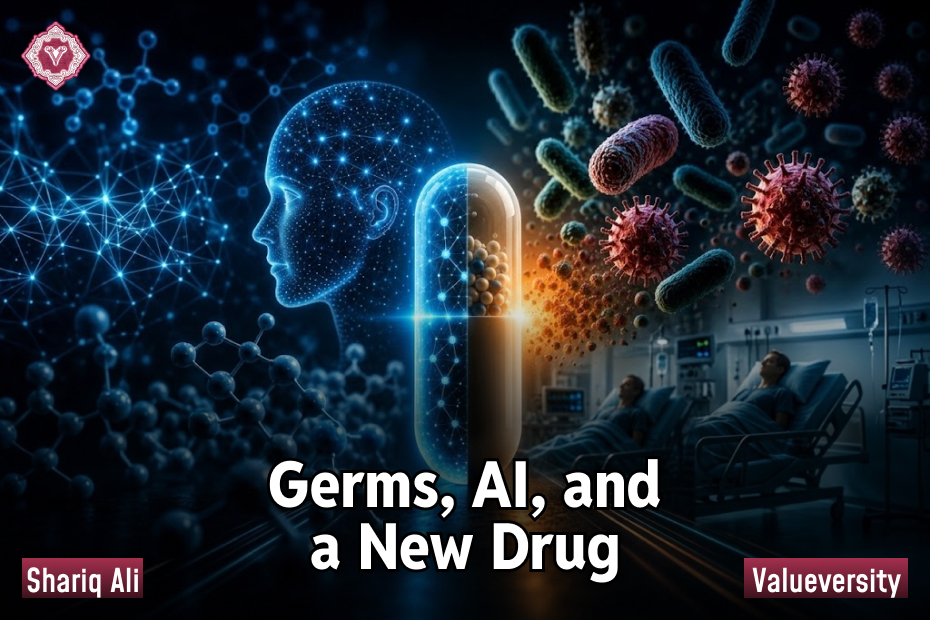
Germs, AI, and a New Drug
Shariq Ali
Valueversity
A room in a hospital isolation ward.
The air carries the distinctive smell of disinfectant.
Lines move across the monitor screen, and every so often, the beep of a machine breaks the silence.
The patient lying in the bed is fighting for his life.
A dangerous infection has spread through his body.
Doctors are giving him antibiotics, but one drug after another is failing.
Each time, the laboratory sends back almost the same answer:
Resistant.
The bacteria are no longer responding to the drug.
This is not the story of just one patient. Across the world, bacteria are gradually developing resistance to the antibiotics that have saved millions of human lives over the past several decades.
We need new drugs. But finding them is not easy.
A Vast Ocean
Searching for a new drug is rather like searching for one particular pearl in a vast ocean.
Among millions upon millions of chemical molecules, which one might be capable of killing a dangerous bacterium?
Testing them one by one would be almost impossible for humans.
This is where artificial intelligence offers a new path.
Scientists at MIT and other institutions trained an AI system to examine the structures of different molecules and predict which of them might be effective against bacteria.
They then asked it to search through thousands of existing compounds.
From this search, a remarkable candidate emerged.
Halicin.
What made Halicin particularly interesting was that it was not new. The molecule already existed and had once been investigated as a possible treatment for diabetes.
AI did not create it.
It simply recognised a property that humans had previously overlooked:
It might also work as an antibiotic.
It was rather like an old book that had been sitting in a library for years, until one day someone discovered a hidden chapter inside it that no one had noticed before.
But the Machine Did Not Make the Decision
AI had only suggested a possibility.
Now it was the scientists’ turn.
Halicin was tested in the laboratory, where it was found to be effective against several dangerous bacteria, including some against which conventional antibiotics have limited effect.
Following this success, AI was allowed to search through a much larger collection.
Within a few days, it examined more than one hundred million molecules and identified further potential candidates.
A task that humans might never have completed by examining molecules one at a time was transformed by the machine into a manageable shortlist of possibilities.
Here, a new relationship between humans and machines begins to emerge.
The machine searches for possibilities.
Humans test them.
And reality makes the final decision.
Perhaps Halicin Is Not the Real Revolution
There is no guarantee that Halicin will one day become a drug routinely used in hospitals.
There is a long journey between success in a laboratory and becoming a treatment that is safe and effective for human beings.
So the real story is bigger than Halicin.
The deeper transformation lies in the way we search for new medicines.
Humans, drawing on knowledge and experience, can explore a limited number of possibilities.
Artificial intelligence can search through millions of possibilities and uncover paths that the human mind might never have considered.
But there is a very clear boundary.
AI can suggest a drug, but it cannot decide that the drug should be given to a patient, because a patient is not simply a set of computer data.
How safe a drug is, what adverse effects it may have, and how effective it truly is in humans can only be established through research, experimentation, clinical trials, and human oversight.
Perhaps the future relationship between humans and artificial intelligence will not be one of competition, but of partnership.
Humans will ask the questions.
Machines will search for answers in places the human mind alone may never be able to reach.
And then humans, guided by knowledge, experience, and ethical responsibility, will decide what to do with those answers.
In that hospital room, the patient is still fighting for his life.
He does not need philosophy.
He needs a drug that works.
Perhaps, in the future, the path to such a drug will have been discovered not by the human mind alone, but with the help of artificial intelligence.
And then perhaps the real question will not be how much more intelligent machines have become than us.
The real question will be:
Are we wise enough to use their discoveries well?